
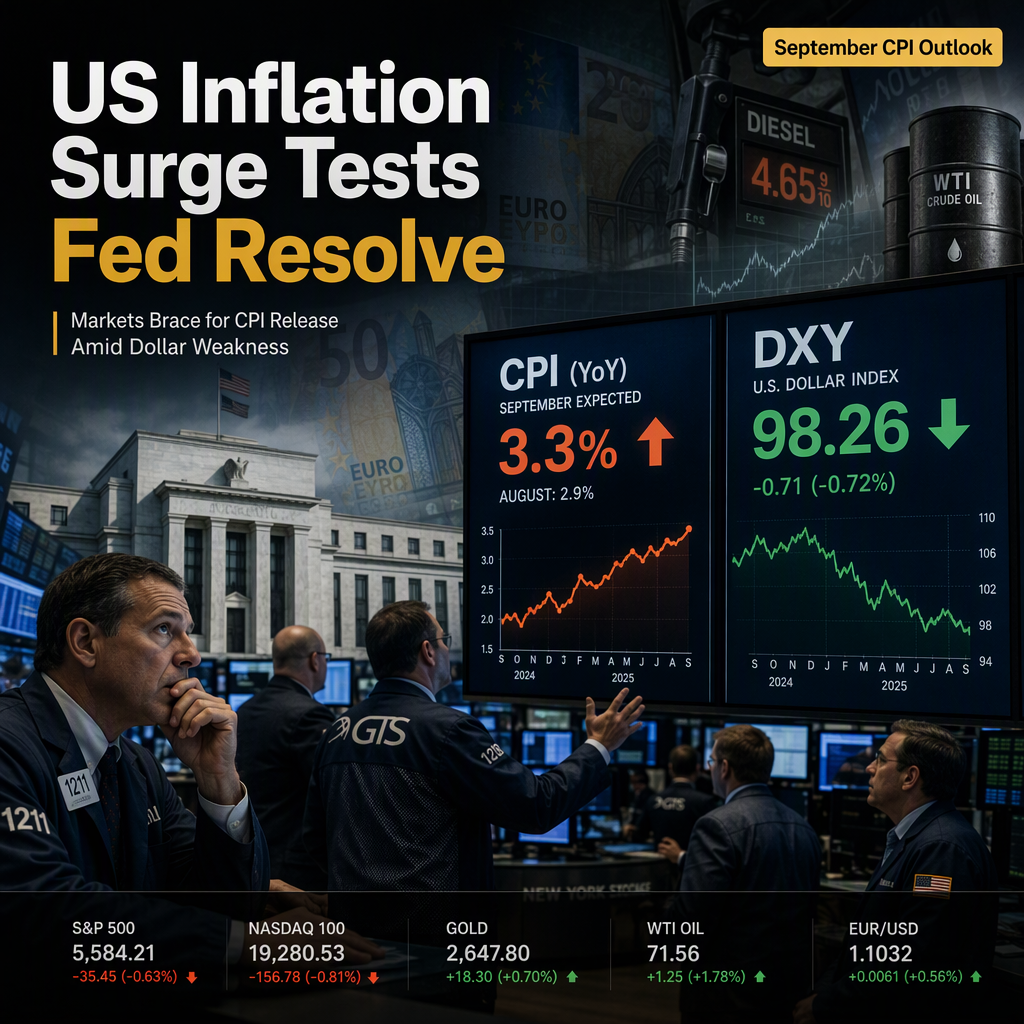
The US Bureau of Labor Statistics is set to release the September Consumer Price Index (CPI) data, with consensus forecasts pointing to a 0.6% monthly increase, up from 0.4% in August, and an annual headline inflation rate rising to 3.6% from 3.4% [1][2][3]. Core CPI, which excludes food and energy, is expected to show a 0.2% monthly uptick and a 2.5% annual increase, compared to 2.4% previously [1][2][3]. Analysts highlight the outsized role of diesel prices in shaping US inflation, noting a 14% rise in US diesel prices during September—from $5.6 to $6.38 per gallon—and a 5% monthly gain in West Texas Intermediate crude oil [1]. Societe Generale estimates that a 1% YoY increase in diesel prices is associated with a 0.06 percentage point rise in inflation surprises, underscoring the material impact of energy costs on headline inflation [1].
Market participants are closely watching the CPI release, as any deviation from expectations could influence the Federal Reserve's policy outlook and the US Dollar's valuation [1][2][3][4]. Recent cautious comments from Fed officials, including Vice Chair for Supervision Michelle Bowman, who stated there is "no urgent need for more rate moves this year," and Minneapolis Fed President Neel Kashkari, who warned of economic pressures from further hikes, have led investors to scale back bets for a 25 basis point rate hike in October [1]. The CME FedWatch Tool shows an 80% probability of a policy hold at the upcoming meeting [1]. Meanwhile, disappointing September labor market data—Nonfarm Payrolls rose by 29K versus expectations of 90K, and the unemployment rate edged up to 4.2% from 4.1%—has further tempered rate hike expectations [1].
The US Dollar Index (DXY) has drifted lower for the second consecutive day, retreating from its highest level since April 2025 but holding above the 102.00 mark as traders await the CPI report [4]. Technical indicators suggest a bullish near-term bias, with MACD at 0.02 and RSI at 64.81, though momentum has softened compared to prior sessions [4]. Despite the pullback in US bond yields, the prospect of a December Fed rate hike and geopolitical uncertainties are limiting downside for the USD [4]. Any weakness below 102.00 is expected to attract buyers near the 101.70-101.65 support zone [4].
On the EUR/USD front, the Euro has shown mild gains above 1.1200, largely due to US Dollar weakness ahead of the CPI release, rather than Euro strength [2][3]. Commerzbank's Volkmar Baur notes that elevated market expectations for US inflation mean a downside surprise could ease Fed pressure and support the Euro [3]. Eurozone inflation data, including a rise in Germany's Wholesale Price Index to 1.9% in September from 0.9% in August and Spain's HICP steady at 5% YoY, have had marginal impact on the Euro [2]. ECB President Christine Lagarde has urged France to consolidate fiscal policy and ruled out intervention in bond markets [2].
CONCLUSION
Markets are bracing for the US September CPI release, with consensus expecting a notable uptick in inflation driven by higher energy prices. The outcome will be pivotal for the Federal Reserve's policy outlook and US Dollar dynamics, as recent labor data and cautious Fed commentary have tempered rate hike expectations. A downside surprise in CPI could ease pressure on the Fed and support the Euro, while technical factors suggest the Dollar remains resilient above key support levels.