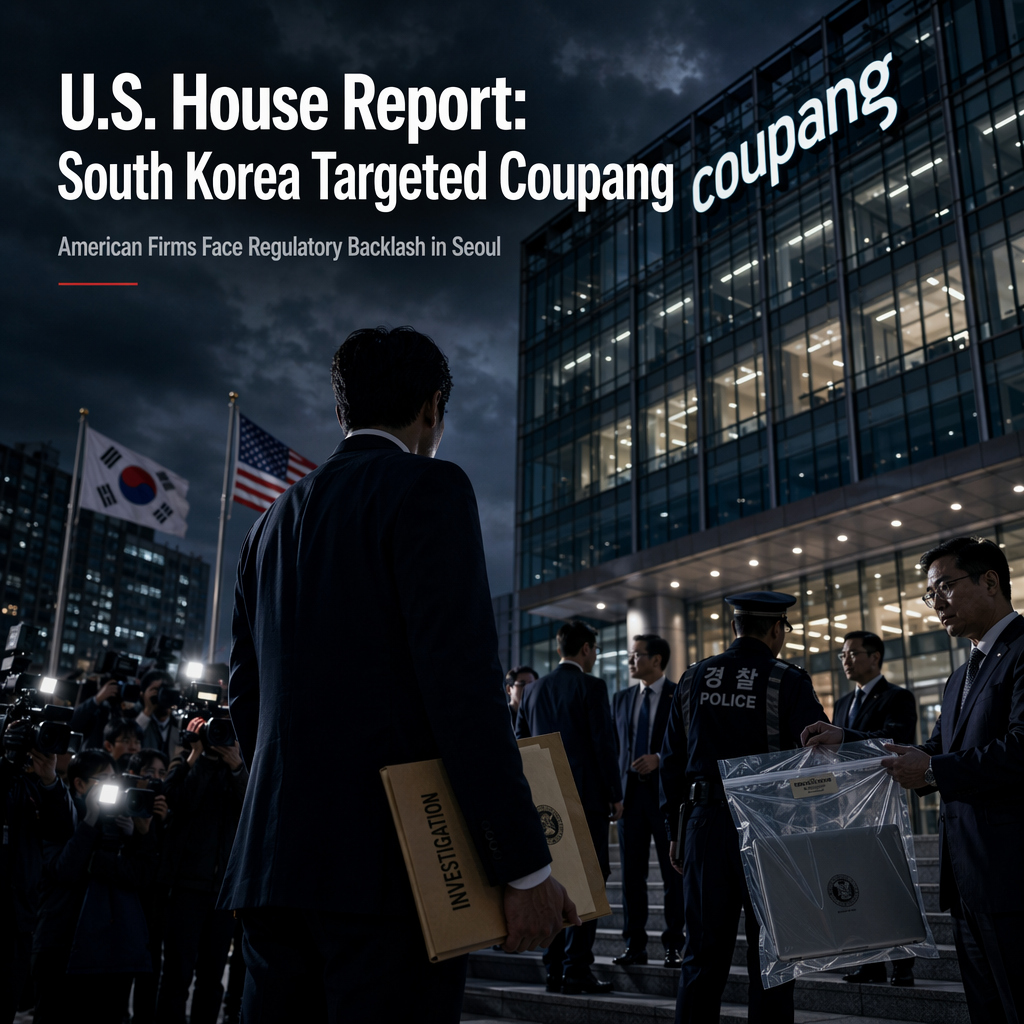
A report released by the U.S. House Judiciary Committee found that the South Korean government discriminated against certain U.S. companies, including the U.S.-based online retailer Coupang, in violation of a trade agreement negotiated in the previous year by President Donald Trump [1]. The committee's investigation, which began in February, concluded that South Korea used its regulatory authority to target Coupang, especially after a 2025 data breach involving a disgruntled former employee [1].
Following the breach, South Korean regulators launched dozens of investigations, issued excessive fines, and threatened criminal charges against Coupang executives, despite the company's assertion that the leak was limited in nature and smaller than initially believed [1]. Coupang's CEO, Park Dae-jun, resigned after the breach, and acting CEO Harold Rogers testified that South Korean officials were informed of the limited scale of the incident in December 2025 [1]. Nevertheless, the government continued its campaign, including thousands of document requests and threats of criminal charges against Rogers, a U.S. citizen [1].
The report also alleges that the South Korean National Intelligence Service compelled Coupang to send divers on a covert mission to retrieve a laptop discarded in a Shanghai river by the former employee, and then misled the public about its involvement in the operation [1]. The House Judiciary Committee, chaired by Rep. Jim Jordan, R-Ohio, characterized South Korea's conduct as part of a broader trend of foreign governments weaponizing regulations to harm American companies and restrict their global competitiveness [1].
Coupang expressed regret over the circumstances leading to the investigation and stated its commitment to finding a constructive resolution to strengthen the U.S.-Korea alliance and promote trade and investment between the two countries [1].
CONCLUSION
The House Judiciary Committee's findings highlight significant tensions between the U.S. and South Korea regarding the treatment of American firms, particularly Coupang. The report's allegations of discriminatory practices and regulatory overreach by South Korea could have substantial implications for bilateral trade relations and the operating environment for U.S. companies in the region.