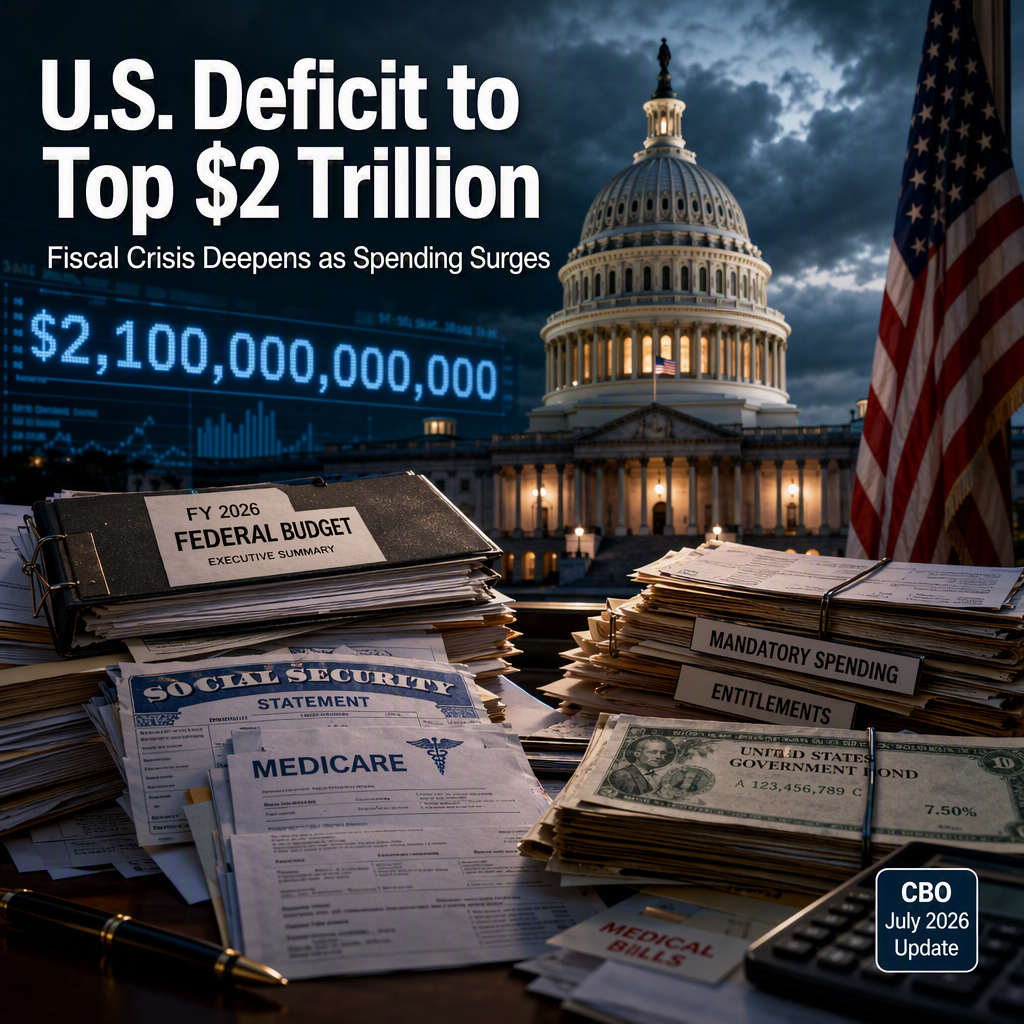
The U.S. federal budget deficit is projected to surpass $2 trillion in fiscal year 2026, marking one of the largest shortfalls on record as government spending continues to outpace revenue growth [1]. According to the Congressional Budget Office's (CBO) July monthly budget update, the federal government ran a nearly $1.8 trillion deficit through the first 10 months of fiscal year 2026, which is $169 billion higher than the same period in fiscal year 2025 [1]. The CBO now estimates the full-year deficit will reach $2.1 trillion, an increase of $200 billion from the previous fiscal year, based on data available through the end of July [1].
The rise in the deficit is primarily attributed to a $308 billion increase in federal spending compared to the previous year, which significantly outpaced the $139 billion rise in tax receipts [1]. Key drivers of increased spending include the cost of servicing the federal government's more than $39 trillion national debt, as well as higher expenditures for Social Security, Medicare, and Medicaid [1]. Interest payments on the debt rose by $117 billion, or 14%, due to higher long-term interest rates and the larger national debt [1]. Social Security spending increased by $70 billion (5%), Medicare by $66 billion (8%), and Medicaid by $45 billion (8%), all driven by factors such as inflation adjustments, increased enrollment, and higher payment rates [1].
On the revenue side, tax receipts from payroll and income taxes rose by a combined $202 billion (5%), with withholdings from workers' paychecks up $141 billion (5%) amid rising wages and salaries [1]. However, corporate income tax collections fell by $89 billion (23%) due to provisions in the One Big Beautiful Bill Act (OBBBA) that expanded deductions for investments, resulting in fewer tax receipts [1]. Tax refunds paid to individuals increased by $23 billion (7%) due to OBBBA provisions, while collections of customs duties, including tariffs, rose by $18 billion (13%) compared to the prior year [1].
The CBO noted that 2026 outlays are expected to be close to its February baseline, but revenues are anticipated to be about $200 billion below projections, mainly due to smaller-than-expected collections of tariff duties following a Supreme Court ruling issued after the baseline was released [1].
CONCLUSION
The CBO's updated projections highlight a worsening U.S. fiscal outlook, with the federal deficit expected to exceed $2 trillion in fiscal year 2026 due to surging spending and weaker-than-anticipated revenues. Rising debt servicing costs and increased mandatory program expenditures are key contributors, while tax policy changes and lower tariff collections further strain the budget. This development signals heightened fiscal challenges ahead for policymakers and markets.