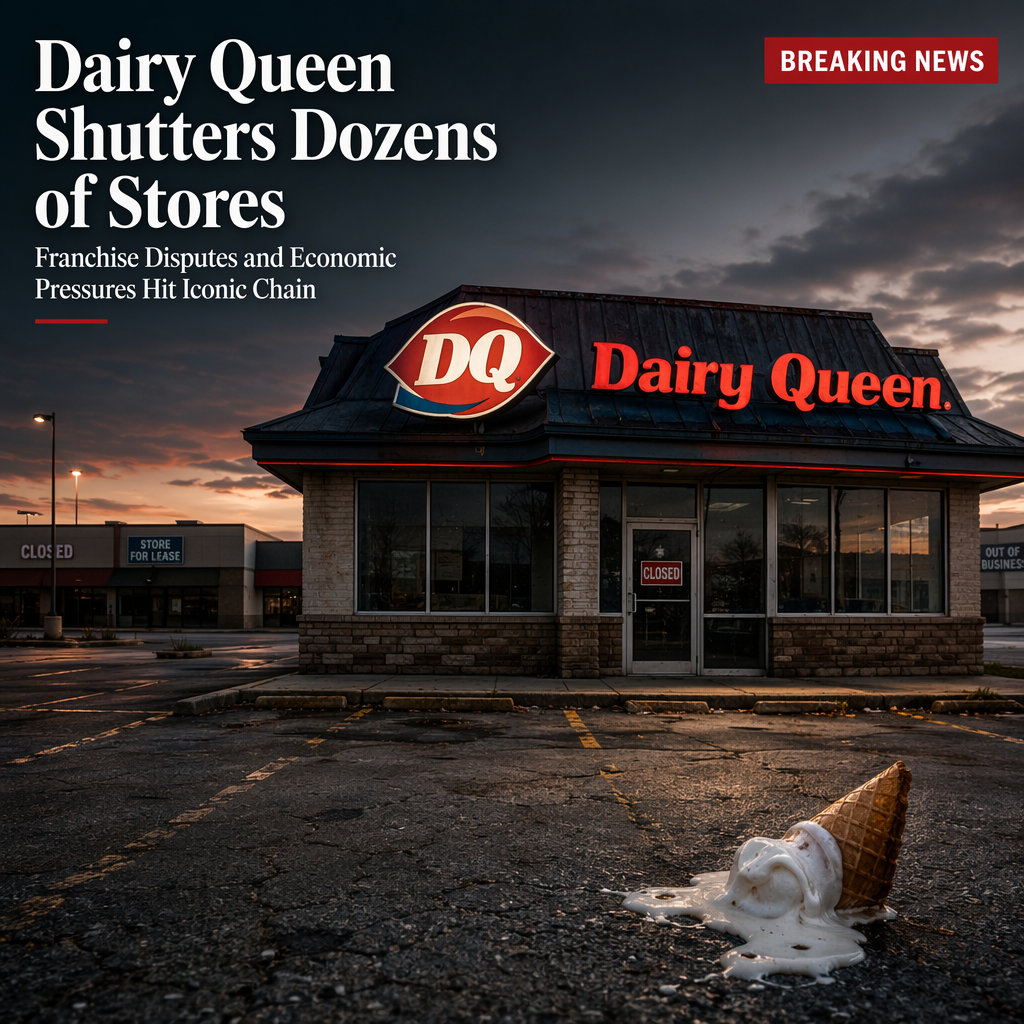
Dairy Queen, one of America's most iconic ice cream chains, has shuttered dozens of locations across the United States due to a combination of financial pressures and corporate compliance disputes [1]. The closures have affected communities from Texas to Alaska, with independent franchisees citing a tightening economic climate and strict corporate mandates as key challenges [1].
In late June, a single franchisee in Alaska closed its three locations in Anchorage, Wasilla, and Palmer, leaving only one Dairy Queen operating in the state, located in Soldotna [1]. Weeks prior, a franchisee in Great Falls, Montana, closed his restaurant after 39 years, opting to convert the location into a Mediterranean restaurant to offer something new to the area [1].
The majority of the closures, however, are linked to a corporate compliance dispute. According to the Austin American-Statesman, Dairy Queen's U.S. parent company revoked the franchise rights of Texas-based operator Project Lonestar after it failed to complete required building remodels. This action prevented the operator from ordering official Dairy Queen inventory, resulting in the immediate closure of 42 Texas locations between February and March [1].
Dairy Queen, a subsidiary of Warren Buffett’s Berkshire Hathaway, currently operates approximately 7,800 locations in more than 20 countries [1]. Despite the recent closures, the company’s growth strategy remains focused on expansion, with plans to open 20 new 'DQ Grill & Chill' restaurants in Puerto Rico, according to a recent press release [1].
CONCLUSION
Dairy Queen's recent wave of store closures highlights the challenges facing U.S. restaurant franchisees amid economic headwinds and strict corporate requirements. While the company is closing dozens of locations domestically, it continues to pursue international growth, signaling a strategic shift in its expansion efforts.