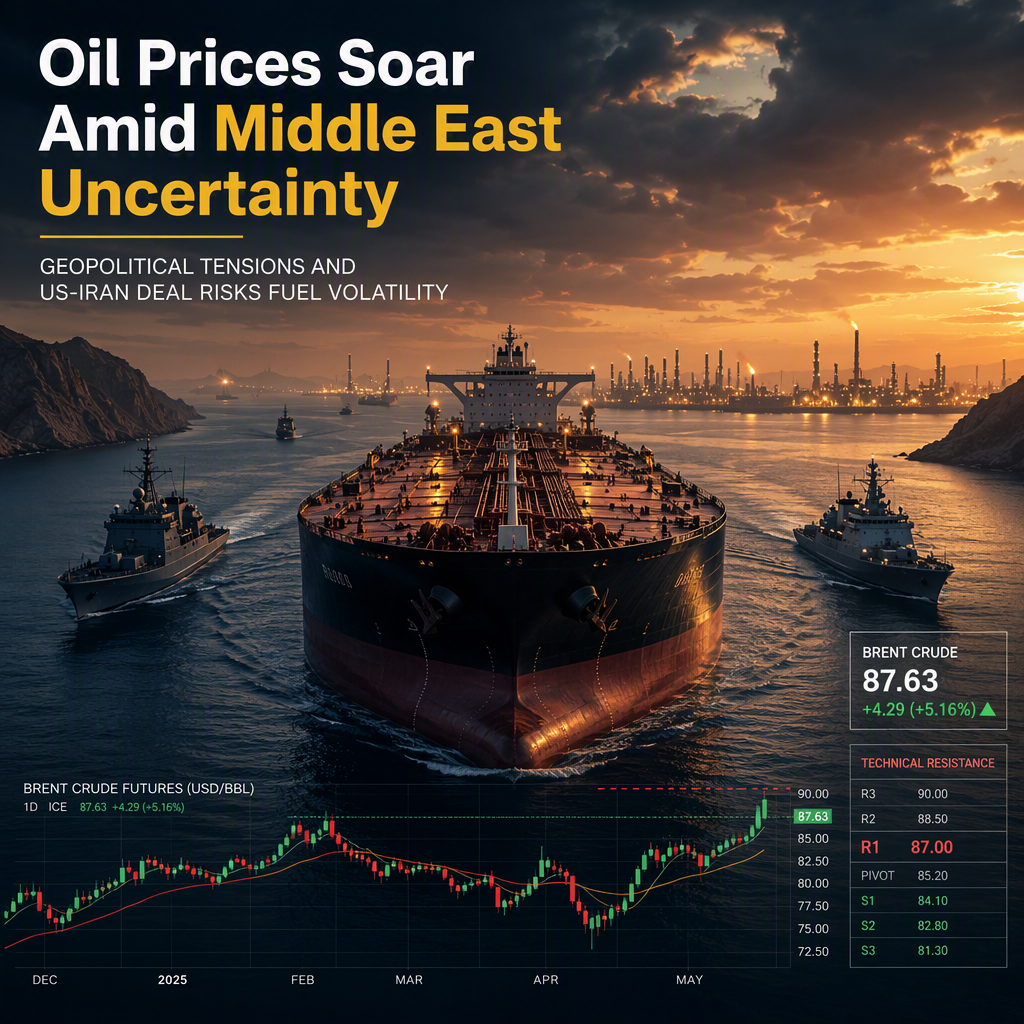
Oil prices have rallied in response to escalating tensions and uncertainty surrounding negotiations between the United States and Iran, as well as broader instability in the Middle East. ICE Brent settled 3.8% higher, climbing back above $82 per barrel, with strength continuing into early morning trading, driven by persistent obstacles to a US-Iran deal and Iranian demands regarding the Strait of Hormuz. These demands include banning US and Israeli ships, seeking compensation from hostile countries, and charging service fees for ships transiting the strait, all of which have limited signs of compromise and increased risks to reaching a sustainable agreement [1]. ING analysts expect Brent to average $80 per barrel in the third quarter, but emphasize significant risks and uncertainty to this outlook [1].
West Texas Intermediate (WTI) futures on NYMEX extended Thursday’s recovery, trading near $77.80 during the day. The oil price had underperformed in the previous two weeks due to hopes of the Strait of Hormuz reopening, a critical passage for nearly 20% of global energy supply. US President Donald Trump stated that he suspended planned strikes on Iran after Iran agreed to an 'Immediate, Complete, and Total OPENING OF THE HORMUZ STRAIT, and an end to Iran’s nuclear threat.' However, the proposed US-Iran deal remains uncertain, with Tehran reportedly close to finalizing a proposal with Oman for joint management of the strait, which is expected to face backlash from global leaders supporting freedom of navigation [2].
Additional market-moving factors include growing friction between Iran-aligned Houthis and Saudi Arabia, following the Houthis' declaration of a Saudi blockade. This has fueled fears of prolonged energy supply disruptions, further supporting oil prices. Saudi Arabia is expected to step up military attacks on Houthis after recent incidents in Najran province and against Yemeni government troops, according to a report from The Guardian [2]. Saudi Arabia also cut its official selling prices for almost all crude grades and to all destinations for September loadings, with Arab Light into Asia reduced by $0.50 per barrel to a $2 per barrel discount to the benchmark. This price cut follows pressure from Asian buyers amid Red Sea escalation, resulting in some tankers taking longer, more expensive routes around Africa [1].
Technical analysis of WTI shows a bearish near-term bias, with prices holding beneath the 20-day exponential moving average (EMA) at $79.32. The Relative Strength Index (RSI) at 46.44 indicates neutral momentum, hinting at cooling downside but not yet signaling a bullish reversal. Immediate resistance is at the 20-day EMA ($79.32), while key support lies at the August 5 low ($73.51); a break below this would expose prices to the July low ($67.09) [2].
CONCLUSION
Oil prices have rebounded sharply due to heightened geopolitical risks and uncertainty over the US-Iran deal, with both Brent and WTI supported by supply disruption fears and regional tensions. Analysts expect continued volatility and risk, with technical indicators suggesting resistance and support levels to watch. The market remains highly sensitive to developments in the Middle East and negotiations over the Strait of Hormuz.