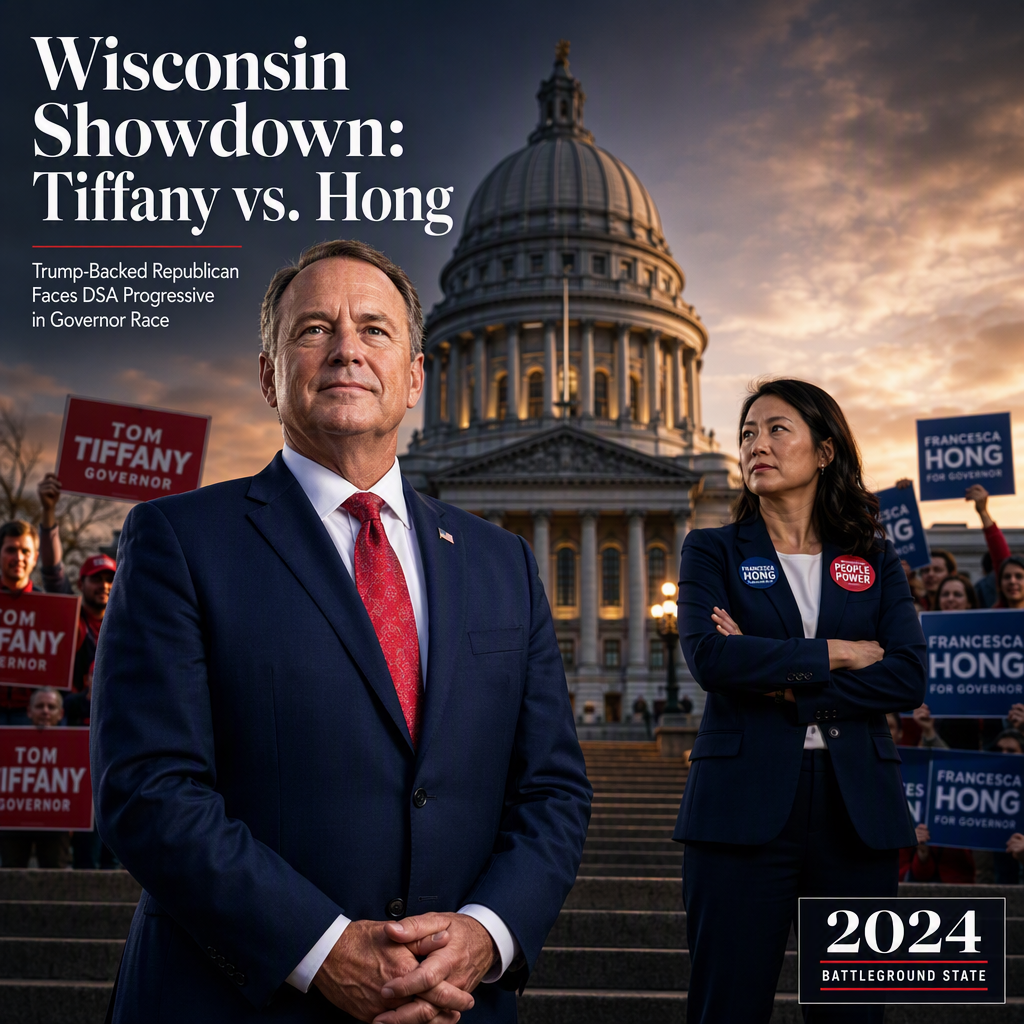
Rep. Tom Tiffany, a member of the House Freedom Caucus and backed by President Donald Trump, won the Republican gubernatorial nomination in Wisconsin, defeating medical service technician Andy Manske, according to the Associated Press [1]. Tiffany emphasized his campaign's focus on lowering property taxes, returning the surplus to residents, controlling utility costs, and allowing Wisconsinites to keep more of their earnings [1]. He described the upcoming election as a fight to 'forge a firewall against socialism,' positioning Wisconsin as a battleground for conservative policies [1].
Tiffany is expected to face state Rep. Francesca Hong, a member of the Democratic Socialists of America, who is likely to secure the Democratic nomination [1]. Hong's platform includes guaranteed paid leave, raising the state's minimum wage from $7.25 to $20 per hour, and imposing a one-year moratorium on building AI data centers in Wisconsin [1]. Hong has faced scrutiny for past social media posts advocating for defunding and abolishing the police, but she has since clarified that she no longer supports those positions and is committed to public safety [1].
Hong also attracted national attention for a resurfaced 2020 social media post suggesting the country should 'cancel Thanksgiving' to stop celebrating colonialism. She has since walked back those comments, stating Thanksgiving is now her 'favorite holiday' and that she has 'evolved' and 'learned' from her past statements [1].
Pro-GOP super PACs, including one aligned with the Republican Governors Association, spent millions of dollars to boost Hong in the primary, viewing her as the weakest Democratic candidate for the general election [1]. The winner in November will succeed Democratic Gov. Tony Evers, who is not seeking a third term, making this race a significant opportunity for the GOP to flip the governor's mansion [1].
CONCLUSION
Tom Tiffany's victory in the Republican primary sets up a high-stakes gubernatorial race against Francesca Hong, whose progressive platform and past controversies have drawn national attention. The contest is viewed as a major GOP opportunity to flip Wisconsin's governor's seat, with both sides emphasizing sharply contrasting visions for the state's future. Market sentiment is cautiously positive, reflecting the potential for policy shifts depending on the election outcome.