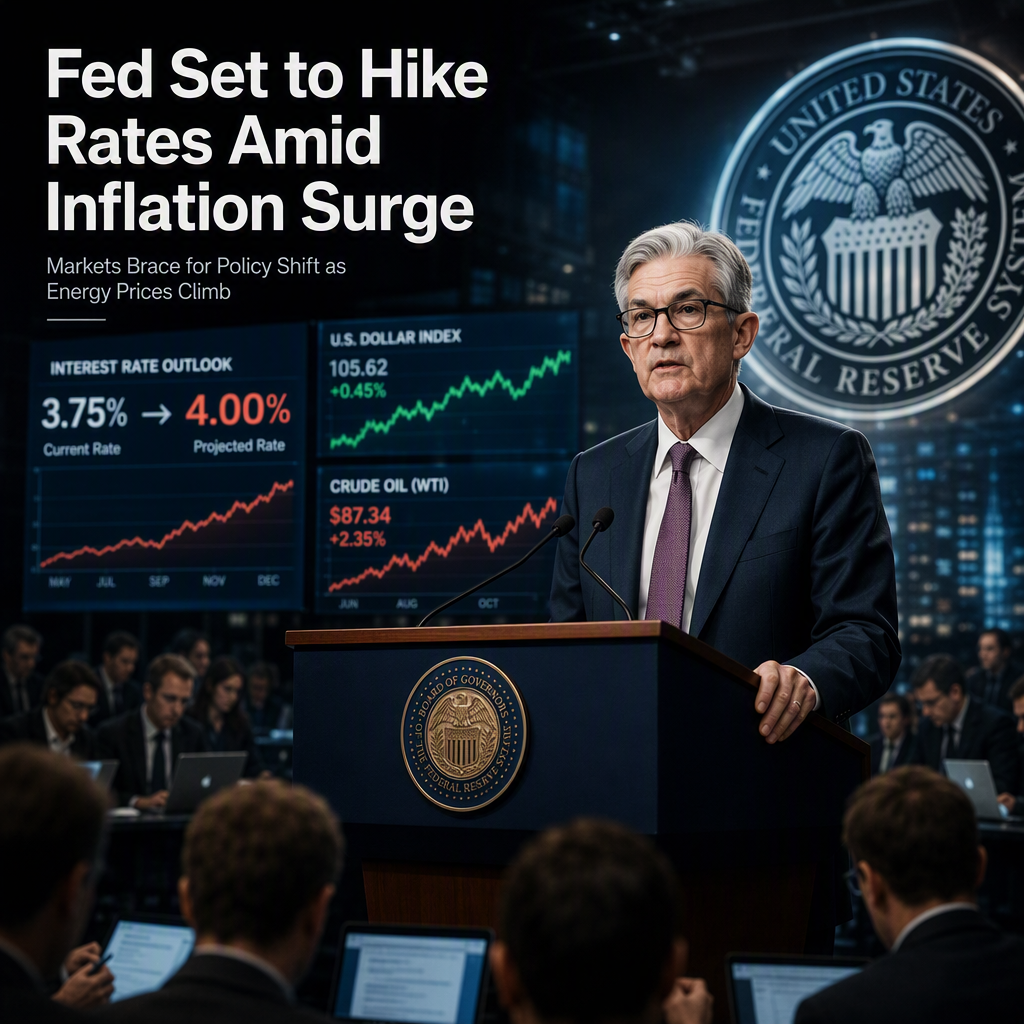
The US Federal Reserve is widely expected to raise its policy interest rate by 25 basis points to a target range of 3.75%-4.00% at its meeting on Wednesday, marking the first increase after five consecutive meetings of holding rates steady [1][2][3][4]. This anticipated move is almost fully priced in by markets, with the CME FedWatch Tool indicating only a 7.5% chance of another policy hold and Fed funds futures pricing in a 94% probability of a hike [1][4]. The decision comes against a backdrop of persistent inflation, with the Consumer Price Index (CPI) holding at 3.4% year-over-year in August and core CPI rising 0.3% month-over-month, both exceeding market expectations [1][2]. The Producer Price Index (PPI) also rose 0.4% in August [2].
The energy shock from the Middle East conflict has contributed to inflationary pressures, with Brent crude prices trading over 50% higher than pre-conflict levels [1][2][3][4]. The US labor market remains robust, as evidenced by a 162,000 increase in Nonfarm Payrolls in August and a 1.2% month-over-month rise in Retail Sales, surpassing expectations [1][2][3]. These data points have reinforced expectations for a rate hike, with analysts noting that a decision to leave rates unchanged would be a significant surprise and could undermine the Fed’s policy credibility [1].
Market participants are expected to focus less on the rate hike itself, which is largely priced in, and more on the Federal Reserve’s forward guidance, the updated Summary of Economic Projections (SEP), and Chair Kevin Warsh’s post-meeting press conference [1][2][3][4]. The June dot plot showed a median year-end rate projection of 3.8% [2]. According to the swaps curve, markets are pricing in almost 100 basis points of tightening over the next twelve months, including another 25 basis point hike by year-end and nearly 50 basis points by September 2027 [4].
The US Dollar remains firm near two-week highs, with the US Dollar Index trading around 99.70, as traders position for a hawkish Fed [2][3][4]. However, analysts at Brown Brothers Harriman (BBH) caution that the risks for the Dollar are asymmetric: there is limited upside from a hawkish outcome but greater downside if the Fed surprises dovishly, given that substantial tightening is already priced in [4]. Silver prices have rebounded ahead of the decision, trading around $64.00 per troy ounce, but face headwinds from higher yields and a strong Dollar [3].
Looking ahead, the market will scrutinize the Fed’s messaging for signals on whether the tightening cycle will continue. The CME FedWatch Tool indicates a nearly 79% probability of at least two rate hikes by year-end [3]. Analysts highlight that persistently high inflation and energy prices could prompt further tightening, but some, including BBH, argue that current US economic conditions do not warrant an aggressive cycle, citing slowing wage growth and already restrictive policy [4].
CONCLUSION
The Federal Reserve is set to deliver a widely anticipated 25 basis point rate hike, with markets focused on the central bank’s guidance for future policy moves. Persistent inflation and energy price shocks have justified tighter policy, but with much of the tightening already priced in, the market reaction will hinge on the Fed’s tone and projections. A hawkish message could support the US Dollar and yields, while any dovish surprise may trigger a notable market response.