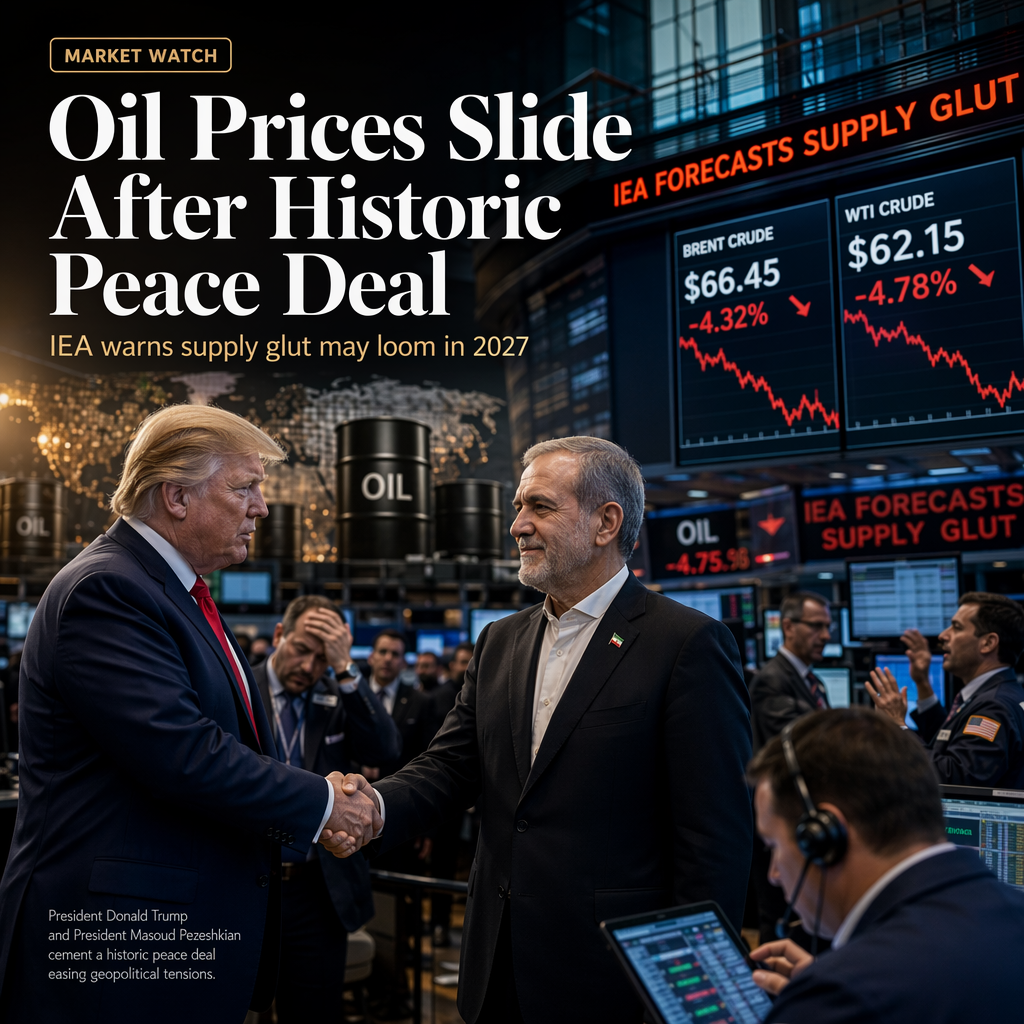
Oil prices fell on Thursday following reports that President Donald Trump and Iranian President Masoud Pezeshkian signed a deal to end the war in the Middle East, a development that has significant implications for global energy markets [1]. International benchmark Brent crude futures for August declined by 1.13% to $78.65 per barrel, while U.S. West Texas Intermediate (WTI) futures for July dropped 1.26% to $75.82 per barrel [1].
The International Energy Agency (IEA) warned of a potential supply glut next year, stating that a lasting resolution to the conflict could lead to significantly higher oil supply volumes and a major overhang in 2027 [1]. According to the IEA's latest monthly oil market report, global supply is expected to drop by 3.9 million barrels per day on average in 2026 to 102.4 million barrels per day, before rebounding to 110.3 million barrels per day next year [1]. The IEA emphasized, "Our first look at 2027 balances shows a significant overhang emerging next year" [1].
Despite the peace agreement, President Trump cautioned that the U.S. could resume attacks on Iran if Tehran fails to honor its commitments, stating, "We're going to bomb the hell out of them if they violate the agreement. I don't want them to. I want them to honor the agreement" [1].
Analysts at New York Life Investment Management noted that while lower oil prices may reduce the risk of energy-driven inflation, the situation is not entirely resolved. They highlighted that oil prices remain above pre-conflict levels, shipping normalization will take time, and both inventories and strategic reserves still require replenishment [1].
CONCLUSION
The signing of a peace deal between the U.S. and Iran has triggered a decline in oil prices, with the IEA forecasting a significant supply glut in 2027. While the immediate risk of energy-driven inflation may be reduced, analysts caution that market normalization will be gradual and uncertainties remain.