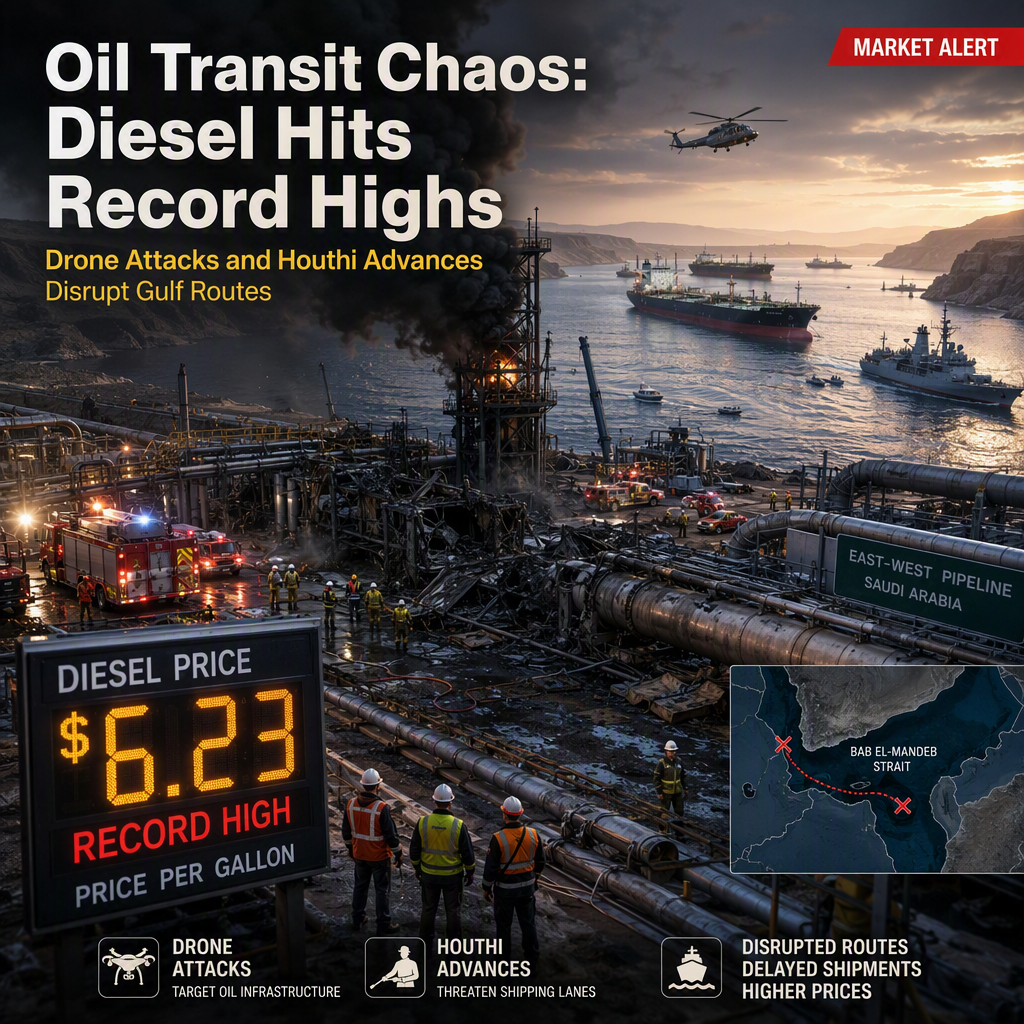
A recent escalation in the Gulf region has significantly tightened the oil supply chain, as a drone attack last week severely damaged Saudi Arabia’s East-West Pipeline, a vital route that transports crude oil to the Red Sea. The pipeline, which had been carrying between 2.6 million and 4 million barrels per day, is expected to be largely out of service for three to five weeks due to ongoing repairs [1]. Simultaneously, Iran-backed Houthi rebels have seized additional territory and strategic islands near the Bab el-Mandeb Strait, further threatening a major shipping route already destabilized by years of attacks [1].
These disruptions have had immediate effects on global energy markets. U.S. diesel prices surged to a record national average of $6.23 per gallon, while regular gasoline reached $4.32. Brent crude oil prices spiked to approximately $110 per barrel during the day [1]. The situation is compounded by the U.S. naval blockade, which has effectively halted Iranian crude exports through the Strait of Hormuz since July 14. As a result, Iranian crude and condensate loadings plummeted to about 220,000 to 255,000 barrels per day in August, down from 740,000 in July and roughly 2 million in March [1]. Commercial shipping through Hormuz remains deeply disrupted, with real-time data showing commodity-vessel transits in the single digits [1].
The economic pressure on Iran is intensifying, affecting not only its oil sector but also the broader economy. Restrictions on trade through the United Arab Emirates and Turkey are making it increasingly difficult for Iran to obtain foreign currency and essential imports, according to Miad Maleki, a senior fellow with the Foundation for Defense of Democracies [1]. Maleki noted that the combined impact of sanctions, the naval blockade, and diplomatic isolation is having a tangible effect on Iran’s economy [1].
The ongoing instability raises questions about Iran’s willingness to make concessions in negotiations and the extent of economic damage it and its allies can inflict while holding out [1].
CONCLUSION
The recent attacks and territorial advances have severely disrupted key oil transit routes, driving up energy prices and intensifying economic pressure on Iran. With critical infrastructure offline and shipping lanes threatened, the market impact is significant and ongoing, with no immediate resolution in sight.