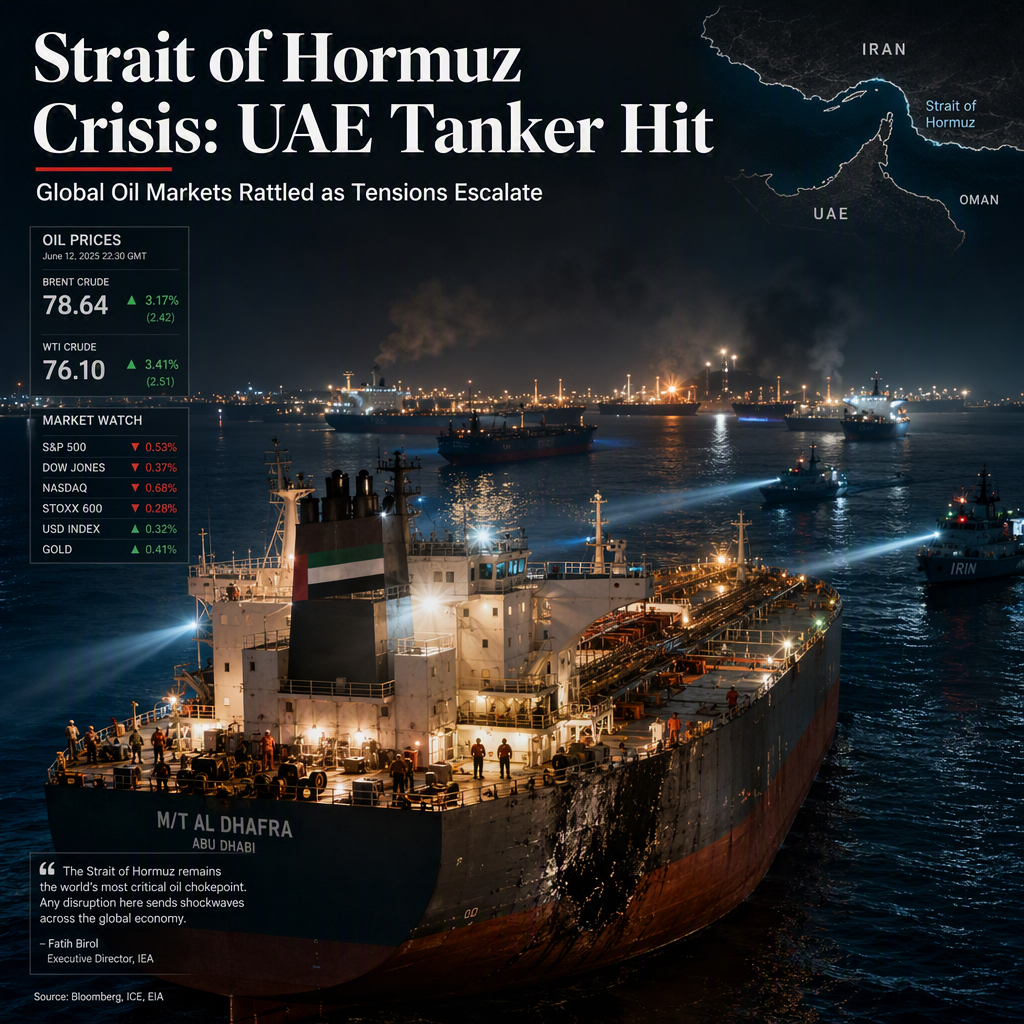
The Abu Dhabi National Oil Company (ADNOC) reported that one of its vessels was targeted by a missile while transiting the Strait of Hormuz in the early hours of Saturday. The incident resulted in no injuries, and ADNOC stated that the situation has been brought under control [1]. The United Arab Emirates condemned the attack in the strongest terms via a post on X [1].
Iran's military has emphasized that the reopening of the crucial Strait of Hormuz is contingent upon the U.S. accepting Iran's conditions. Sardar Mohbi, a spokesman for Iran's Islamic Revolutionary Guard Corps, clarified that the reopening is subject to Iran's specific mechanism and conditions, and is unrelated to ongoing negotiations between Iran and Oman [1]. Iranian state media published a draft plan Thursday that would restrict traffic through Hormuz, including a ban on U.S. and Israeli ships and requiring compensation from nations that have harmed Iran before transit is allowed. This plan is currently under review by Iran's parliament [1].
The closure of the Strait has triggered a global energy supply shock, driving up gas prices, exacerbating inflation, and raising alarms about oil reserves. Oil prices rose Friday as investors awaited an agreement suggested by the Trump administration earlier in the week to open the strait for freedom of navigation. Brent crude futures gained more than 1% to close at $83.55 a barrel, while U.S. West Texas Intermediate advanced about 1% to settle at $78.18 per barrel. Despite this, prices fell more than 7% for the week [1]. Ship traffic through Hormuz was down 33% on Friday compared to the previous day, with most vessels using the Iranian route, according to trade intelligence firm Kpler [1].
Treasury Secretary Scott Bessent told CNBC that an agreement to open Hormuz with freedom of movement could come as soon as Wednesday, and President Donald Trump and Secretary of State Marco Rubio had indicated that an agreement was imminent. However, a deal has not yet been announced [1]. Iran and Oman are working on an agreement to define transit routes, with inbound traffic through Iranian waters and outbound traffic through Omani waters [1].
A brief hiatus in fighting between the U.S. and Iran after a June 17 memorandum of understanding was followed by weeks of attacks and counterstrikes, including Tehran targeting several Gulf neighbors with missiles and drones [1].
CONCLUSION
The missile targeting of a UAE oil tanker underscores heightened tensions and instability in the Strait of Hormuz, with significant implications for global energy markets. Oil prices have reacted with a modest rise, but the ongoing closure and uncertainty continue to weigh on market sentiment. The situation remains fluid, with negotiations ongoing but no resolution yet announced.