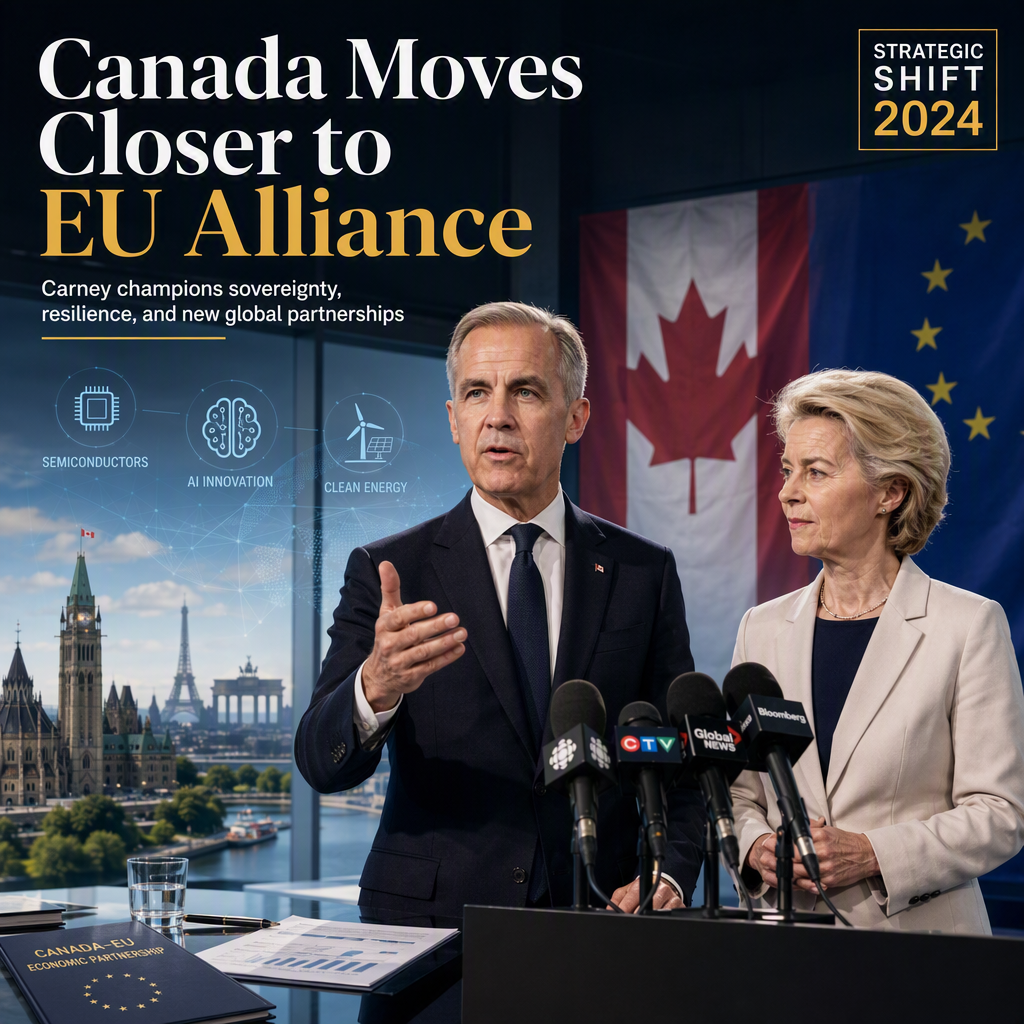
Canadian Prime Minister Mark Carney emphasized Canada’s commitment to strengthening its economic and technological sovereignty while remaining a reliable international partner, stating, "We are not fair-weather allies, we do not pursue zero-sum deals" [1]. Carney outlined that sovereignty requires secure access to AI, semiconductors, critical minerals, payment systems, clean energy, vaccines, and space communications [1].
On Thursday, Carney backed closer ties between Canada and the European Union, supporting Brussels’ push for associate membership for Canada. He warned that tariffs and supply chains are being weaponized, referencing escalating tensions with U.S. President Donald Trump, who recently called the EU’s proposal for Canadian associate membership "laughable" and threatened heavy tariffs on Europe if the move is seen as hostile [2]. Carney did not mention Trump by name but alluded to the use of tariffs and financial mechanisms for coercion, and the exploitation of supply chain vulnerabilities [2].
Carney stated that Canadian lawmakers would ultimately vote on the final structure of any alliance with the EU, emphasizing that the process is at an early stage and would involve multiple debates and a parliamentary vote [2]. European Commission President Ursula von der Leyen expressed the EU’s desire to elevate its relationship with Canada to the "highest level possible" and to work with Carney on opening the door for Canada to become the first associate member of the EU, though such a category does not currently exist under EU treaties and would require creation and ratification by member states [2].
Market reaction to Carney’s remarks was muted, with the Canadian Dollar (CAD) showing little movement. USD/CAD remained in consolidation below the 1.4000 psychological level, trading broadly unchanged on the day [1]. The CAD was the strongest against the Swiss Franc among major currencies, but overall currency movements were limited [1].
Carney clarified that the goal of closer EU-Canada ties is not to create a rival power bloc but to bolster collective resilience and set an example for other democracies [2].
CONCLUSION
Canada is signaling a strategic shift towards deeper economic and political integration with the European Union, while reaffirming its commitment to sovereignty and reliable alliances. Despite heightened rhetoric from the U.S., market reaction has been limited, with the Canadian Dollar remaining stable. The process for formalizing closer EU-Canada ties is in its early stages and will require parliamentary approval.