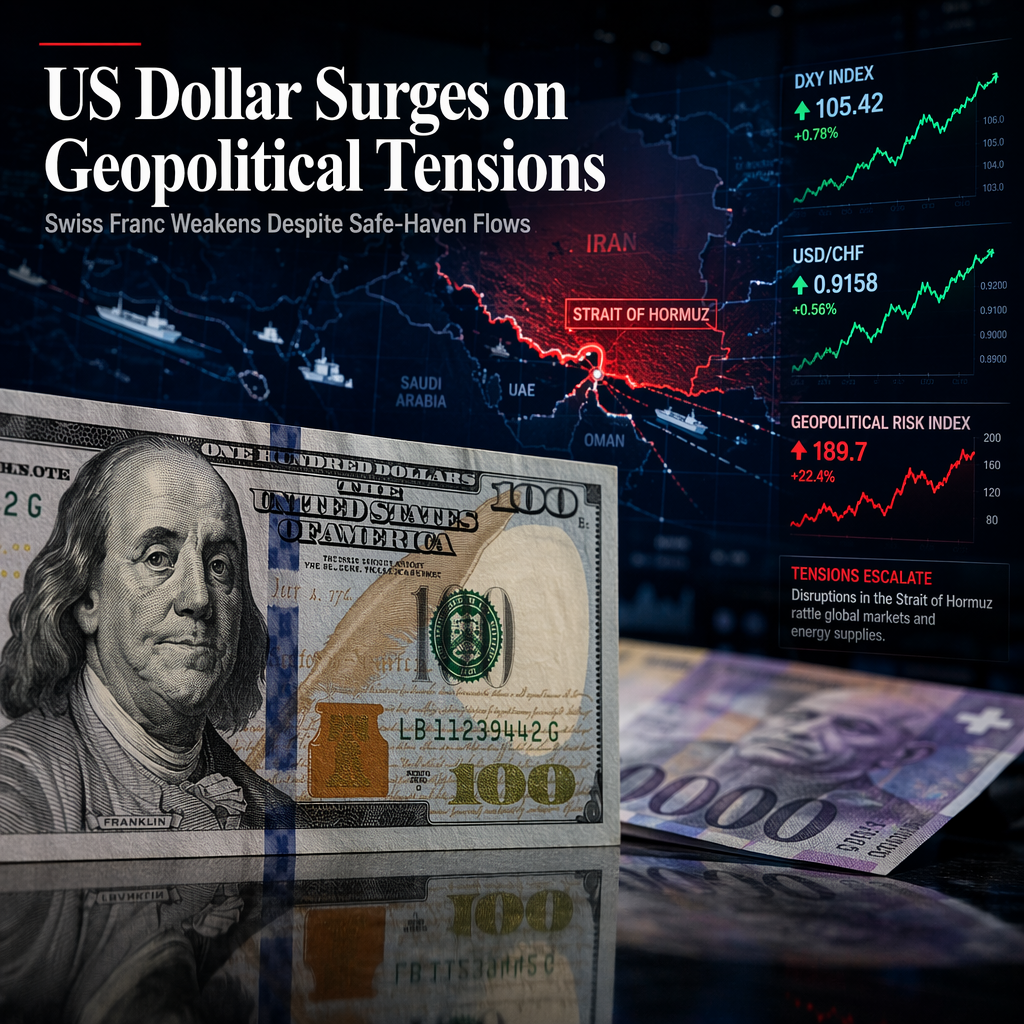
The US Dollar advanced against major currencies, including the Swiss Franc, following renewed geopolitical tensions between the United States and Iran. Both articles report that the US Dollar Index (DXY) held above 101.00, trading around 101.10 during the Asian session on Wednesday, while USD/CHF extended its gains for the third consecutive day, trading near 0.8090 [1][2]. The Greenback's appreciation was attributed to safe-haven demand after US airstrikes on Iran, which were in response to Iranian attacks on commercial vessels in the Strait of Hormuz, including a Qatari LNG carrier and a Saudi oil tanker [1][2]. The situation has heightened fears of global energy disruptions, as shipping companies and producers consider bypassing the strategic waterway [2].
Iranian officials responded strongly to the US actions. Iranian Parliament Speaker Mohammad Bagher Ghalibaf declared that the era of bullying and extortion has ended, and Iran would not yield to pressure. The Iranian military command condemned the attacks as blatant aggression and promised a crushing military response, while Tehran reaffirmed its intent to block any US interference in the Strait of Hormuz [1].
Despite the Dollar's recent gains, both sources note that its upside could be limited by cooling expectations for further Federal Reserve rate hikes. LSEG data shows market pricing for total Fed rate increases by December has dropped to roughly 26 basis points, down from 38 basis points a week earlier, following weaker-than-expected Nonfarm Payrolls data [1][2]. Fed officials offered mixed signals: Governor Christopher Waller cautioned about the use of forward guidance, while New York Fed President John Williams expressed less concern about domestic price pressures due to falling energy prices and signaled steady growth and balanced risks, emphasizing a data-dependent approach to future policy [2]. The FXSFedSentiment Index slipped by 0.34 points to 125.38, indicating a modest pullback in perceived hawkishness, though it remains in hawkish territory [2].
In Switzerland, the 10-year government bond yield edged above 0.34%, tracking a global rise in borrowing costs as surging oil prices reignited inflation concerns. This occurred despite Swiss inflation slowing to 0.5% in June, its first decline in eight months and well within the Swiss National Bank’s (SNB) 0–2% target range. The Swiss labor market also showed strength, with the non-seasonally adjusted unemployment rate falling to 2.9% in June 2026, below the 3.0% of the previous two months and beating forecasts of 3.1% [1]. The IMF has urged the SNB to maintain flexibility, and the central bank reaffirmed its commitment to currency market interventions [1].
CONCLUSION
Renewed US-Iran tensions have driven safe-haven flows into the US Dollar, pushing it higher against the Swiss Franc and other major currencies. However, the Dollar's further upside may be capped by cooling Fed rate hike expectations and mixed central bank signals. Swiss economic fundamentals remain stable, but the SNB stands ready to intervene if needed.