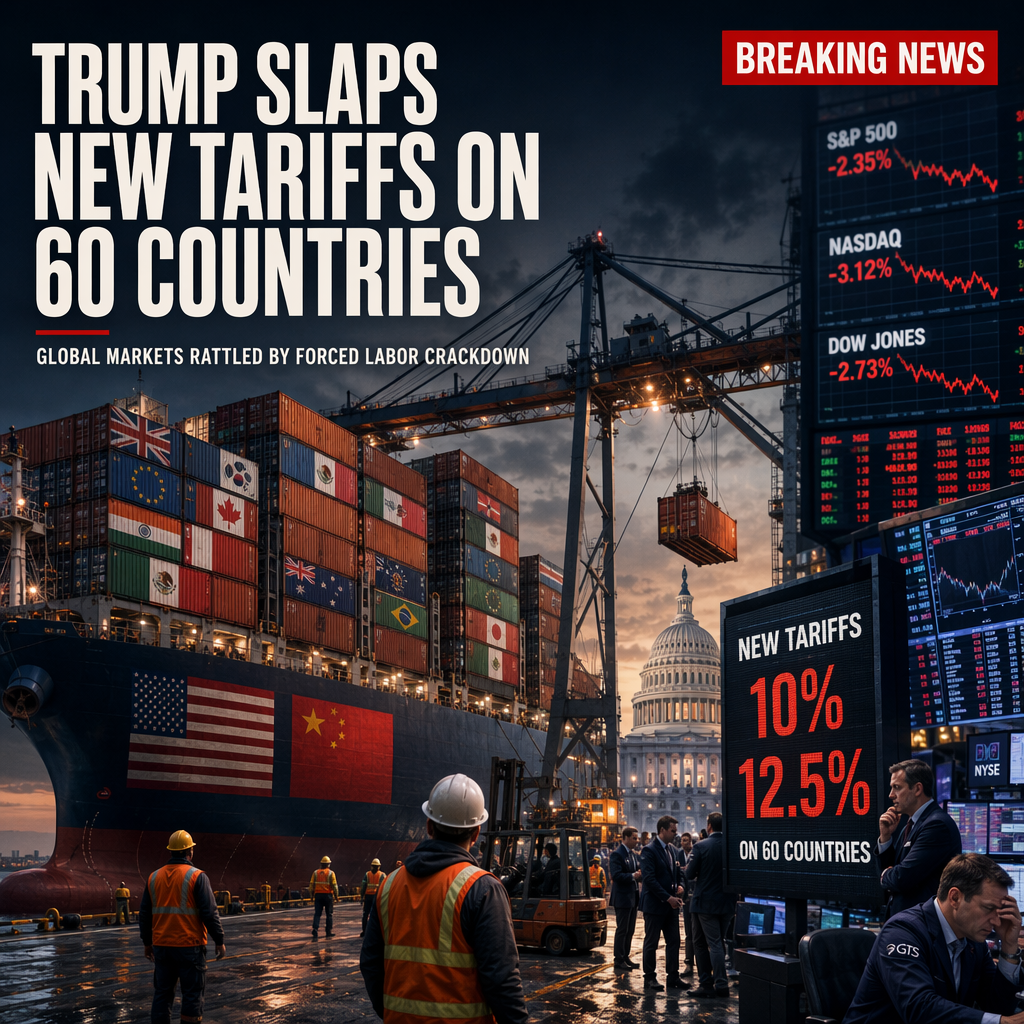
On July 23, 2026, President Donald Trump announced new tariffs ranging from 10% to 12.5% on imports from 60 countries, citing accusations of 'forced labor' and aiming to protect American workers and industries [2][3]. The tariffs will take effect at 12:01 a.m. ET on Friday morning and replace the expiring temporary 10% tariff, which was struck down by the Supreme Court in February for exceeding presidential authority under the International Emergency Economic Powers Act [3]. The new tariffs are enacted under Section 301 of the Trade Act of 1974, following months-long investigations into trading practices [3].
Countries facing a 10% tariff include India, Malaysia, Mexico, Bangladesh, Cambodia, Canada, and the United Kingdom [1][3]. Chinese goods are subject to a higher 12.5% levy, while Taiwan and the European Union, the largest single U.S. trading partner, will also face up to a 12.5% tariff rate [1][3]. The new EU rate lowers the previous 15% cap agreed upon by Trump and European Commission President Ursula von der Leyen in 2025 [3]. The U.K. tariff mirrors a prior deal between Trump and then-Prime Minister Keir Starmer to lower tariffs on U.K. imports to 10% [3].
The tariffs target a broad range of imports but include exemptions for fertilizers, some types of fuel, foods, autos, certain metals, and pharmaceuticals, with generic drugs continuing to have a zero percent tariff for two years [3]. Ambassador Jamieson Greer stated, 'The United States has had a forced labor import ban for nearly a century, and rigorously enforces it; it’s well past time for our trading partners to do the same,' highlighting the administration's focus on labor standards [3]. The European Union strongly rejected the forced labor accusation even before the final determination was issued [3].
Market analysts and industry observers note that the announcement has caused concern among global markets, particularly due to the significant trading partners affected and the potential for supply chain disruptions [1][2]. The higher levy on Chinese goods is expected to prompt further rerouting of supply chains, with increased redirection of Chinese products through Vietnam and other Southeast Asian markets [1]. Traders are closely monitoring support levels for major U.S. indices, with warnings of increased volatility and inflationary pressures in the coming months [2]. Key price levels to watch include resistance near recent highs for the S&P 500 and support around the 4,500 mark [2]. The administration has not ruled out further tariff actions, stating that compliance with labor standards will remain a priority [2].
CONCLUSION
The Trump administration's new tariffs on 60 countries mark a significant escalation in U.S. trade policy, with broad market implications and heightened volatility expected. While exemptions soften the blow for some sectors, the targeted tariffs—especially on China and the EU—are likely to disrupt supply chains and increase costs for businesses and consumers. Analysts and traders remain cautious, watching for further developments and potential retaliatory measures.