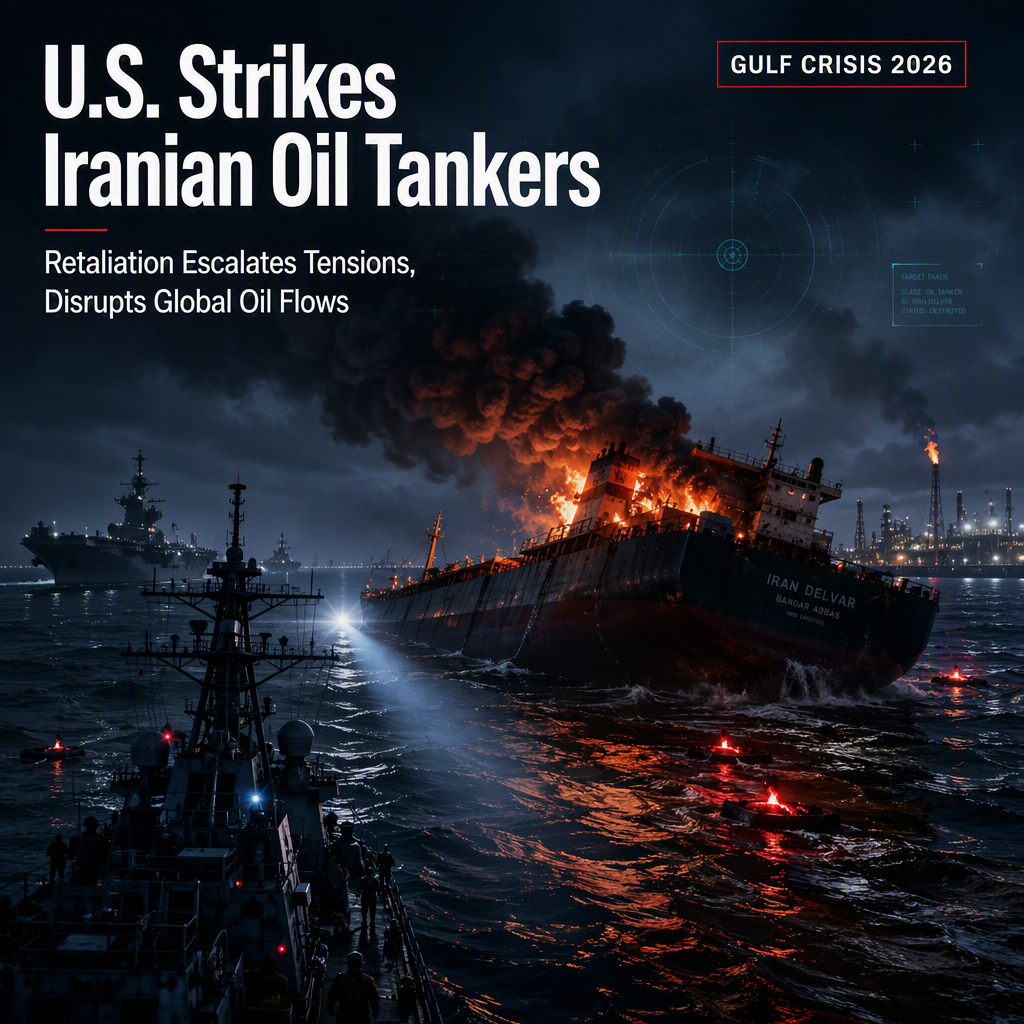
On September 5, 2026, U.S. forces struck three Iranian crude oil tankers in retaliation for ballistic missile attacks launched by Iran's Islamic Revolutionary Guard Corps (IRGC) against two U.S. Navy warships patrolling the region, according to U.S. Central Command (CENTCOM) [1]. The attacks resulted in one tanker being permanently disabled off Kharg Island, another near Jask, and a third targeted in the Gulf of Oman [1]. CENTCOM reported that a U.S. aircraft carrier and a guided-missile destroyer successfully evaded the missile attacks, with no American personnel harmed [1].
Admiral Brad Cooper, CENTCOM commander, issued a stern warning: "Let the message to the IRGC be clear: If you shoot at two of our ships, we will impose an even higher economic cost — taking out three of yours," emphasizing the U.S. commitment to defending its forces and threatening further action against Iran's oil fleet if necessary [1]. Defense Secretary Pete Hegseth echoed this stance on social media, stating, "It's simple: if Iran shoots at U.S. ships, we will destroy (and sink) their oil tankers. All they have to do is stop shooting at @USNavy" [1]. As of the report, there was no immediate response from Iranian authorities [1].
The incident occurs amid ongoing disruptions to global oil flows, as Iran—OPEC's third-largest producer—has seen its exports severely impacted by a U.S. blockade initiated in mid-April, effectively shutting the Strait of Hormuz, a critical waterway for world oil supply [1]. Prior to the conflict, Iran exported 90% of its crude via Kharg Island [1]. U.S. President Donald Trump has previously threatened to seize Kharg Island and recently posted an AI-generated video depicting its destruction [1].
The tanker strikes followed the U.S. Treasury Department's announcement of sanctions against Golden Global Yatirim Bankasi Anonim Sirketi, a Turkish investment bank, and two subsidiaries, accused of facilitating funds for an arm of Iran's Revolutionary Guard [1]. The Treasury alleges these entities enabled the transfer of Iranian oil revenues from China to Turkey, where they were converted to cash and gold [1]. Golden Global Bank is the second major financial institution targeted under "Operation Economic Outcast," a campaign to isolate Tehran through sanctions on its business partners [1].
CONCLUSION
The U.S. strikes on Iranian oil tankers mark a significant escalation in the ongoing conflict, further disrupting global oil flows and increasing economic pressure on Iran. With the Strait of Hormuz effectively shut and new sanctions targeting Iran's financial networks, the market faces heightened uncertainty and potential volatility in energy prices.