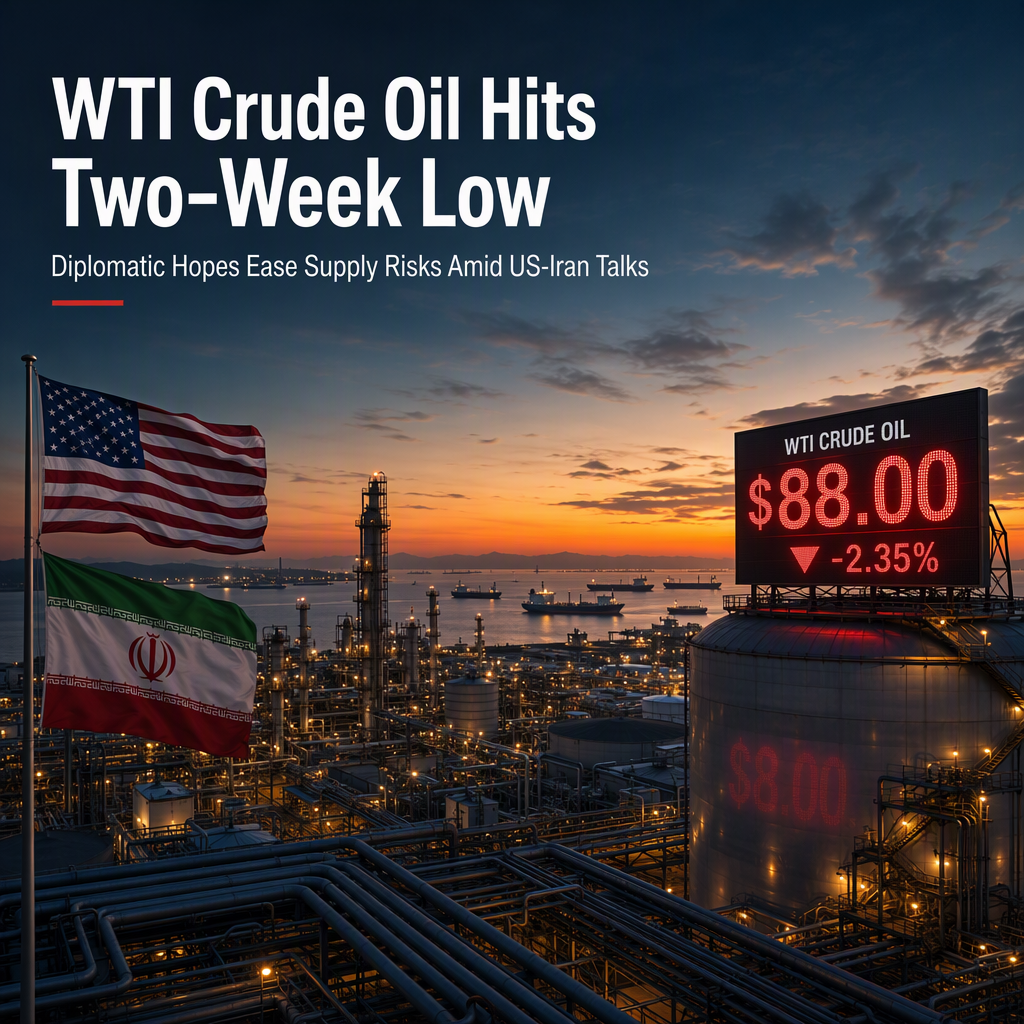
West Texas Intermediate (WTI), the benchmark US crude oil price, continued its downward trajectory for the fifth consecutive day on Wednesday, trading near the mid-$88.00s during the Asian session and marking a decline of over 1% for the day. This places WTI at its lowest level in more than two weeks, with the commodity appearing vulnerable to further losses as it approaches the 50.0% Fibonacci retracement at $87.87, while still holding above the 100-day simple moving average (SMA) at $84.97 [1].
The recent easing of supply risks has contributed to the negative bias in oil prices. Saudi Arabia is reportedly working to restore operations on an oil pipeline to the Red Sea, and there are growing hopes for a diplomatic resolution to the US-Iran conflict. Iran has reportedly offered to unblock the strategic Strait of Hormuz in exchange for a US military de-escalation, which has added to market optimism and exerted downward pressure on oil prices [1].
Despite these developments, geopolitical risks remain. US President Donald Trump stated at the United Nations General Assembly that he faces a significant decision on whether to pursue a deal with Iran or "annihilate" the Islamic Republic if the conflict remains unresolved. Additionally, tighter US sanctions targeting Iranian aviation are set to take effect on Wednesday, maintaining a geopolitical risk premium and limiting further declines in crude oil prices [1].
From a technical perspective, daily oscillators indicate waning bullish momentum, with the MACD moving deeper into negative territory and the RSI retreating to 46.8, below the midline. Key support levels are identified at $87.87 (50% Fibo.), $84.97 (100-day SMA), and $84.52 (61.8% Fibo.), with deeper pullbacks potentially exposing $79.75 (78.6% Fibo.) and $73.67 (cycle floor). On the upside, resistance is seen at $91.23 (38.2% Fibo.), $95.37 (23.6% Fibo.), and the cycle high near $102.07 [1].
CONCLUSION
WTI crude oil prices are under pressure due to easing supply risks and diplomatic overtures between the US and Iran, though geopolitical tensions and new US sanctions on Iran continue to provide some support. Technical indicators suggest further downside risk, but the broader uptrend remains intact as long as key support levels hold.