
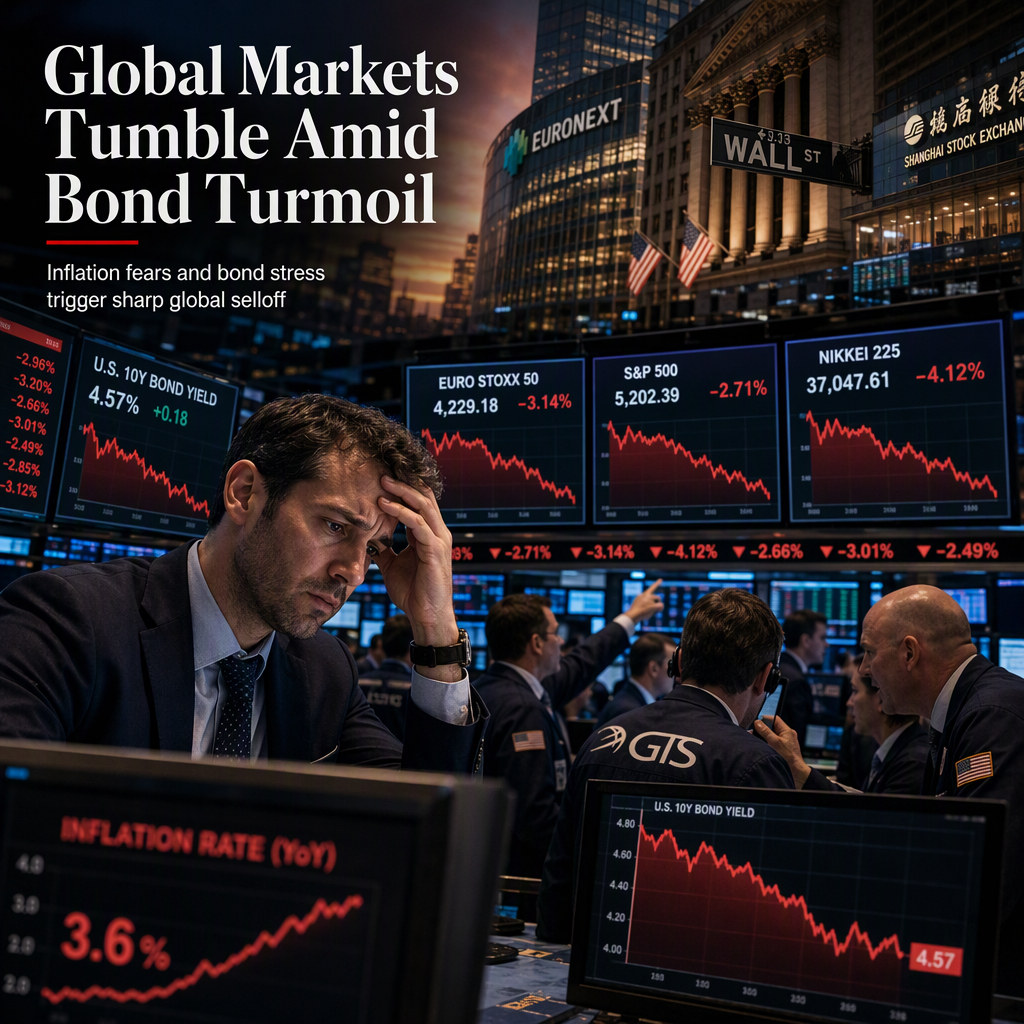
Global equity markets experienced a significant selloff as wider European bond spreads and renewed inflation concerns weighed heavily on risk sentiment, according to Deutsche Bank strategists [1]. European stocks led the decline, with the STOXX 600 falling by 1.00% after three consecutive days of gains. The CAC 40 dropped 1.22%, and Italy’s FTSE MIB saw an even steeper decline of 2.51%. European banks were particularly hard hit, losing 3.38% on the day [1].
The negative sentiment extended to the United States, where the S&P 500 slipped 0.22% from its record high set the previous day. Nearly three-quarters of the S&P 500 constituents ended lower, with cyclical sectors such as industrials and materials underperforming, falling 2.14% and 1.53% respectively [1]. The Russell 2000 small-cap index dropped 1.31% to a four-month low, while the Nasdaq and the Mag-7 showed relative resilience, each declining by 0.22% and 0.20% respectively [1].
Asian markets also weakened, despite Samsung reporting a nine-fold increase in profits, which nonetheless disappointed some investors. The KOSPI was the weakest major Asian market, down 1.24%. The Nikkei fell 0.87%, and Chinese indices such as the CSI 300 and Shanghai Composite declined by 0.43% and 0.27% respectively. The Hang Seng and ASX also closed lower, by 0.69% and 0.74% respectively. US and European equity futures were broadly flat at the time of reporting [1].
The broad-based decline across regions and sectors underscores heightened market sensitivity to bond market volatility and inflation risks. The underperformance of cyclical and financial stocks, alongside disappointing reactions to strong corporate earnings in Asia, highlights the prevailing risk-off tone in global markets [1].
CONCLUSION
Global equities faced a sharp retreat as bond market stress and inflation fears triggered widespread risk aversion. Losses were most pronounced in European banks and cyclical sectors, with US and Asian markets also under pressure. The market reaction signals heightened caution among investors amid ongoing macroeconomic uncertainties.