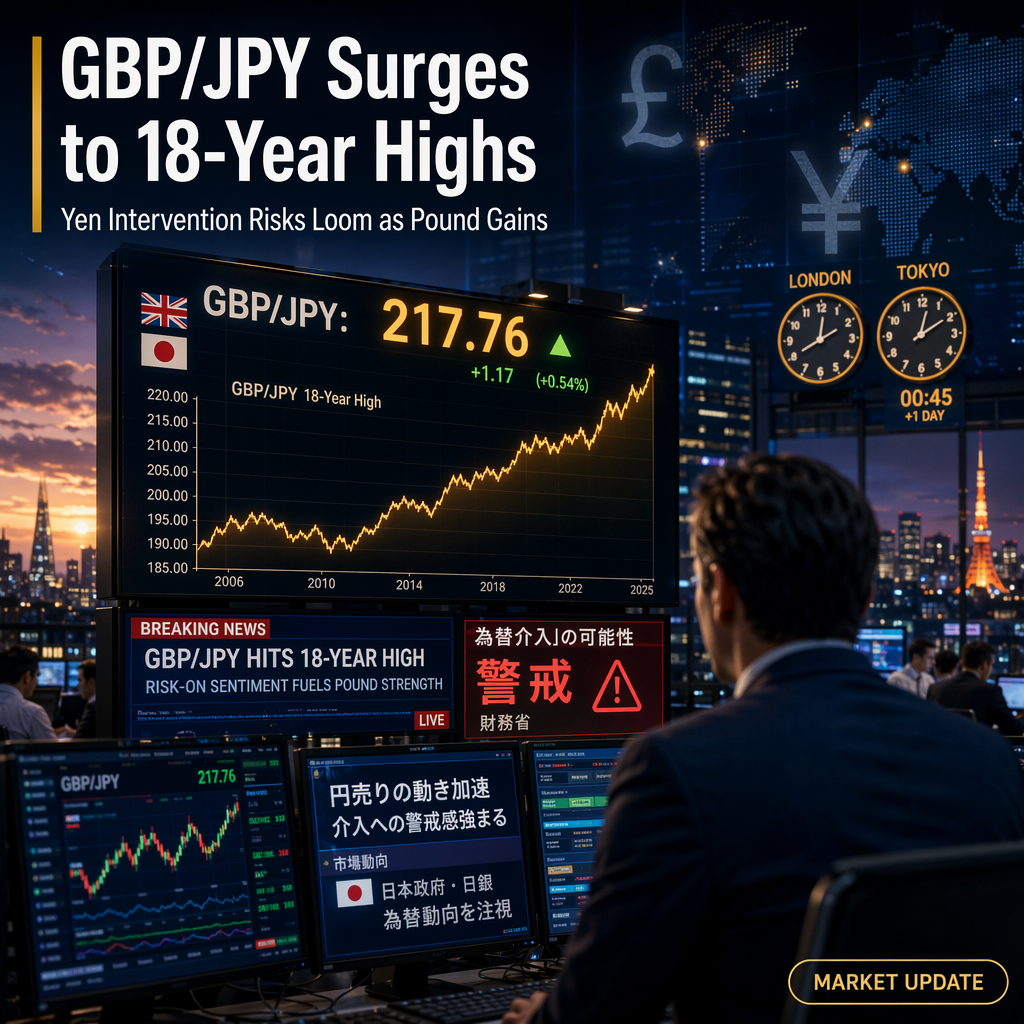
The British Pound surged approximately 0.50% against the Japanese Yen on Thursday, trading at 217.76 and approaching year-to-date highs last seen in February 2008. This move was supported by improved risk appetite following comments from US President Donald Trump regarding Iran's willingness to negotiate, as well as broader geopolitical developments including US strikes on Iran and a war premium in crude oil prices [1][2][3]. The GBP/JPY pair is now challenging key resistance levels at 218.00, with further upside targets at 219.00, 220.00, and the January 2008 high of 222.76. Technical indicators such as the Relative Strength Index (RSI) are bullish and nearing overbought territory, suggesting continued momentum for buyers [1].
Meanwhile, the Japanese Yen has been under pressure, with USD/JPY easing about 0.1% to just below 162.50 after reaching four-decade highs earlier in the week. Despite favorable conditions for Dollar strength—including firm US jobless claims (215K vs. 218K consensus), hawkish Federal Reserve commentary, and heightened geopolitical tensions—the Yen's weakness persisted, highlighting that marginal buyers may already be fully positioned. The Stochastic RSI for USD/JPY is rolling out of overbought territory near 74, while price stalls beneath 163.00 [2].
Intervention risk remains a focal point, as Tokyo's Ministry of Finance has not publicly set a line in the sand but maintains readiness for action. Previous interventions in April and May totaled a record 11.73 trillion Yen, yet the Yen quickly returned to intervention levels within six weeks. The sharp, short-lived Yen surge on July 2 remains unattributed, pending monthly intervention data expected later in July [2]. The Bank of Japan raised its policy rate to 1.00% in June, and the government's revised policy agenda now calls for monetary policy that supports stable price growth [2].
On the Sterling side, the Bank of England held rates at 3.75% in June on a 7-2 vote, with two policymakers advocating for a hike to 4.00%. Services inflation stands at 3.7%, and a household energy cap is set to rise 13.5% in Q3. Markets assign roughly 76% odds to a rate hike before year-end. Political developments in the UK are progressing, with Andy Burnham set to become Labour leader on July 17 and Prime Minister on July 20, though the fiscal program remains unpriced [3].
CONCLUSION
GBP/JPY has reached 18-year highs amid improved risk sentiment and persistent Yen weakness, despite intervention risks and geopolitical tensions. Technical and fundamental factors suggest further upside for the Pound, while the Yen remains vulnerable to policy and intervention dynamics. Market participants are closely watching for potential Japanese intervention and UK fiscal developments, both of which could significantly impact currency trajectories.