
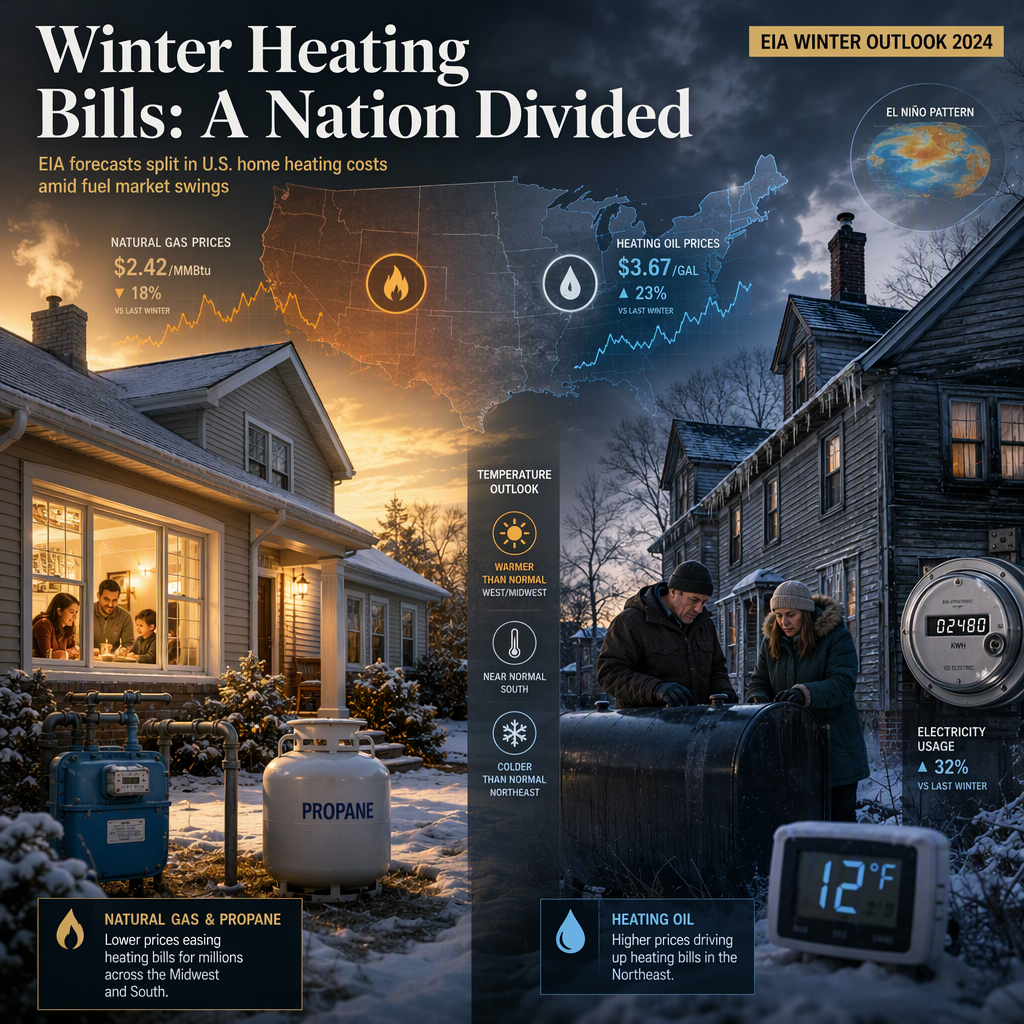
The U.S. Energy Information Administration (EIA) released its winter fuels outlook, highlighting a significant divide in heating costs for American households based on their primary fuel source as colder weather approaches. According to the EIA, households using natural gas and propane—collectively about half of all U.S. households—are expected to see lower energy expenditures this winter, primarily due to reduced fuel costs. Specifically, homes heated by natural gas are projected to spend 9% less compared to last year, with all weather scenarios indicating spending decreases. However, regional differences exist: the West is expected to see a 7% increase in natural gas spending, while other regions may experience declines ranging from 10% to 15% [1].
For propane users, expenditures are forecasted to decrease by 3%, with possible outcomes ranging from a 10% decrease to an 8% increase. The South is expected to see flat spending, while the Midwest and Northeast could see declines of 4% and 15%, respectively. In contrast, households relying on heating oil are projected to face a 21% increase in expenditures nationally, with an uncertainty range between 15% and 35% [1].
Electricity-heated homes are also expected to see higher costs, with a 4% rise in spending anticipated. The West could experience a 9% increase, the South and Midwest each a 3% increase, and the Northeast a 3% decrease. These projections are based on the EIA's assumption that national average temperatures will be similar to last year, with warmer conditions in the Northeast and much colder temperatures in the West compared to the previous winter. The Midwest and South are expected to have temperatures similar to last year [1].
The EIA also noted that the National Oceanic and Atmospheric Administration (NOAA) has identified a strong El Niño pattern for this winter, which could result in significant temperature variations from the current forecast [1].
CONCLUSION
The EIA's outlook indicates a mixed picture for U.S. home heating costs this winter, with natural gas and propane users likely to benefit from lower prices, while those relying on heating oil and electricity may face higher bills. Regional and weather-related uncertainties, including the potential impact of El Niño, add further variability to these projections. Consumers are advised to monitor local conditions and fuel prices as the season progresses.