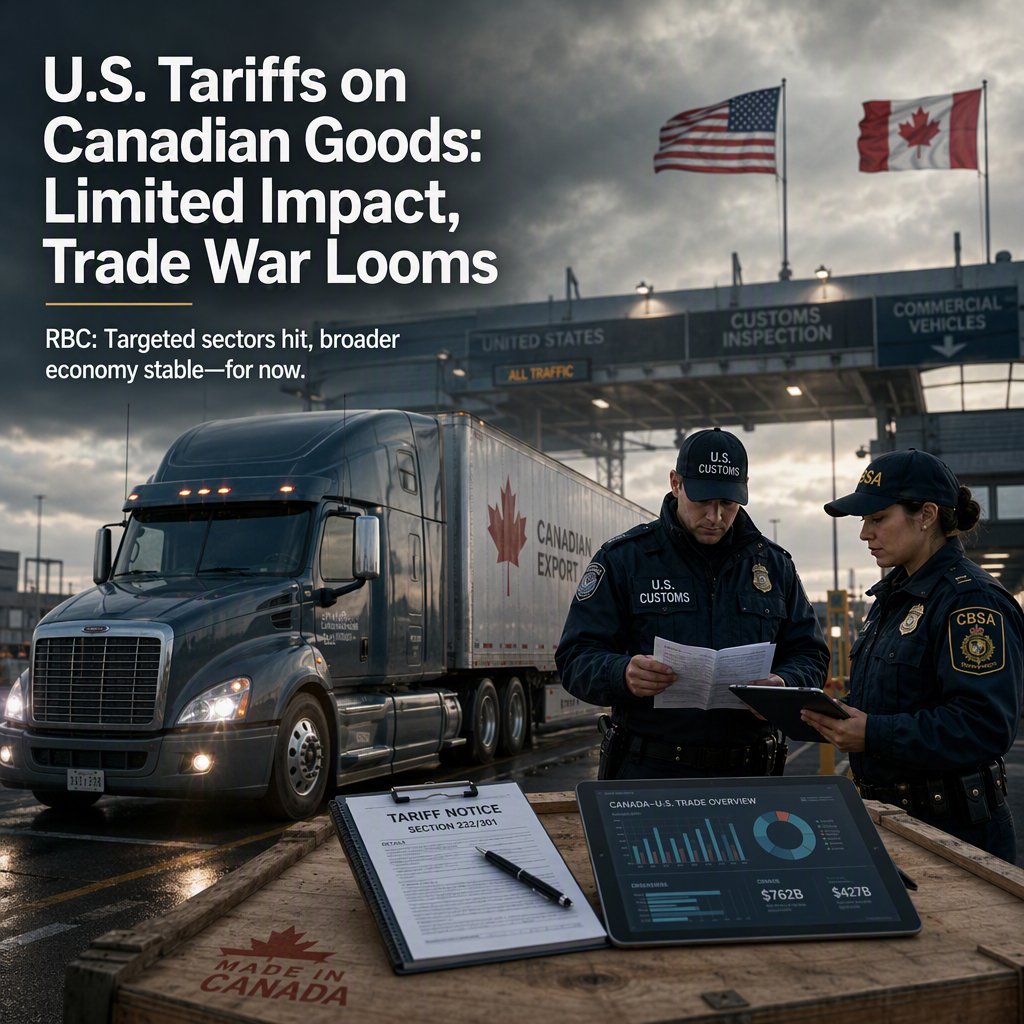
Royal Bank of Canada (RBC) economist Nathan Janzen has analyzed the recent imposition of new U.S. tariff retaliation and import bans on selected Canadian products, describing the move as a modest escalation in the ongoing trade dispute between the two countries [1]. The tariffs, enacted under Section 338, currently affect only a small portion of bilateral trade—specifically, 5% of U.S. imports from Canada—resulting in significant disruption for targeted sectors but having a limited overall impact on the broader economy [1].
Janzen notes that while the U.S. administration's latest response to Canada's retaliatory tariffs may appear alarming, the actual escalation is relatively minor at this stage [1]. The newly imposed 50% tariff on certain products is expected to have a marginal effect on the Canadian economy, as these goods were already likely too expensive for U.S. importers due to previous tariffs [1]. The main concern highlighted by RBC is the potential for future escalation into a broader Canada/U.S. trade war, which could impact a much larger share of trade, though this has not occurred with the latest measures [1].
The analysis concludes that, for now, the macroeconomic impact remains contained, with the most significant effects felt by specific Canadian exporters directly targeted by the tariffs [1].
CONCLUSION
The new U.S. tariffs on Canadian products represent a limited escalation in the trade dispute, with minimal macroeconomic impact according to RBC. The primary risk remains the possibility of a broader trade war, but current measures are not expected to significantly affect the overall Canadian economy.