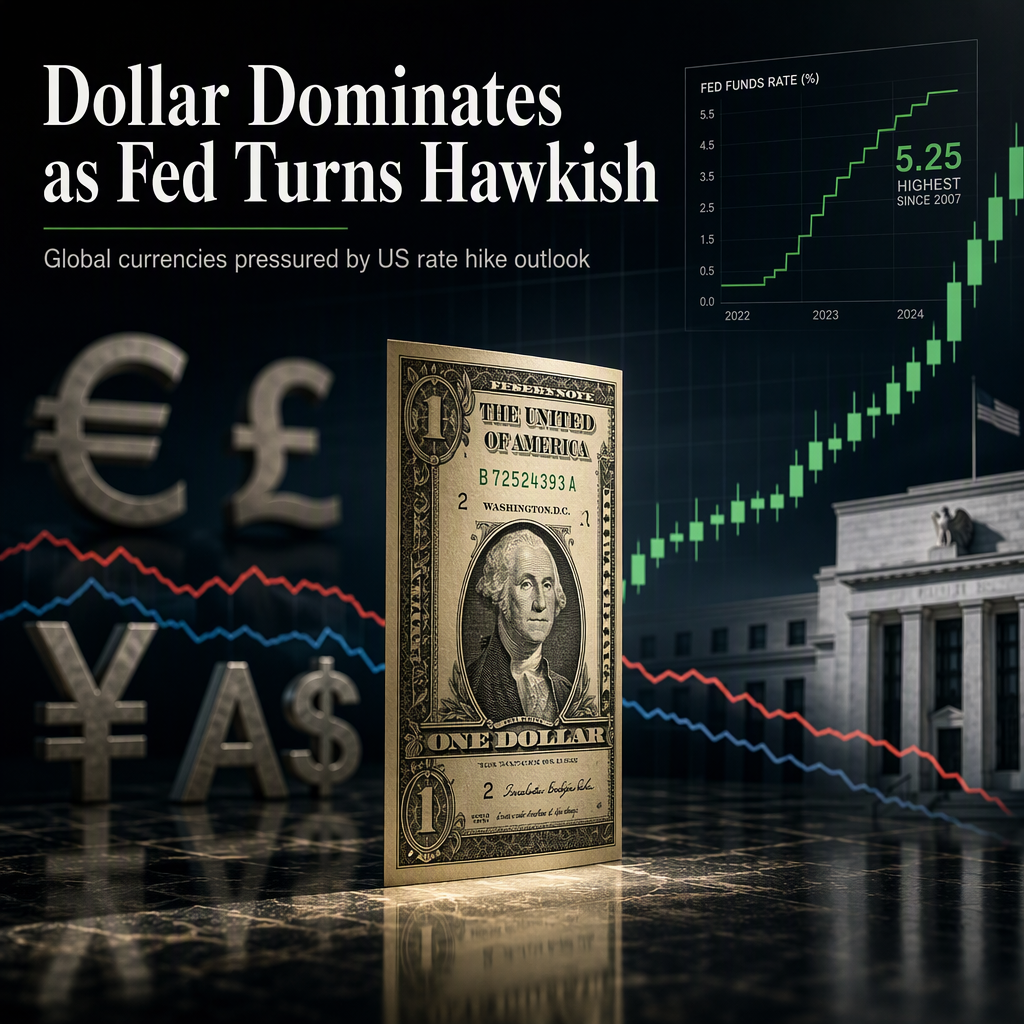
The US Dollar (USD) gained strength against major currencies during Asian trading hours on Tuesday, driven by a hawkish outlook from the Federal Reserve (Fed) and rising expectations for further interest rate hikes before year-end [1][2][3][4]. The Fed recently raised its benchmark rate to 3.75%–4.00% and signaled the likelihood of at least one more hike this year, with traders now pricing in a 55.4%–56.5% probability of a 25 basis point increase at the October meeting, up from around 43.5% a week earlier, according to the CME FedWatch tool [1][4]. St. Louis Fed President Alberto Musalem emphasized the need for earlier, incremental hikes to curb persistent inflation, warning that without further policy restraint, inflation could remain substantially above the 2% target for the next 18 months [1][3][4]. Chicago Fed President Austan Goolsbee also highlighted the risks posed by repeated supply shocks [1].
The Australian Dollar (AUD) softened, with AUD/USD trading near 0.7115, as the Fed's hawkish stance supported the Greenback [1]. However, expectations for a Reserve Bank of Australia (RBA) rate hike next week remain high, with money markets pricing in a 90% chance of a 25bp increase to 4.6%, and Commerzbank analysts noting an 85% probability priced in by the OIS market [1]. Technical analysis suggests a constructive near-term outlook for AUD/USD, with key support at 0.7085 and resistance at 0.7160 [1].
The British Pound (GBP) consolidated above the mid-1.3300s against the USD, remaining close to its lowest level since July 30 [2]. The divergence between the Fed's hawkish bias and the Bank of England's (BoE) cautious, on-hold stance contributed to the GBP's underperformance [2]. Geopolitical tensions in the Middle East further underpinned the safe-haven USD, while a pullback in oil prices eased inflation concerns and capped US bond yields [2]. Market participants are awaiting speeches from FOMC members and upcoming economic data, including flash PMIs from the UK and US, as well as a meeting between US President Donald Trump and Chinese President Xi Jinping [2].
The New Zealand Dollar (NZD) slipped for a third consecutive day, with NZD/USD trading around 0.5700, as the Reserve Bank of New Zealand (RBNZ) signaled a gradual approach to future rate hikes [3]. Despite a dovish surprise at the September meeting, markets are still pricing in a potential rate hike in October due to rising oil prices and inflation risks [3]. ING analysts cautioned that the RBNZ's guidance is data-dependent and could change if energy prices remain elevated [3]. Broader market sentiment was mixed, influenced by US-China diplomatic prospects and ongoing Middle East tensions, including new US sanctions targeting Iranian airlines [3].
The Japanese Yen (JPY) weakened, with USD/JPY rising to around 157.55, following the Bank of Japan's (BoJ) lack of hawkish guidance after a 25bp rate hike to 1.25% last week—the highest in 31 years [4]. Swaps markets see less than a 20% chance of another hike at the October meeting but a 90% chance for December [4]. Reports of BoJ rate checks signaled potential intervention to support the Yen, which analysts at MUFG/BTMU said could cap further depreciation as USD/JPY approaches the 160.00 level [4].
Across all markets, the Fed's hawkish tone and rising rate expectations were the dominant drivers, reinforcing USD strength and pressuring other major currencies [1][2][3][4].
CONCLUSION
The Federal Reserve's hawkish outlook and rising expectations for further rate hikes have strengthened the US Dollar against major currencies, including the AUD, GBP, NZD, and JPY. Central banks in Australia, New Zealand, and Japan are taking more cautious or gradual approaches, while the Bank of England maintains a dovish stance. Market participants are closely watching upcoming central bank meetings, economic data releases, and geopolitical developments for further direction.