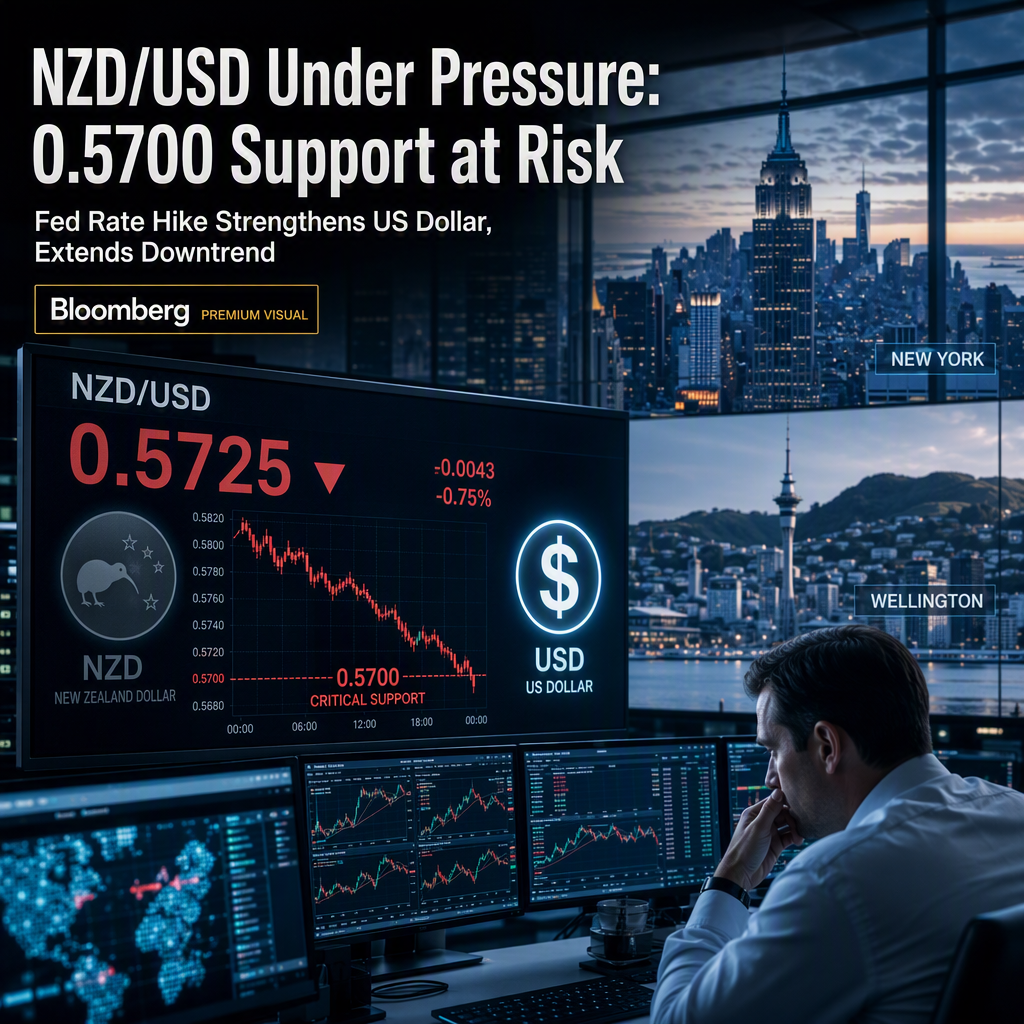
The New Zealand Dollar (NZD) declined against the US Dollar (USD) on Friday, falling by 0.11% after a week marked by the Federal Reserve's first rate hike in three years, which bolstered the Greenback against most G8 currencies [1]. The NZD/USD pair traded at 0.5725, having reached a high of 0.5787 earlier in the session before reversing and closing near the daily low [1].
Technical analysis indicates that sellers dominated the market on Friday, with the Relative Strength Index (RSI) nearing oversold territory for the second time in September, suggesting the downtrend is likely to continue [1]. A bearish continuation would require NZD/USD to decisively break below 0.5700, which would expose the July 8 daily low of 0.5671 and potentially challenge the year-to-date low of 0.5626 [1]. Conversely, a move above 0.5750 could open the path to test resistance at 0.5800, followed by the 100-day Simple Moving Average (SMA) at 0.5834, the 200-day SMA at 0.5853, and the 50-day SMA at 0.5856 [1].
The article highlights that the NZD is influenced by several factors, including the health of the New Zealand economy, central bank policy, performance of the Chinese economy, and dairy prices, as dairy is New Zealand's main export [1]. Decisions by the Reserve Bank of New Zealand (RBNZ) regarding interest rates, particularly in relation to inflation targets, also play a significant role in NZD valuation. The rate differential between New Zealand and the US Federal Reserve is noted as a key driver for the NZD/USD pair [1].
No explicit forward-looking statements or analyst opinions are provided regarding the immediate outlook for NZD/USD beyond the technical levels discussed [1].
CONCLUSION
The NZD/USD pair is under pressure following the Fed's rate hike, with technical indicators pointing to a potential continuation of the downtrend if 0.5700 support is breached. Market sentiment is negative, and the pair's direction will likely depend on upcoming economic data and central bank actions. Investors should monitor key technical levels and macroeconomic developments for further cues.