
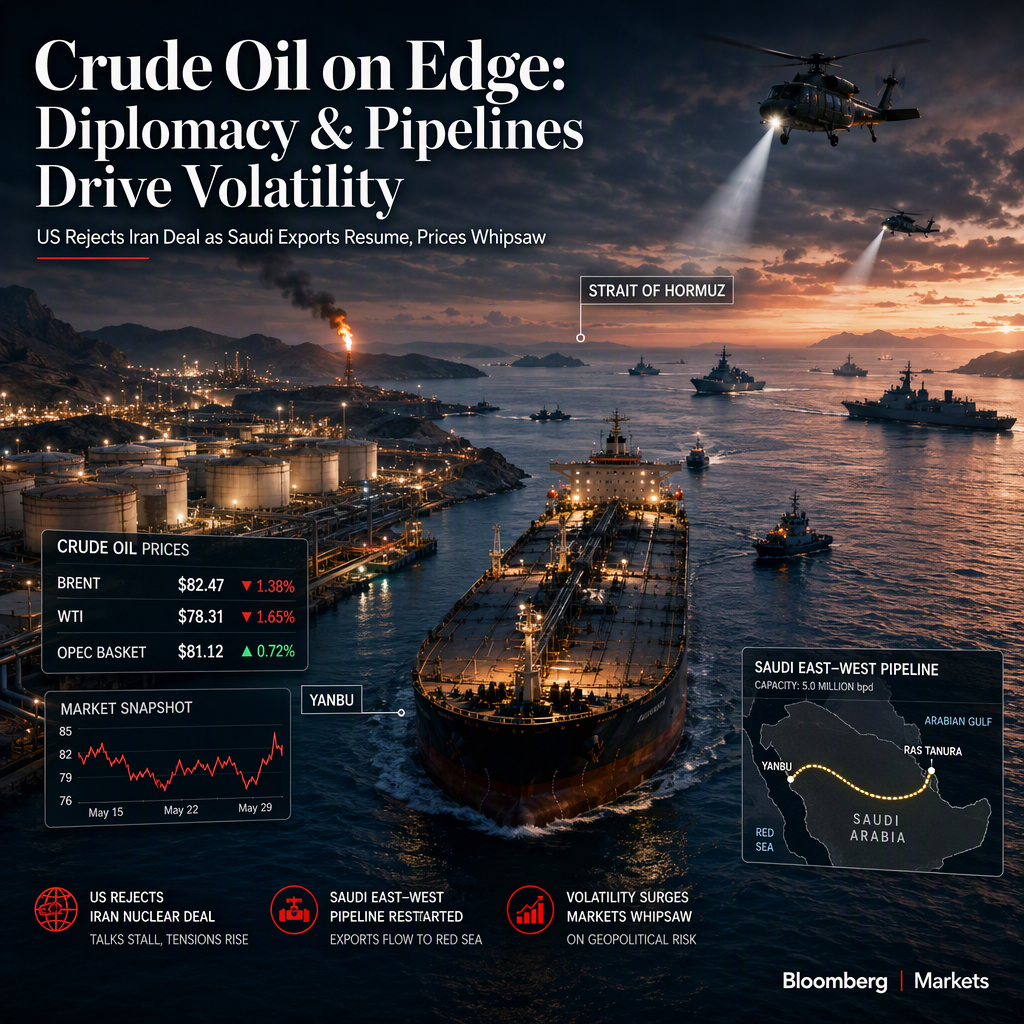
Crude Oil prices experienced significant volatility following a series of diplomatic and operational developments involving the United States, Iran, and Saudi Arabia. President Trump rejected Iran's seven-day plan for the Strait of Hormuz, which initially lifted Crude Oil to its highest level since Thursday. However, this gain was erased after Saudi Arabia restarted its East-West pipeline and the US offered potential sanctions relief, leaving Crude Oil near $91.50, effectively unchanged from Friday's session and indicating that the weekend's events had a net zero impact on price so far [1].
Iran's proposal involved reopening the Strait of Hormuz after seven days if the US first lifted its naval blockade, dropped sanctions on Iranian oil, and released frozen assets, with nuclear talks to follow. President Trump deemed these terms unacceptable on Saturday, stating in a Sunday interview that such terms might have been considered a year ago, before the current conflict and blockade. On Monday, a US official indicated that President Trump is willing to ease sanctions and release frozen assets in exchange for concrete nuclear progress, but both sides remain divided on the sequence of actions. The market's focus is on which side will move first, as either scenario could result in increased Iranian oil exports and more tankers passing through Hormuz, which would pressure Crude Oil prices downward [1].
There have been three versions of Iran's nuclear offer since Friday. A senior Iranian official stated there would be no nuclear flexibility even if Washington accepted the plan. Other sources described an offer to send Iran's most enriched uranium to a third country, while a Saudi broadcaster reported that Iran has agreed to halt enrichment in exchange for sanctions relief. The latter, if true, would be the most significant for Crude Oil markets, as it could unlock sanctions relief and restore Iranian exports, though this report has the least substantiation. Iran's Foreign Minister Araghchi stated on Sunday that Iran is fully prepared for the war to resume [1].
Operationally, Saudi Arabia resumed exports through its East-West pipeline to the Red Sea port of Yanbu on Monday, ending a 17-day halt caused by earlier drone damage. Current flows are near 3.5 million barrels per day, with a capacity of about 7 million barrels per day, and these exports bypass the Strait of Hormuz. A full return to capacity could take about six weeks. Additionally, Saudi Arabia increased shipments through the strait, raising total exports to a wartime high above 5 million barrels per day in September. Ship-tracking data showed 132 transits of Hormuz in the week to September 27, up from 116 the previous week, compared to roughly 130 per day before the war began in February [1].
CONCLUSION
Crude Oil markets remain highly sensitive to diplomatic and operational developments involving the US, Iran, and Saudi Arabia. Despite significant weekend events, prices returned to prior levels, reflecting ongoing uncertainty and the market's focus on the timing and sequence of potential sanctions relief and export increases.