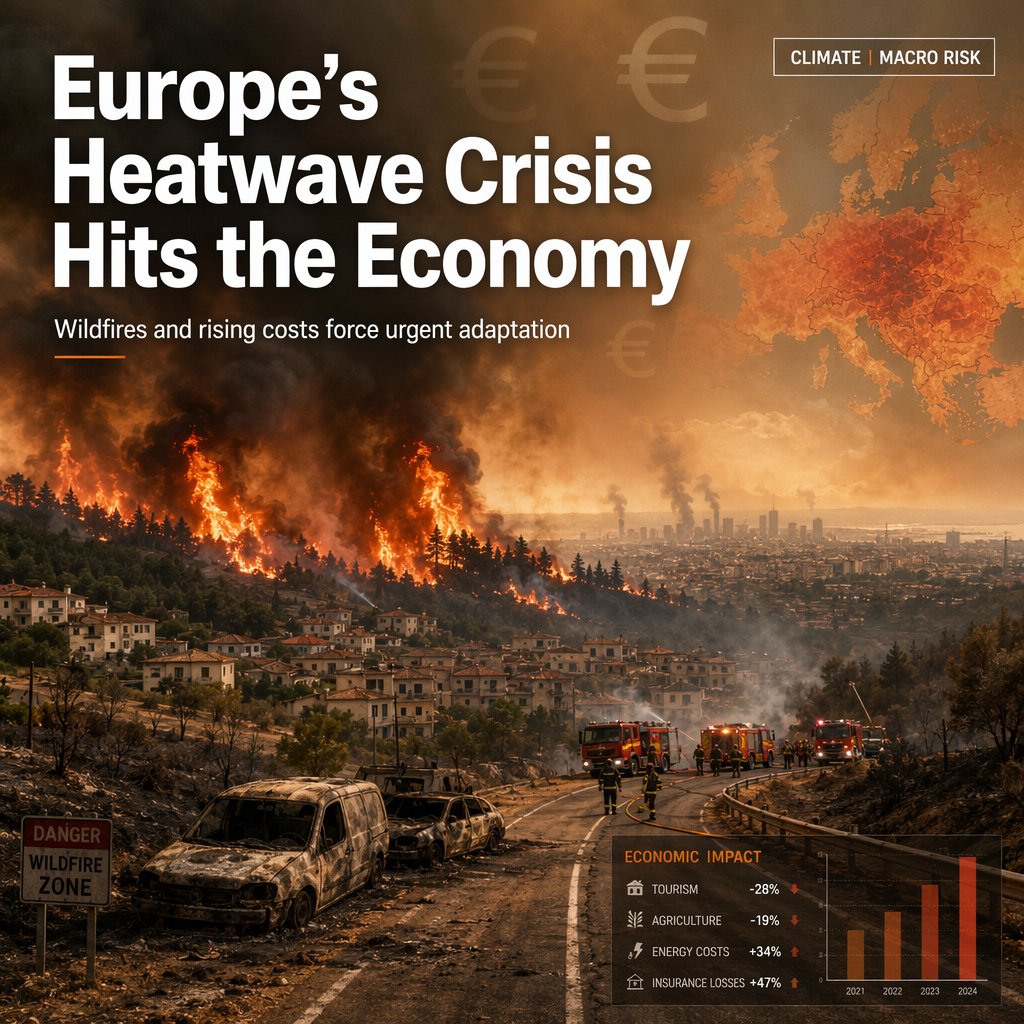
Western Europe is experiencing severe economic challenges as a result of increasingly frequent and intense heatwaves, with wildfires in Spain and France burning 300,000 acres and forcing the evacuation of 300,000 people [1]. These events are part of a broader trend, with the World Meteorological Organization (WMO) reporting that Western Europe recorded its hottest June ever this year and noting a growing number of larger fires and an extended fire season across the continent [1]. The economic impact is significant, affecting infrastructure, business operations, and public budgets. Costs are rising for cooling, healthcare, emergency response, transportation, and agriculture, while insurance claims and public spending are also under pressure [1].
French Finance Minister Roland Lescure described the latest wildfires as "like a clap of thunder" for the local economy, emphasizing that the fires are only one aspect of the broader economic strain caused by rising temperatures [1]. Economists warn that repeated heatwaves—Western Europe is facing its third in six weeks—are reducing productivity, disrupting supply chains, depressing tourism, and increasing food prices, turning summer weather into a recurring macroeconomic risk [1]. Georg Zachmann, a senior fellow at Bruegel, stressed the urgent need for early adaptation and slowing the pace of climate change to prevent overwhelming Europe's capacity to absorb such risks [1].
ING's Global Head of Macro, Carsten Brzeski, stated that heatwaves have "quietly graduated from 'weather event' to 'macro variable,'" highlighting their growing influence on economic performance [1]. According to a 2025 joint paper, heatwaves, droughts, and floods during the summer of 2025 caused the European economy to lose approximately 0.3% of output, with potential cumulative losses reaching 0.8% by 2029 due to lost productivity, supply chain disruptions, and reduced tourism revenue [1].
The market implications are substantial, as the persistent extreme weather events are now recognized as a macroeconomic risk, impacting GDP and requiring significant adaptation measures across multiple sectors [1].
CONCLUSION
Europe's escalating heatwaves and wildfires are no longer isolated weather events but have become a major macroeconomic risk, eroding output and straining public and private resources. Policymakers and economists emphasize the urgent need for adaptation and mitigation strategies to prevent further economic damage. The market takeaway is clear: climate-related disruptions are now a central concern for Europe's economic outlook.