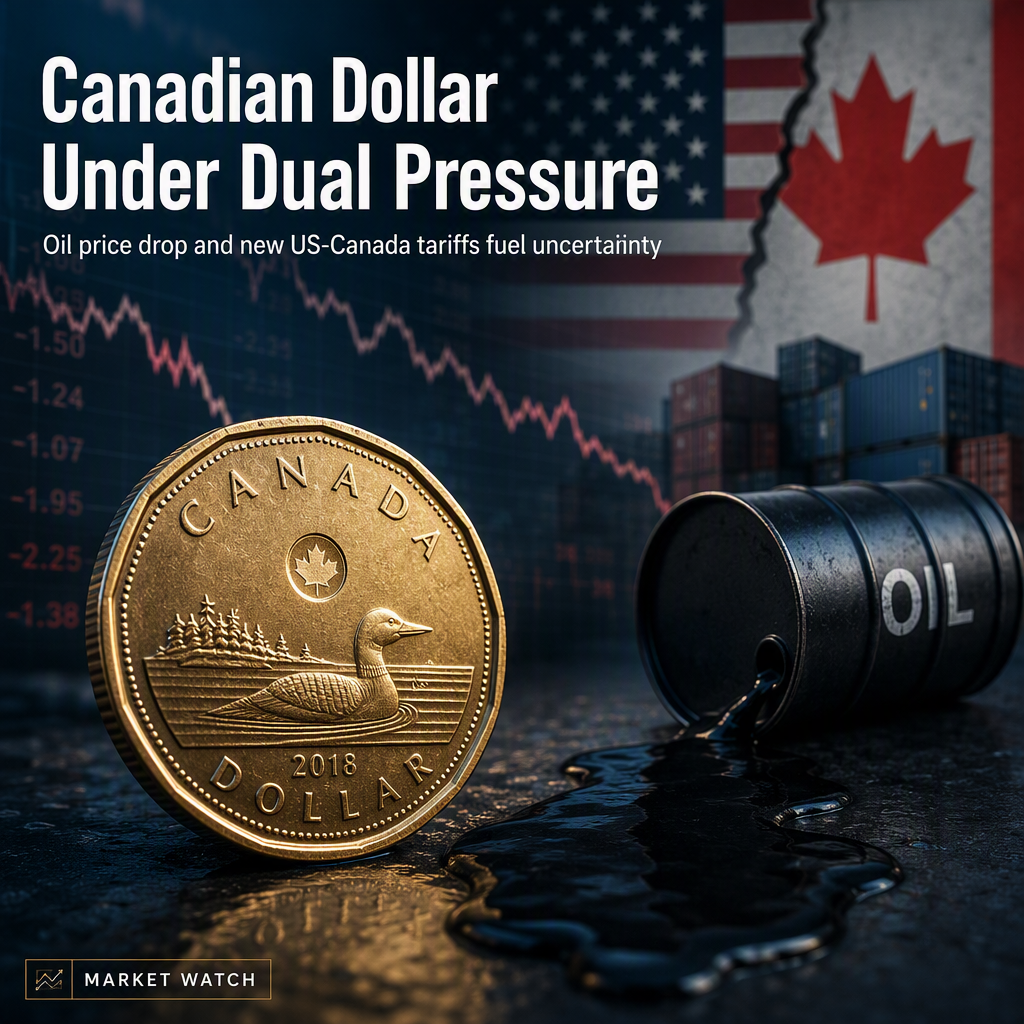
The Canadian Dollar (CAD) is experiencing downward pressure due to a sharp decline in Oil prices and the announcement of new US tariffs, with USD/CAD trading around 1.3835 on Tuesday, down 0.07% on the day. The currency pair lacks clear direction as both the US Dollar (USD) and the CAD face their own headwinds, with the Greenback also weakening amid improved market sentiment and mixed US economic data [1].
West Texas Intermediate (WTI) Oil prices fell 3.35% to approximately $81.75, following a statement from US President Donald Trump that the US Navy had removed or destroyed all mines in the Strait of Hormuz, reducing geopolitical risk premiums in Oil markets. As Canada is a major crude exporter, lower Oil prices negatively impact the CAD, but this effect is currently offset by a softer US Dollar. The US Dollar Index (DXY) fell 0.05% to 98.95 [1].
US economic data provided little support for the USD, with the Conference Board Consumer Confidence Index dropping to 89.4 in August from a revised 90.2 in July, marking a second consecutive monthly decline. Dana M. Peterson, Chief Economist at The Conference Board, noted that the Expectations Index slipped further into negative territory, though consumers' assessment of the present situation improved moderately. US labor market data showed a slight improvement, with private employers adding an average of 11.75K jobs per week over the four weeks ending August 8, up from 9.5K previously [1].
On the Canadian side, trade tensions intensified as the Canadian government announced retaliatory tariffs targeting around $20 billion worth of US products, covering approximately 700 items with tariffs of 15%, 25%, or 50%. These measures are set to take effect on September 8. Additionally, Ottawa announced a C$7.5 billion support package for businesses and workers affected by the new US tariffs. While these developments add uncertainty to Canada's economic outlook, their immediate impact on the CAD has been limited, with USD/CAD remaining slightly lower as US Dollar weakness offsets the negative impact of falling Oil prices [1].
Strategists at Scotiabank described the situation as a "trade whirlwind" for the CAD, citing the rapid escalation of tariffs and ongoing negotiations, which contribute to the current market uncertainty [1].
CONCLUSION
The Canadian Dollar is under pressure from both a sharp drop in Oil prices and escalating trade tensions with the US, but the immediate market impact has been contained by concurrent US Dollar weakness. While uncertainty remains elevated due to new tariffs and support measures, the USD/CAD pair has shown only modest movement, reflecting a balance of opposing forces in the market.