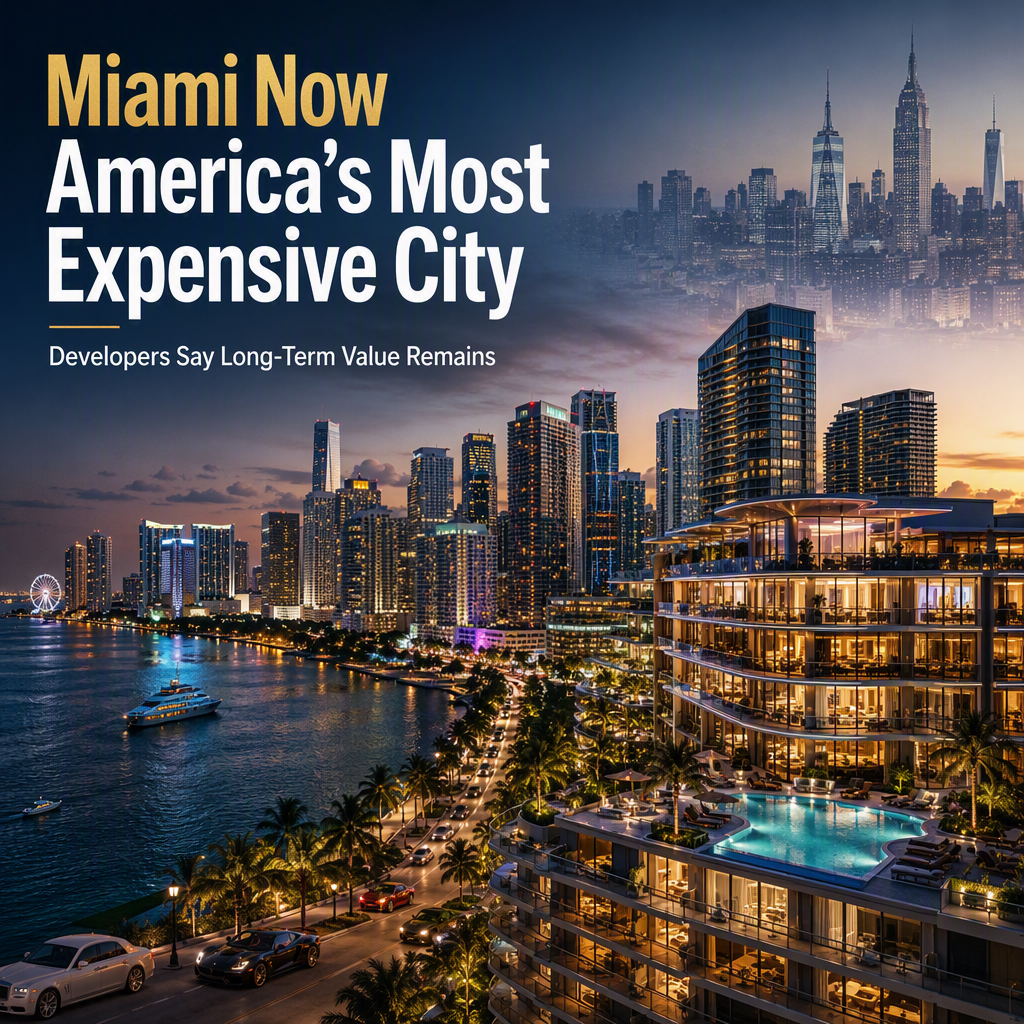
Recent economic data indicates that the overall cost of living in the Miami-Fort Lauderdale-West Palm Beach metropolitan area has now surpassed that of greater New York, according to a Bloomberg analysis of U.S. Bureau of Economic Analysis data [1]. Specifically, housing costs in South Florida are reported to be approximately 5% higher than in New York and its suburbs [1]. Additionally, consumer prices in South Florida have increased by 36% since 2019, marking the second-highest inflation surge among major U.S. markets, with only Tampa experiencing a higher rise [1]. South Florida home prices have jumped 79% since the pandemic, based on S&P CoreLogic Case-Shiller data [1]. Furthermore, Florida's average annual homeowners insurance premium is $8,292, which is roughly four times the average in unspecified comparison regions [1].
Despite these figures, top real estate developers maintain that Miami continues to offer significant long-term value compared to New York City. Danielle Naftali, EVP of marketing, sales, and design at Naftali Group, emphasized that Miami has evolved into a world-class city, attracting permanent residents and major cultural and hospitality investments, which has naturally led to increased costs [1]. Ryan Shear, managing director at PMG, noted that Miami was historically underpriced relative to cities like New York, London, or Los Angeles, and is now experiencing a period of 'catch-up' in terms of real estate values [1]. Both executives argue that, despite the recent surge in prices and cost of living, Miami remains a 'bargain play' and a 'value city' for buyers, especially when considering long-term growth prospects and the absence of state income tax [1].
The influx of both individuals and companies to South Florida, along with high-profile real estate transactions, has contributed to the region's economic transformation. However, developers caution that headline-grabbing sales do not fully capture the underlying value proposition that Miami still offers compared to other major global cities [1].
No specific market reactions or analyst forecasts are provided in the article, but the perspectives of leading developers suggest continued optimism about Miami's real estate market and its comparative advantages over New York City [1].
CONCLUSION
While Miami has overtaken New York in overall cost of living and housing expenses, real estate developers assert that the city still presents long-term value and growth potential. The combination of rapid price increases, high insurance premiums, and strong migration trends underscores Miami's evolving status as a major global city, yet industry leaders remain bullish on its future prospects.