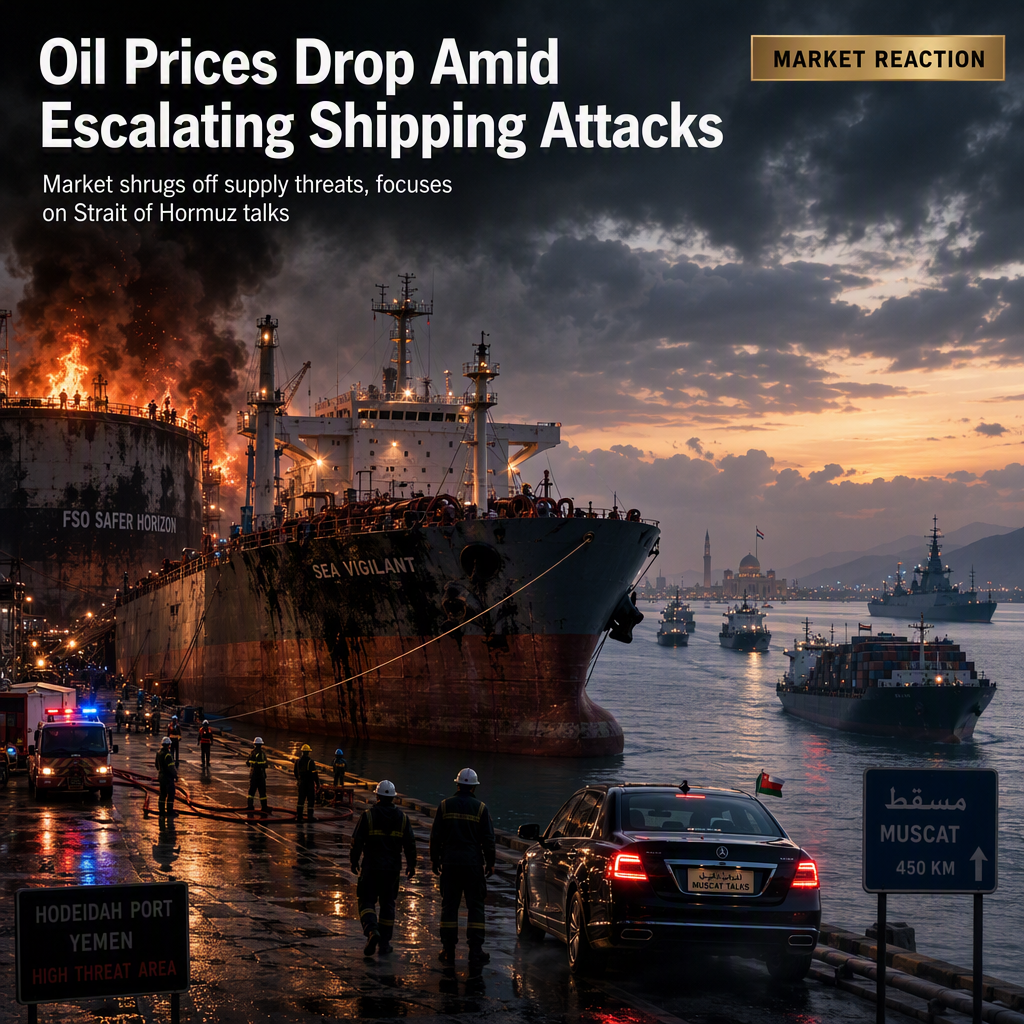
Crude oil prices declined on Thursday, with WTI trading just above $82.00, down more than 1.5%, and Brent holding slightly above $86.50 with a similar loss, despite the ongoing war expanding to Egypt, a country previously unaffected for five months [1]. The market reaction appears muted to the escalation, instead focusing on ongoing shipping negotiations in Muscat regarding the Strait of Hormuz [1].
On Wednesday, a drone attack struck two gas vessels at Egypt's Damietta port, igniting a floating storage unit and spreading fire to an adjacent carrier. Cairo confirmed the cause on Thursday, though no party has claimed responsibility. This incident is significant as Egypt's Suez Canal and pipeline have served as the primary safe route for Saudi oil exports since the Strait of Hormuz became inaccessible. Meanwhile, the southern bypass has also faced attacks, with Yemen's Houthis claiming a strike on the East-West pipeline to Yanbu and recently declaring a maritime blockade of Saudi Arabia. Additionally, loadings at a Black Sea terminal were suspended after two tankers were attacked, indicating that all alternative routes to the Hormuz chokepoint are now under threat [1].
Despite these disruptions, the market is reacting to developments in Iran-Oman negotiations over the Strait of Hormuz. Tehran rejected Muscat's proposal for shared oversight, instead seeking greater Iranian control and warning that the Strait would remain closed if Oman does not agree. Iran's foreign ministry stated there are no plans to negotiate with Washington, and the most optimistic outcome is a reopening of the waterway under Iranian supervision with a transit fee, which would impose a permanent cost on Gulf oil exports rather than removing the current risk premium. Tanker trackers reported only 14 transits on Wednesday, compared to about 100 daily before the conflict, but the market interpreted this as a sign of normalization [1].
In terms of supply, US commercial crude oil inventories fell by 7.2 million barrels in the week to July 24, roughly six times the expected draw, leaving stocks at 404.5 million barrels—about 7% below the five-year average. Cushing, the WTI delivery hub, is near 19.4 million barrels, approaching the minimum operational level. The Strategic Petroleum Reserve (SPR) is at 307.7 million barrels after an eighteenth consecutive weekly draw, marking its lowest level in over forty years. Despite these tight inventories, Chinese buyers reportedly have ample stocks and are staying out of the market [1].
CONCLUSION
Despite significant disruptions to key oil shipping routes and a sharp drawdown in US crude inventories, oil prices have fallen as the market focuses on negotiations over the Strait of Hormuz rather than the broader conflict. The potential for a reopening under Iranian control with added costs, rather than a reduction in geopolitical risk, appears to be shaping market sentiment. Inventory tightness is being offset by subdued demand from major buyers like China.