
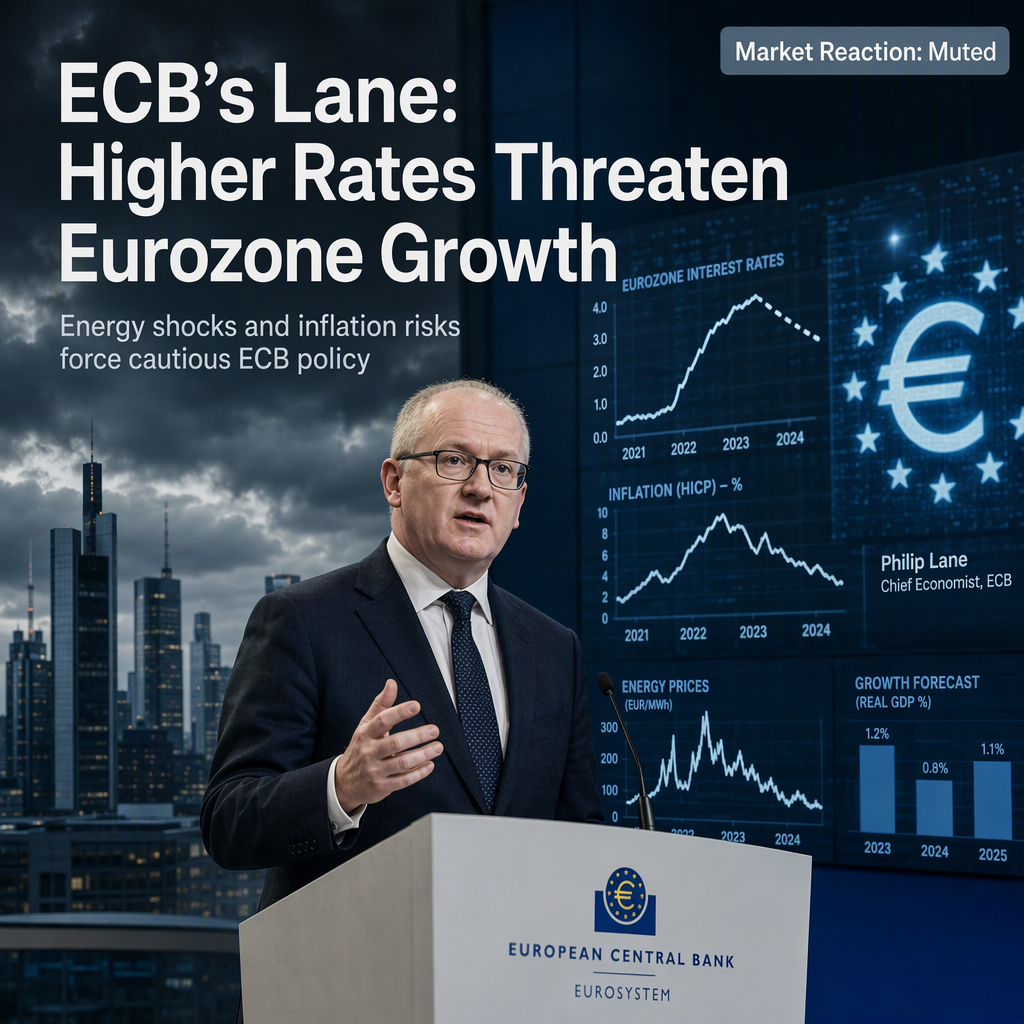
European Central Bank (ECB) Chief Economist Philip Lane has cautioned that rising long-term interest rates are expected to moderate economic growth in the Eurozone, with the impact on growth and monetary policy pass-through likely to be greater than previously projected [1]. Lane emphasized that underlying inflation indicators do not show a sustained upward shift in medium-term inflation, suggesting that inflation expectations remain de-anchored [1].
Lane described the ECB's current monetary policy approach as a 'middle path,' advocating for a measured response rather than aggressive tightening. He noted that high energy costs are creating demand destruction, which could limit the extent of necessary ECB rate adjustments [1]. Additionally, Lane warned that a second wave of the energy supply shock presents direct upside risks to inflation and downside risks to growth, highlighting the delicate balance the ECB faces in its policy decisions [1].
Market reaction to Lane's remarks was muted, with no immediate movement observed in the Euro (EUR). However, at the time of reporting, EUR/USD was down 0.5%, trading slightly below 1.1200, primarily due to concerns over French fiscal policy rather than Lane's comments [1]. Lane's speech was rated 4.6/10 on the FXS Speechtracker, below the historical baseline of 5.3/10, indicating a slightly more cautious tone [1].
Lane's emphasis on the growth drag from higher yields and the risks posed by energy supply shocks supports expectations for a cautious and flexible ECB policy stance. The Euro remains sensitive to incoming data, with the central bank likely to avoid aggressive tightening in favor of measured adjustments [1].
CONCLUSION
ECB Chief Economist Lane's remarks signal a cautious approach to monetary policy, with higher long-term rates expected to slow growth and energy shocks posing risks to both inflation and economic expansion. The Euro showed little immediate reaction, but Lane's dovish tone reinforces expectations for a flexible, data-driven ECB policy path.