
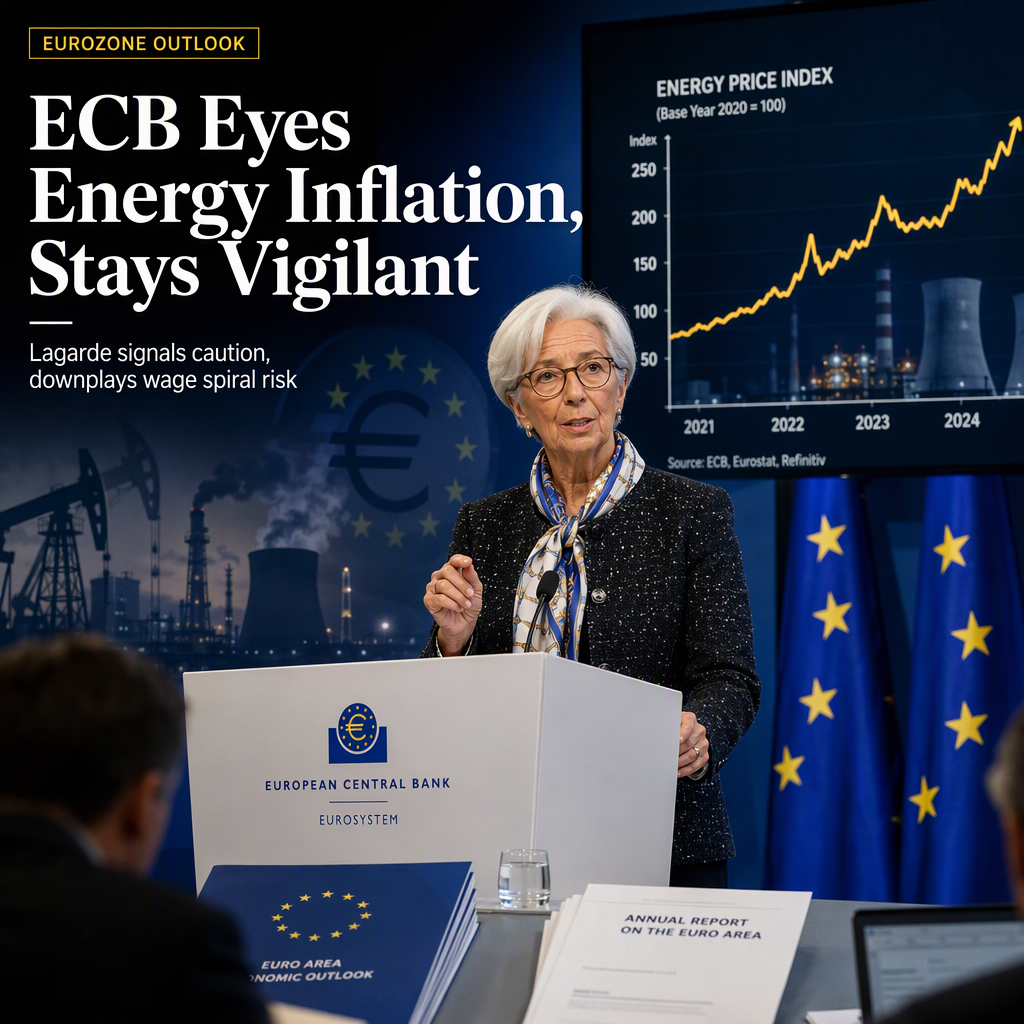
European Central Bank (ECB) President Christine Lagarde stated on Wednesday that inflation in the Eurozone has been rising predominantly due to energy prices, though not exclusively so [1]. Lagarde emphasized that the ECB is not currently seeing any second-round effects from inflation, such as broad-based wage-price spirals, but noted the importance of anticipating and monitoring for such developments rather than waiting until they are fully apparent [1]. She highlighted that in Europe, there is anticipation of wage increases through collective bargaining arrangements, which the ECB is closely following as potential entry points for inflationary pressures [1].
Addressing concerns about French debt, Lagarde asserted that the primary solution lies in French fiscal policy rather than monetary intervention [1]. She also commented on Euro area growth, describing a projected 1.1% growth rate in 2026 as "not brilliant, but not bad" [1]. Lagarde clarified that she will not run for French president [1].
Market reaction to Lagarde's remarks was muted, with the EUR/USD pair rising by 0.06% to trade at 1.1205 at the time of reporting [1]. The FXS Speechtracker assigned Lagarde's speech a score of 4.6/10, below the historic baseline of 5.6/10, indicating a more cautious and less forceful tone than usual [1]. While Lagarde's comments leaned slightly hawkish in terms of vigilance, she stopped short of signaling aggressive monetary tightening, instead emphasizing targeted vigilance and fiscal responsibility [1].
Overall, the speech suggests that the ECB is maintaining a balanced stance, with limited immediate impact on the Euro's direction. Markets are likely to interpret Lagarde's remarks as watchful but not decisively hawkish, given the focus on energy-driven inflation and the absence of clear second-round effects [1].
CONCLUSION
ECB President Lagarde's remarks signal a cautious but balanced approach to inflation, emphasizing energy as the main driver and downplaying immediate risks of second-round effects. The market response was limited, reflecting the absence of aggressive policy signals. Investors are likely to view the ECB's stance as vigilant but not overtly hawkish in the near term.