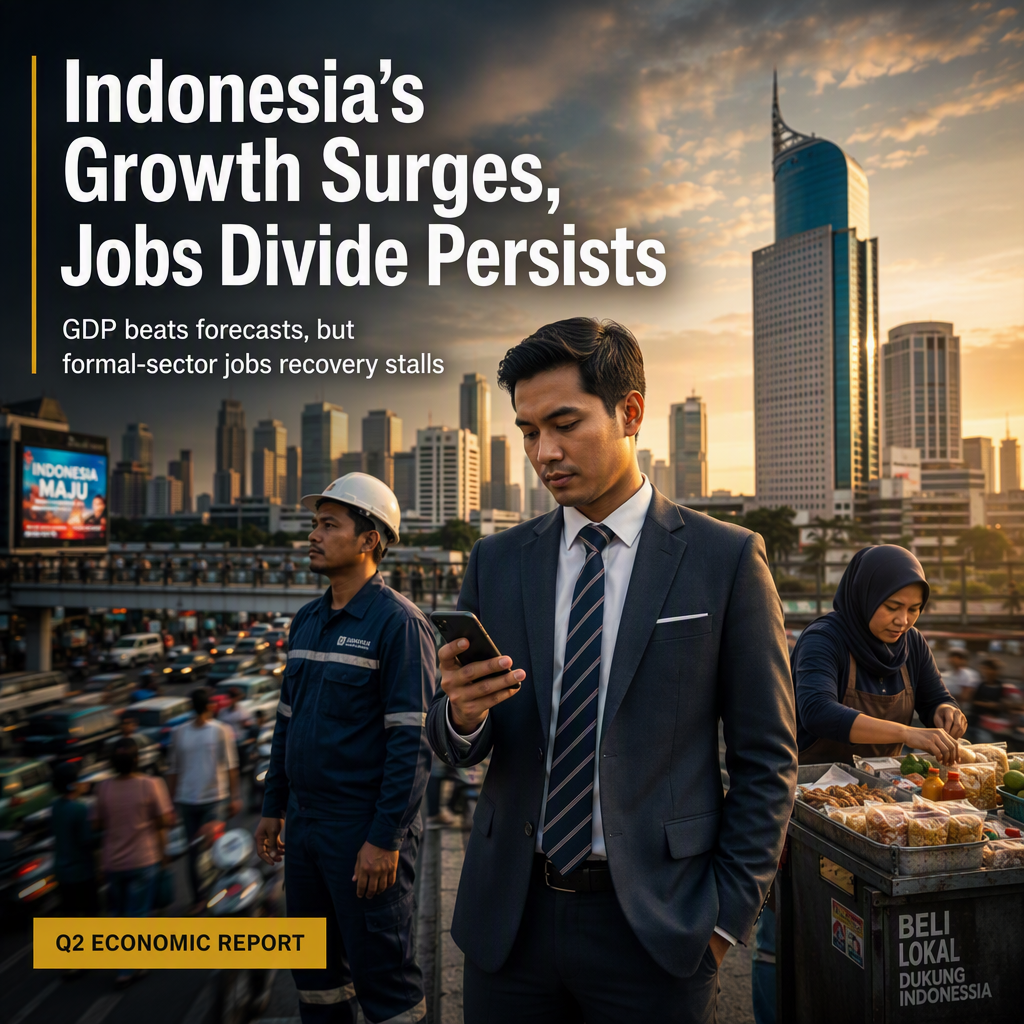
Indonesia's economy grew by 5.3% year-on-year in the second quarter, slowing from 5.6% in the first quarter but surpassing market expectations of 5.1% growth, according to Standard Chartered's Aldian Taloputra [1]. The slowdown was anticipated as temporary factors such as Eid spending and the harvest season faded, yet Q2 GDP still expanded at a faster pace than in 2025 [1].
Stronger-than-expected data for the first half of the year prompted Standard Chartered to raise its 2026 GDP growth forecast to 5.3% from 5.2% [1]. Despite this upward revision, the bank maintains that growth will remain modest, averaging 5.2% in the second half of the year, due to a weak recovery in formal-sector employment and cautious private-sector investment [1].
The unemployment rate declined to 4.65% in May from 4.74% in November 2025, indicating ongoing job creation. However, the share of formal-sector jobs, which typically provide better income security, decreased to 40.7% of total employment from 42.3% over the same period [1].
Government priority programmes—including free meals, village cooperatives, social spending, and infrastructure initiatives—along with relatively healthy household consumption, are expected to support near-term growth and help offset subdued external demand and cautious private-sector activity [1].
CONCLUSION
Indonesia's Q2 GDP growth outperformed expectations, leading to an upward revision in the 2026 growth forecast. However, persistent challenges in formal-sector employment and private-sector investment suggest that growth will remain modest, with government programmes and household consumption playing a key supporting role.