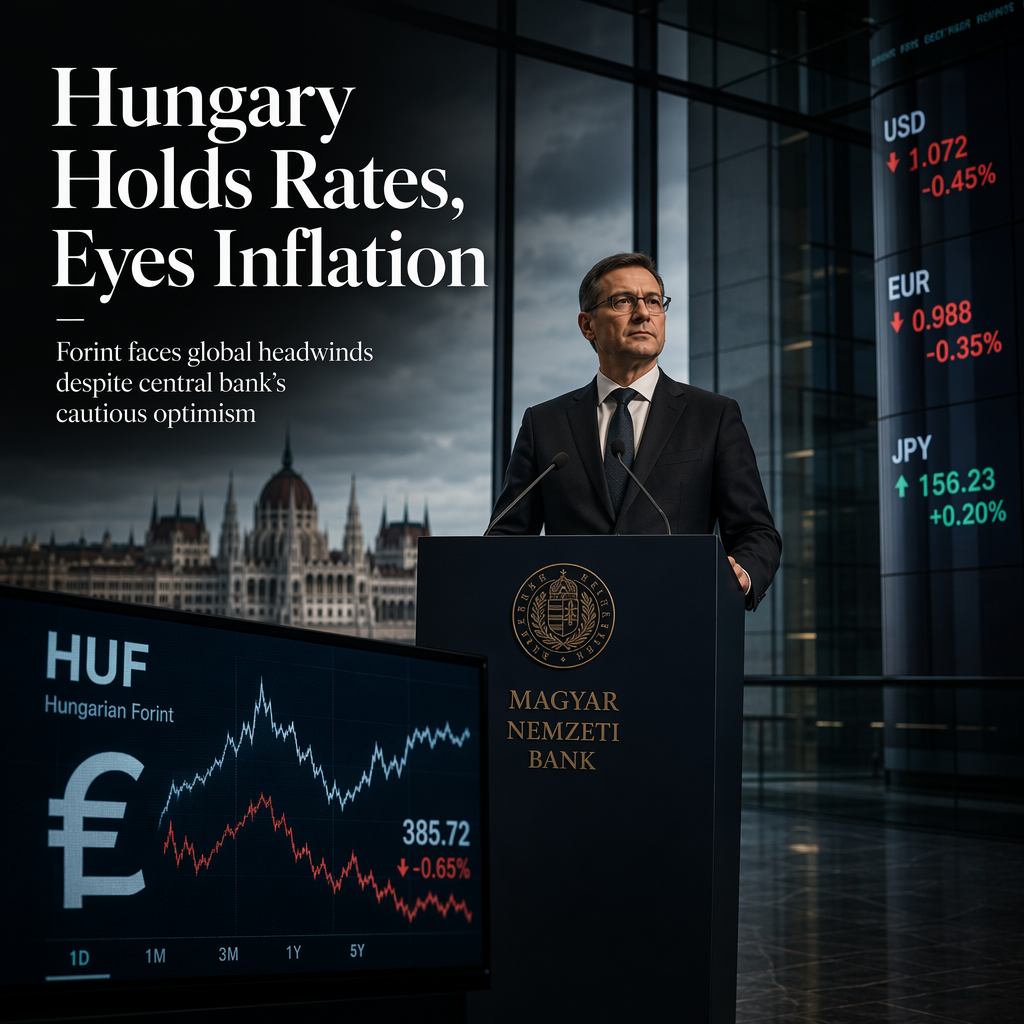
The National Bank of Hungary (NBH) has paused its rate-cutting cycle and reduced its inflation target from 3.0% to 2.5%, a move that was widely anticipated by the market following the April general election [1]. According to ING strategist Frantisek Taborsky, this policy stance creates a supportive backdrop for the Hungarian Forint (HUF), with the combination of a lower inflation target and a halt to rate cuts seen as positive for the FX market [1].
Taborsky notes that the market could quickly price in rate hikes at the front end of the curve if energy prices rise again and Hungarian inflation increases in the coming months. The NBH forecasts an average inflation rate of 3.1% for next year [1]. Meanwhile, the long end of the yield curve still offers opportunities for convergence trades, with expectations that long-term yields will gradually decline [1].
Despite these supportive domestic factors, the global environment presents significant challenges. The US dollar is at record strength, and the EUR/HUF exchange rate remains highly sensitive to energy prices and potential Federal Reserve rate hikes. These global factors could exert renewed pressure on emerging market currencies, including the forint, although they have shown resilience so far [1].
Overall, ING maintains a bullish bias for the forint and sees the potential for a retest of the 360 EUR/HUF level. However, further developments are expected to be heavily influenced by global market dynamics at this time [1].
CONCLUSION
The NBH's pause in rate cuts and lower inflation target provide a supportive environment for the Hungarian Forint, but global factors such as US dollar strength and energy prices could dominate the outlook. While ING remains cautiously optimistic on the forint, market direction will depend on external developments in the coming months.