
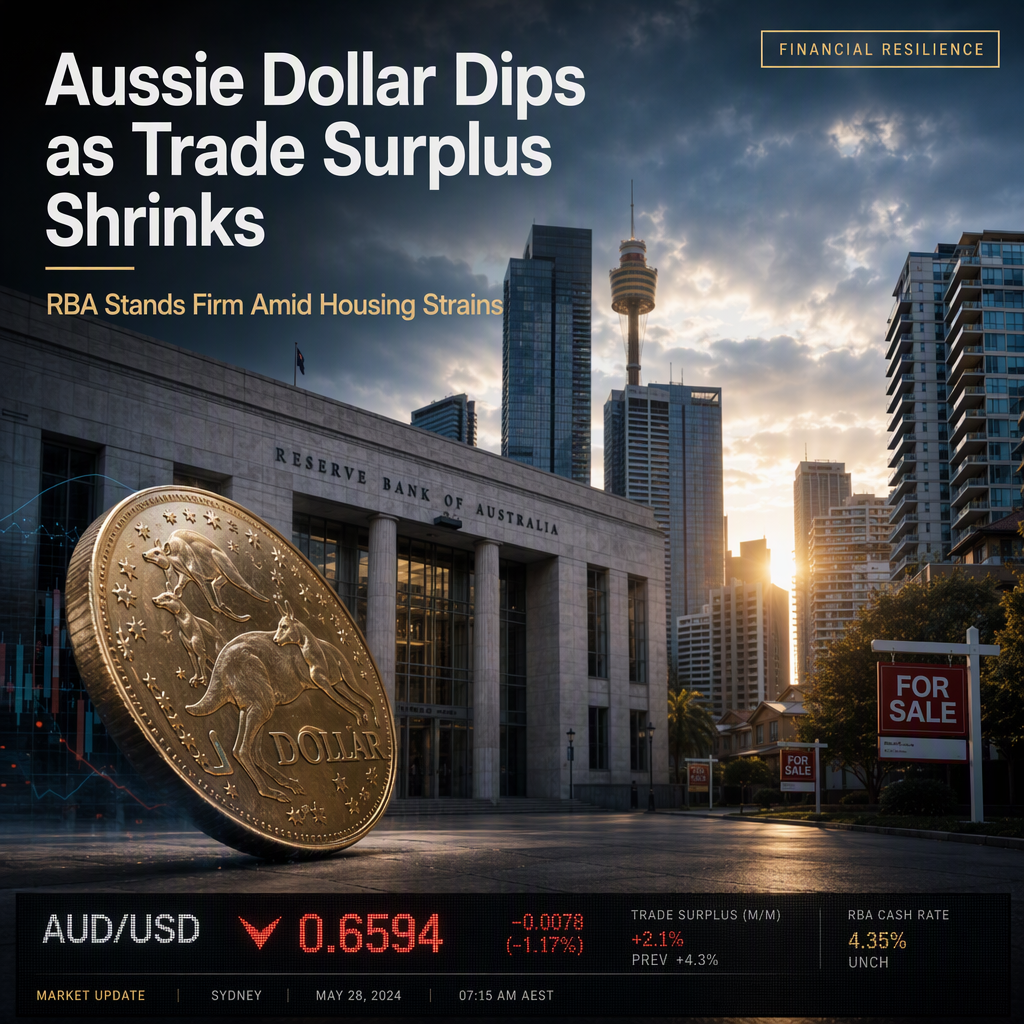
Australia's trade surplus shrank significantly in August, with the latest data from the Bureau of Statistics showing a surplus of AUD$495 million, down from a revised AUD$1,351 million in July (previously reported as AUD$1,923 million) [1][3]. This narrowing was driven by a 5.8% month-on-month increase in imports, outpacing a 3.7% rise in exports for the same period [1][3]. In response, the Australian Dollar (AUD) edged lower against the US Dollar (USD), with the AUD/USD pair trading around 0.6944–0.6945 during the early Asian session on Thursday, reflecting mild losses [1][2][3].
Despite the weaker trade balance, the Reserve Bank of Australia (RBA) expressed confidence in the resilience of households and businesses. In its Financial Stability Review, the RBA stated that even if house prices were to fall a further 20%, only 5% of mortgages would be in negative equity, and less than 1% of borrowers are currently in negative equity [2]. The RBA also noted that banks are well positioned to withstand a material deterioration in the housing market, with overall household balance sheets remaining strong and loan arrears low [2]. However, the RBA acknowledged that cash flow pressures are expected to increase for smaller businesses and energy-intensive firms, and that major risks to domestic financial stability are coming from abroad [2].
Market reaction to the trade data and RBA's review was muted, with the AUD/USD pair showing little movement and losing just 0.02% on the day at the time of reporting [2][3]. Technical analysis indicates that AUD/USD remains capped under the 100-day simple moving average, with the Relative Strength Index (14) at 26.8 in oversold territory, suggesting stretched downside momentum but no immediate reversal [1].
Analyst commentary from Commerzbank’s Volkmar Baur highlighted ongoing weakness in Australia's real estate sector, with building permits falling by 6.1% in August and prices in major cities continuing to decline [1]. Baur suggested that the RBA is likely to remain on hold, as the effects of previous rate hikes are still filtering through the economy, particularly in the housing market [1].
On the US side, softer inflation data has reduced expectations for an immediate Federal Reserve rate hike, with the odds of an October hike falling to about 38.2% from 45% prior to the PCE data release [1]. This could potentially act as a tailwind for the AUD, though immediate support from further RBA rate hikes appears limited [1].
CONCLUSION
Australia's sharply reduced trade surplus and ongoing housing market weakness have weighed on the Australian Dollar, though the RBA maintains that the financial system and households remain resilient. Market reaction has been subdued, with technical indicators suggesting the AUD/USD pair is oversold but not yet poised for a reversal. Forward-looking commentary points to a cautious RBA stance, with limited near-term support for the Aussie from monetary policy.