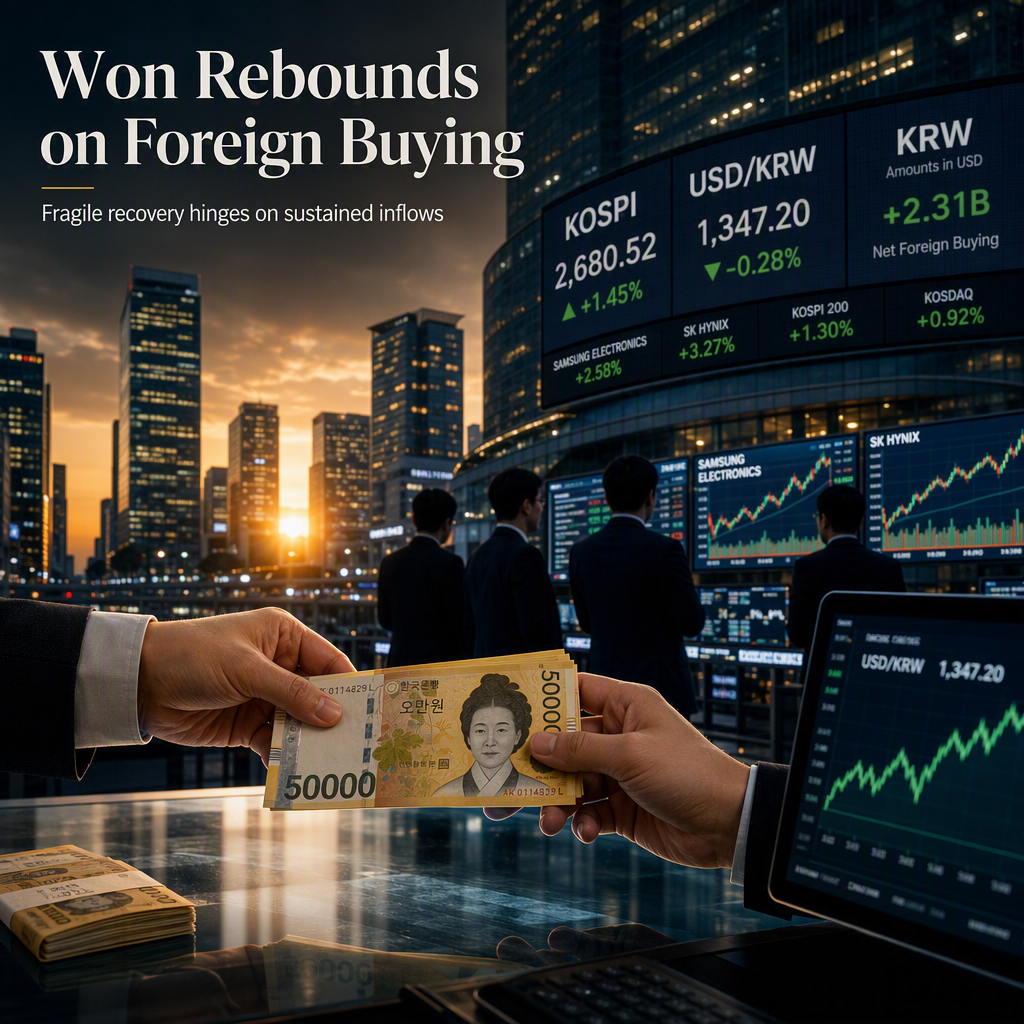
The South Korean Won (KRW) experienced a modest rebound as USD/KRW eased slightly from its Friday highs into the New York close, coinciding with a recovery in Korean equities and a brief return of foreign investors as net buyers [1]. The KOSPI index rose by 2.66%, led by semiconductor stocks, and foreign investors net purchased approximately KRW 439 billion worth of equities during the session [1]. This positive movement was further supported by a pullback in oil prices and some easing in U.S. Treasury yields, which improved the broader risk environment [1].
Despite the rebound, OCBC’s Christopher Wong cautioned that this may not signal a lasting shift in market flows. He noted that foreign equity selling had been a significant drag on the KRW in the preceding week, especially within the large-cap technology sector [1]. Wong emphasized that a sustained recovery in the KRW would require a slowdown or reversal in foreign selling, as the currency remains highly sensitive to U.S. yields, oil prices, and shifts in technology sentiment [1].
The underlying semiconductor and export story continues to provide support for the KRW, but its status as a high-beta currency means it is vulnerable to external factors. Wong suggested that softer U.S. rates and a more durable return of foreign equity inflows could pave the way for further KRW recovery, while renewed foreign selling and elevated rates or oil prices would likely keep USD/KRW elevated [1].
USD/KRW last closed at 1386, with daily momentum remaining bullish and the RSI approaching overbought territory. Risks are currently skewed to the upside, with resistance levels noted at 1388 (23.6% Fibonacci retracement of July high to September low) and 1410 (50-day moving average) [1].
CONCLUSION
The South Korean Won's recent rebound is driven by a temporary return of foreign equity inflows and improved risk sentiment, but its recovery remains fragile and dependent on sustained foreign investment and softer U.S. rates. Market risks are skewed to the upside, with technical resistance levels suggesting potential for further USD/KRW strength if negative factors persist.