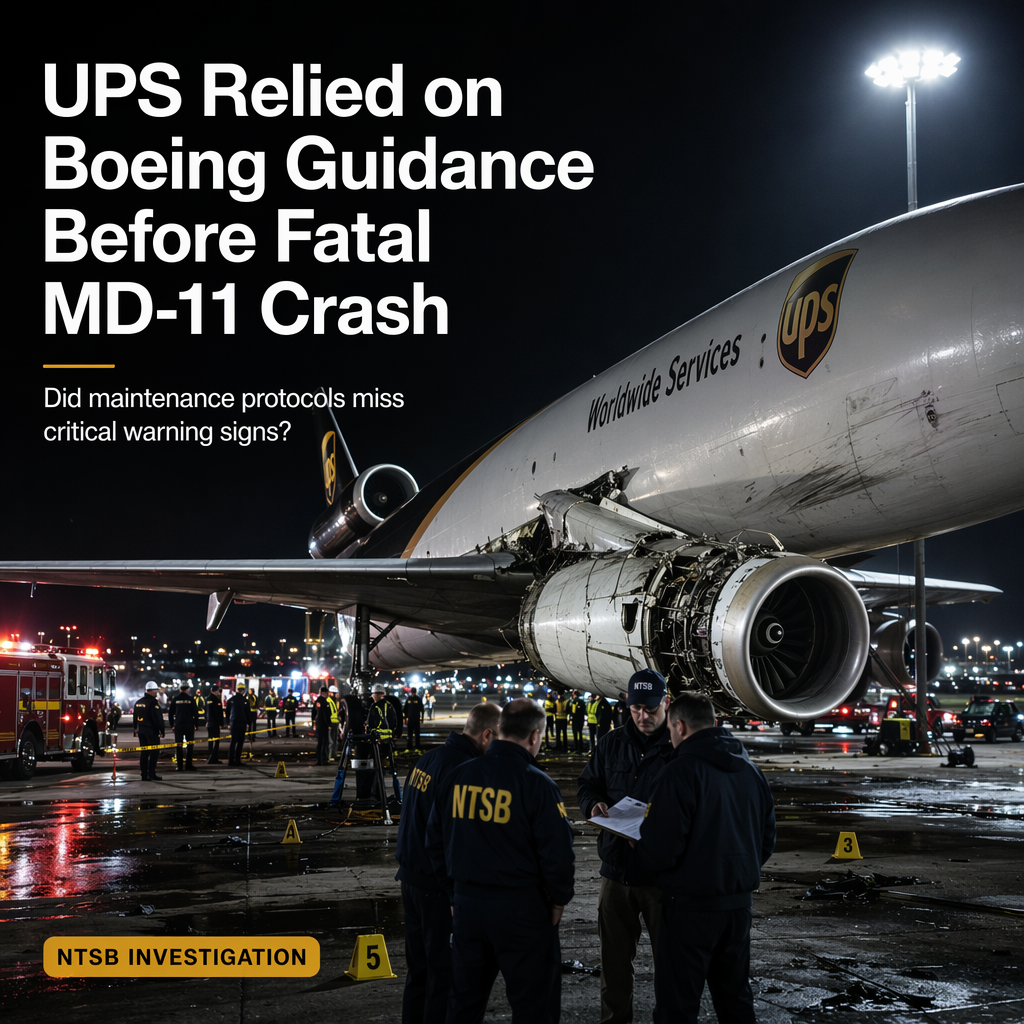
UPS stated that it relied on Boeing's assessment regarding a known engine mount issue when it decided not to implement enhanced inspections on its MD-11 fleet prior to the fatal crash of UPS Flight 2976 in Louisville on November 4, 2025. According to newly released National Transportation Safety Board (NTSB) filings, UPS said Boeing's 2008 and 2011 service letters described the engine mount issue as not a 'safety of flight' condition and indicated that existing inspection intervals were sufficient to detect problems with the engine mount's spherical bearings [1].
The crash involved a McDonnell Douglas MD-11 cargo jet, resulting in the deaths of three crew members and 12 people on the ground, with 23 others injured. The NTSB has not yet released its final report on the accident [1]. UPS emphasized that it followed all required Boeing and Federal Aviation Administration-approved maintenance programs and did not alter its maintenance schedule because Boeing did not update its Maintenance Planning Document (MPD) to require additional tasks. UPS argued that Boeing's failure to revise the MPD signaled that no further maintenance was necessary beyond what was already being performed [1].
Boeing, in its own submission to investigators, stated that after reviewing a 2008 operator report of a failed spherical bearing, it determined the issue was not a safety concern based on available information. Boeing issued a service letter recommending enhanced inspections and later revised the aircraft maintenance manual to include an inspection procedure for bearing movement. Boeing also noted that operators are responsible for maintaining their fleets in coordination with regulators, using Boeing's recommendations to develop their own maintenance programs [1].
Both companies said they will continue cooperating with the NTSB investigation. UPS also argued that Boeing's Continued Operational Safety process failed to identify the damaged bearing and related structural damage as a flight safety issue, and that maintenance records showed no evidence of bearing migration before the crash. Testimony during the NTSB hearing indicated that bearings could fail without visible movement [1].
CONCLUSION
The filings reveal that UPS and Boeing both relied on existing guidance and did not consider the engine mount issue a flight safety risk prior to the crash. With the NTSB's final report still pending, both companies have pledged continued cooperation with the investigation. The incident has significant implications for maintenance protocols and regulatory oversight in the aviation industry.