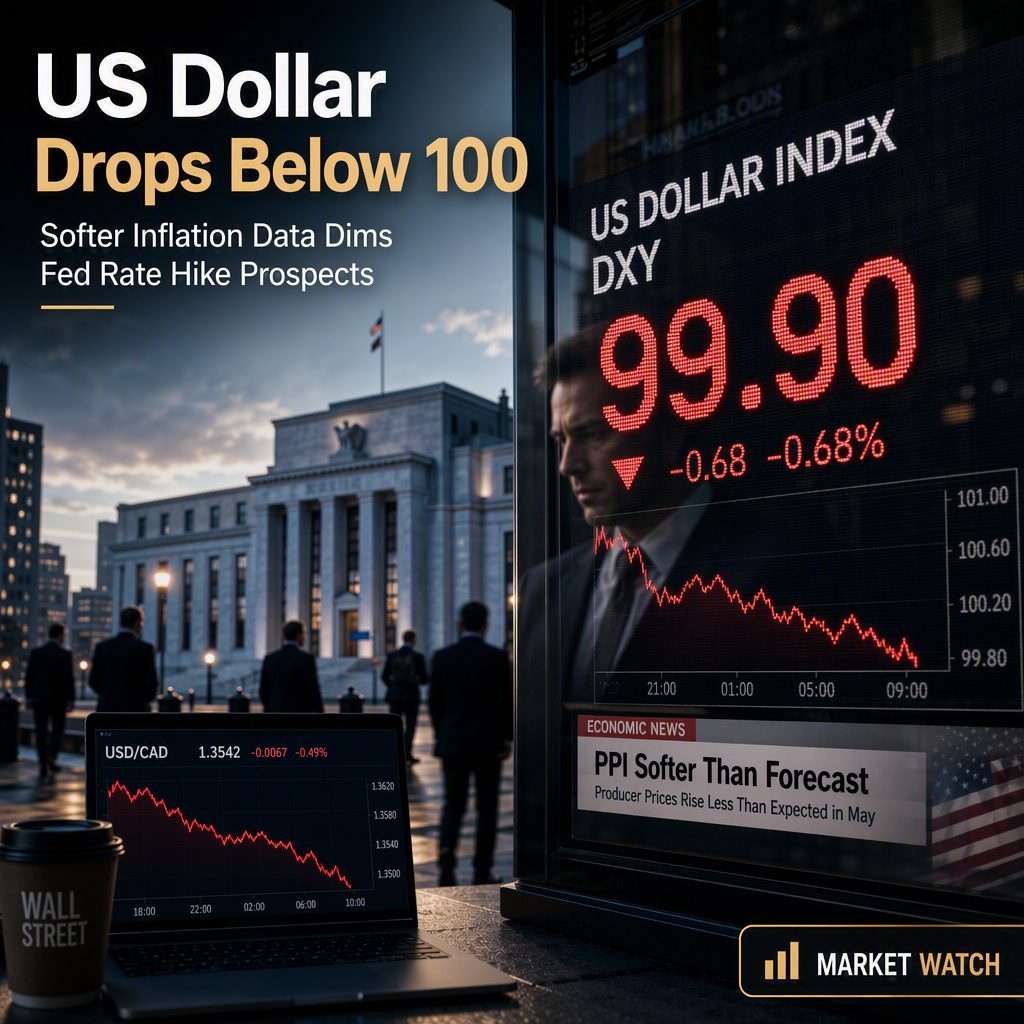
The US Dollar Index (DXY) fell below the 100.00 mark, trading near 99.90 during Asian hours on Friday, as softer-than-expected US inflation data weighed on the currency [1]. The decline in the US Dollar was mirrored in the USD/CAD pair, which lost ground for the second consecutive day, trading around 1.3920, as the greenback weakened following the inflation report [2].
The Bureau of Labor Statistics reported that the US Producer Price Index (PPI) was unchanged in July, following a revised 0.1% decline in June, and below the market consensus of a 0.2% increase [1][2]. The core PPI, which excludes food and energy, rose 0.2% month-over-month in July, softer than the expected 0.3% gain [1][2]. On an annual basis, headline PPI climbed 4.7% year-over-year in July, while core PPI increased 4.2% over the same period [1][2]. These figures have led to a reduction in market expectations for a Federal Reserve rate hike at the September meeting, with the CME FedWatch Tool showing a 34.8% probability, down from 40% immediately after the PPI data release [1][2].
US Initial Jobless Claims rose to a seasonally adjusted 209,000 for the week ended August 8, up from 200,000 previously and above the 204,000 estimate [1]. Fed Bank of Richmond President Tom Barkin stated that it remains an "open question" whether further monetary tightening will be needed to bring inflation back to target, or if inflation is already on a downward path, highlighting ongoing policy uncertainty [1]. Rabobank’s Jane Foley noted that recent US data has set back Fed rate hike speculation, opening the prospect of further downside for the Dollar, though she cautioned that a spike in oil prices could reverse this trend [1].
On the oil front, prices edged lower as investors monitored diplomatic efforts to reopen the Strait of Hormuz, with crude continuing to flow out of the Persian Gulf despite ongoing risks [2]. The US claims that up to 9 million barrels of oil per day are currently transiting the strait, aided by increased US naval escorts [2]. TD Securities commented that while near-term momentum in oil has eased, fundamental tightness in crude and product markets should ultimately support further upside, suggesting the recent pullback is due to short-term dynamics rather than a change in supply-demand fundamentals [2].
CONCLUSION
Softer US PPI data has reduced expectations for a Federal Reserve rate hike in September, leading to a weaker US Dollar and impacting currency pairs such as USD/CAD. While the immediate outlook for the Dollar is bearish, ongoing uncertainty around inflation and oil market dynamics could influence future moves. Market participants remain cautious ahead of upcoming US retail sales data and developments in the energy sector.