
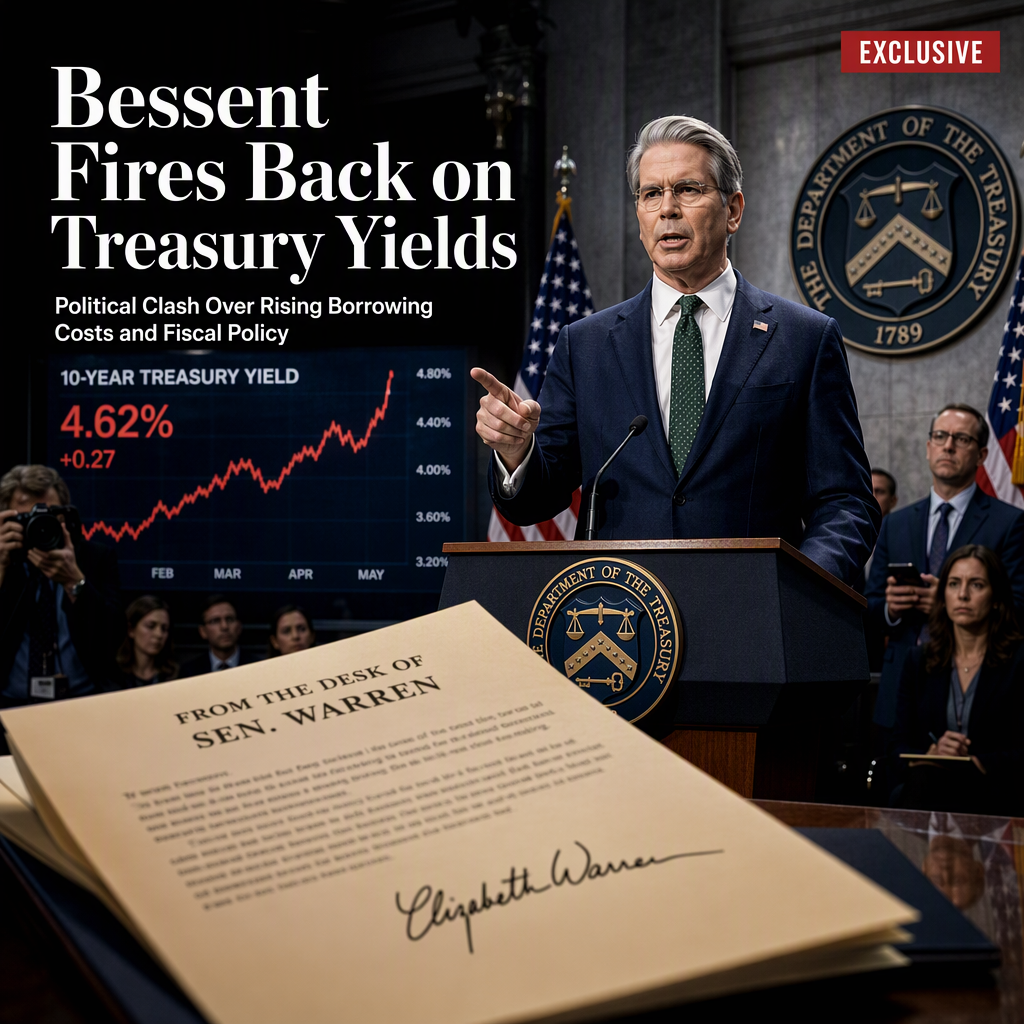
Treasury Secretary Scott Bessent issued a pointed response to Senator Elizabeth Warren's letter regarding the recent rise in the 10-year Treasury yield, which FOX Business obtained exclusively [1]. Warren, who has sent over 100 letters to the Treasury Department in the past 21 months, requested information on what the Trump Administration is doing to lower borrowing costs for average Americans, specifically referencing the surge in Treasury yields and its impact on the economy [1]. She accused the Treasury secretary of increasing costs, attributing the rise in yields to the Federal Reserve's decision to raise the federal funds rate by a quarter of a percentage point due to inflation concerns [1]. Warren also criticized the One Big Beautiful Bill, claiming its tax cuts would add $4.7 trillion to the national debt over a decade and primarily benefit the ultra-wealthy and large corporations, while cutting health care and food assistance for families [1]. She further noted that the Iran war has cost taxpayers an estimated $43.6 billion to date, according to the Pentagon [1].
Bessent refuted Warren's characterization, stating that her concerns were insincere and accusing her of lacking knowledge about financial markets. He pointed out that as the federal funds rate climbed from near zero to its highest level in 22 years, with inflation reaching a 40-year high, Warren supported the Biden Administration's spending policies, which he described as reckless [1]. Bessent argued that Warren blamed the economic consequences on the Federal Reserve rather than her own fiscal policies and criticized her support for a $5 trillion tax hike on Americans [1]. He defended the Working Families Tax Cuts, claiming they continue to deliver for families and workers across the country [1].
In addition to addressing Warren's concerns about Treasury yields, Bessent announced a new set of sanctions against Iran, describing them as "an economic D-Day," during an event at the Treasury Department on August 24 [1]. The letter concluded with Bessent offering Warren a "Foreign Exchange for Dummies tutorial" and a handwritten note wishing her a Happy Indigenous Peoples' Day, highlighting the personal and academic rivalry between the two, as Warren is a former Harvard Law professor and Bessent previously taught economic history at Yale [1].
No specific market reactions or analyst opinions were discussed in the article. The exchange between Bessent and Warren underscores ongoing political tensions regarding fiscal policy, inflation, and the impact of government spending on Treasury yields [1].
CONCLUSION
The exchange between Treasury Secretary Bessent and Senator Warren highlights deep political divisions over fiscal policy and the causes of rising Treasury yields. While Warren attributes the surge to Federal Reserve actions and government spending, Bessent defends current policies and criticizes Warren's economic understanding. The debate signals continued scrutiny of fiscal decisions and their impact on borrowing costs, but no immediate market reaction was reported.