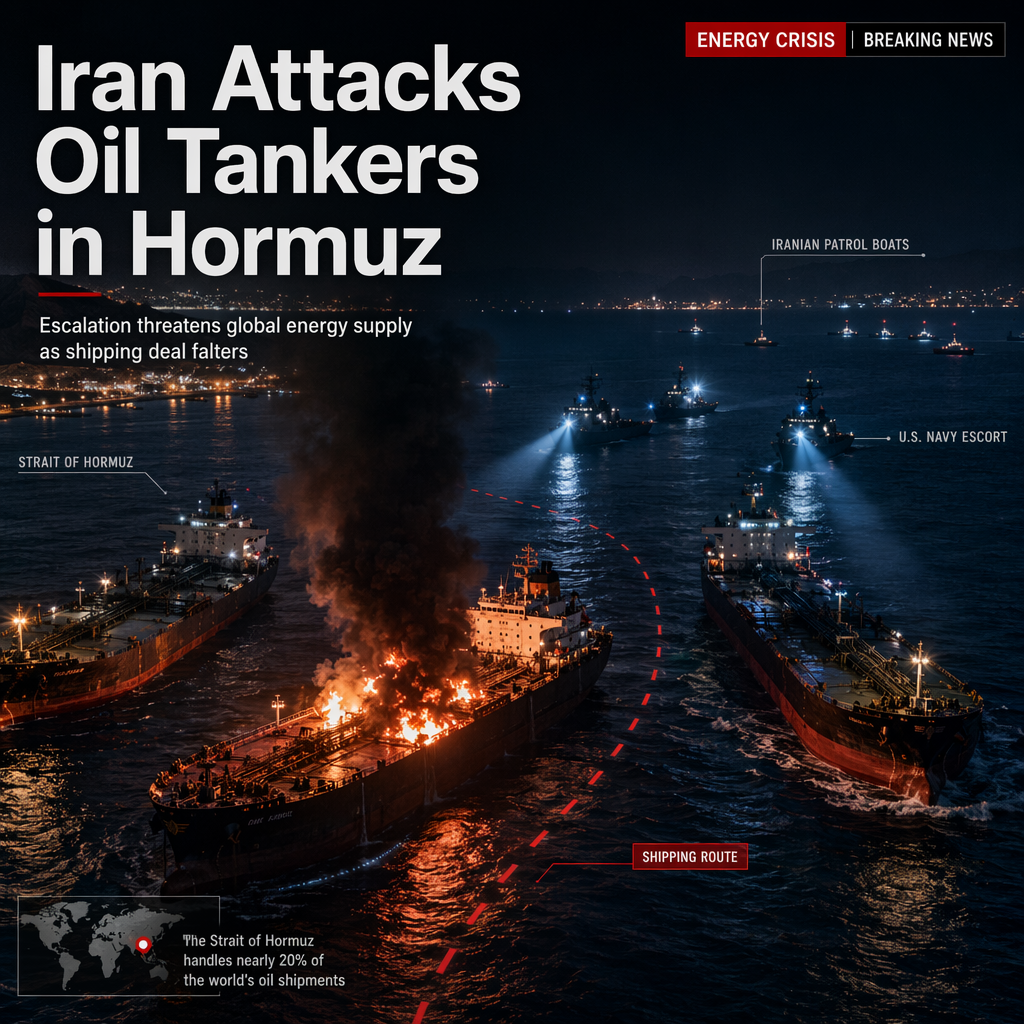
This week, Iran attacked three oil tankers navigating the Strait of Hormuz via a U.S.-protected southern corridor, escalating tensions in the region and threatening the security of a critical global oil transit route [1]. The attacks are seen by analysts as an effort by Iran to destabilize the southern shipping lane, which allows oil and gas tankers to exit the Persian Gulf without passing through Iranian-controlled waters, and to reassert its influence over the strait [1]. The U.S.-Iran deal, intended to open the Strait of Hormuz, left the specific shipping routes undefined, resulting in competing Iranian-controlled and U.S.-protected corridors [1].
According to senior U.S. officials, military escorts have enabled between 5 million and 8 million barrels per day of oil to exit Hormuz, though this remains well below the pre-war level of 20 million barrels per day [1]. Under the interim agreement, Iran promised safe passage for commercial ships and agreed not to charge tolls for 60 days, in exchange for the U.S. lifting its naval blockade and temporarily easing sanctions on Iranian oil sales [1]. However, Tehran has insisted that safe passage applies only to ships using the northern route through Iranian territorial waters, while the U.S. and its Gulf allies have increased exports via the southern corridor with U.S. military support [1].
U.S. Energy Secretary Chris Wright stated on June 24 that "Iran will not have the ability to close the Strait of Hormuz going forward," emphasizing that the U.S. military is committed to keeping the strait open regardless of the deal [1]. Maritime intelligence analysts describe the recent fighting as "the most significant escalation of the conflict since its opening phase" earlier in the year [1]. The attacks are part of what analysts call a "sporadic targeted campaign" by Iran to destabilize the southern corridor and send a message to Gulf State producers not using the northern route [1].
The ambiguity in the U.S.-Iran deal, particularly regarding the undefined shipping routes, has contributed to the current escalation. While the deal's fifth paragraph states that Tehran will "make arrangements using its best efforts" to ensure safe passage, the lack of clarity has allowed both sides to interpret the agreement differently, fueling renewed conflict in the region [1].
CONCLUSION
The recent Iranian attacks on tankers in the Strait of Hormuz have significantly escalated tensions and highlighted the fragility of the U.S.-Iran shipping agreement. With oil exports through the strait still below pre-war levels and the security of key shipping lanes in question, the market faces heightened uncertainty over energy supplies from the region.