
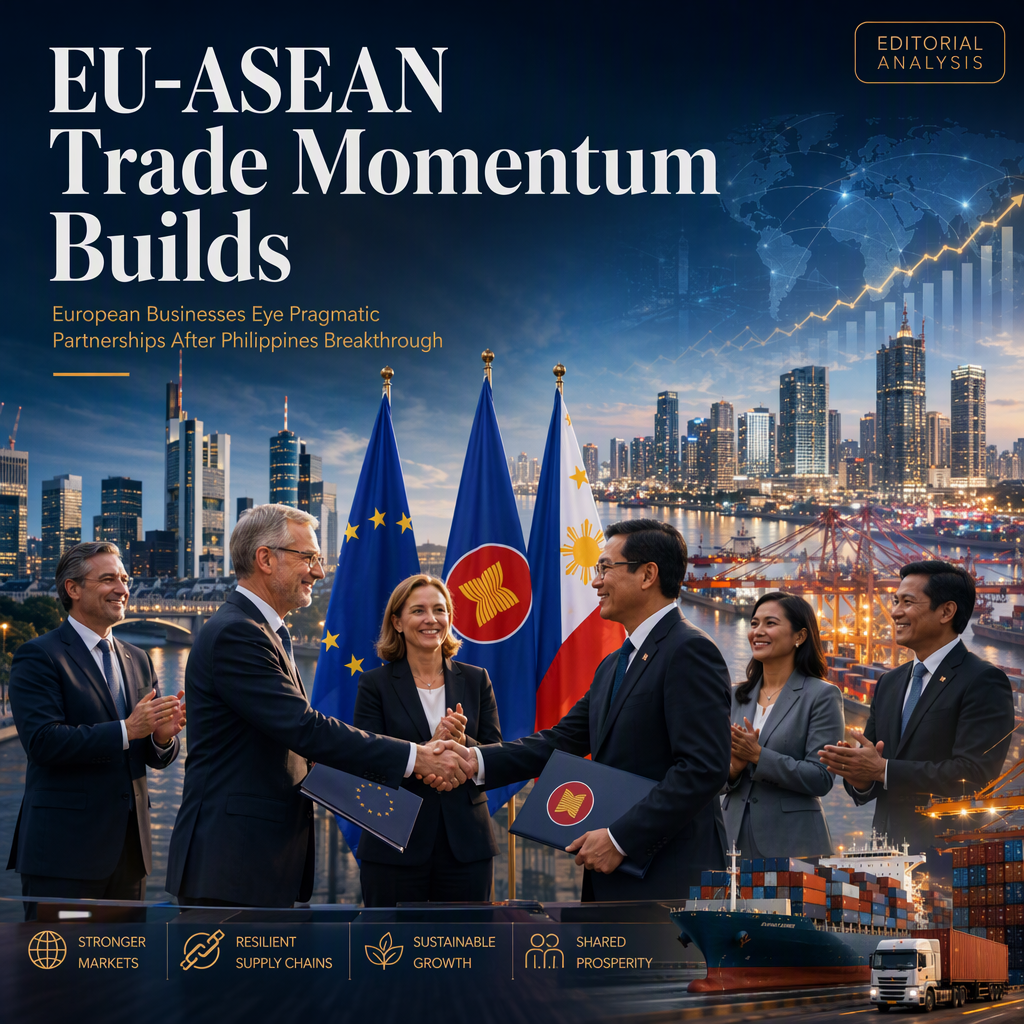
European businesses are urging the European Union to pursue a comprehensive region-to-region trade agreement with ASEAN, following the recent breakthrough in the EU's free trade deal with the Philippines last week [1]. This development is seen as a strategic move by Brussels to diversify its trade and political relationships, particularly in light of ongoing global tensions and supply chain disruptions [1]. Industry bodies have praised the EU-Philippines agreement as evidence of Brussels' willingness to adopt a more pragmatic approach in Asia, prioritizing economic opportunities and supply chain resilience over strict adherence to rights reforms [1].
The European Chamber of Commerce stated, 'The Philippines agreement sets a precedent for broader EU-ASEAN engagement,' emphasizing that European companies are eager for Brussels to focus on trade pragmatism given the current geopolitical climate [1]. ASEAN, with its collective market of over 650 million people, is viewed as a key region for European businesses seeking to reduce reliance on China and tap into fast-growing economies [1].
Negotiations between the EU and Thailand are ongoing, and European businesses anticipate that Brussels will continue to seek similar agreements with other ASEAN countries [1]. While human rights and political reforms remain topics of discussion, industry groups argue that economic cooperation should be the primary focus to ensure supply chain and market resilience [1].
European businesses have also warned that delays in concluding broader EU-ASEAN agreements could allow competitors from other regions to gain a stronger presence in ASEAN markets [1]. No specific financial values, market analysis, or ticker symbols were mentioned in the article [1].
CONCLUSION
European businesses view the EU-Philippines trade deal as a catalyst for broader EU-ASEAN economic cooperation and are pressing for accelerated negotiations. The prevailing sentiment is that prioritizing trade pragmatism is essential for maintaining European competitiveness and mitigating global supply chain risks.