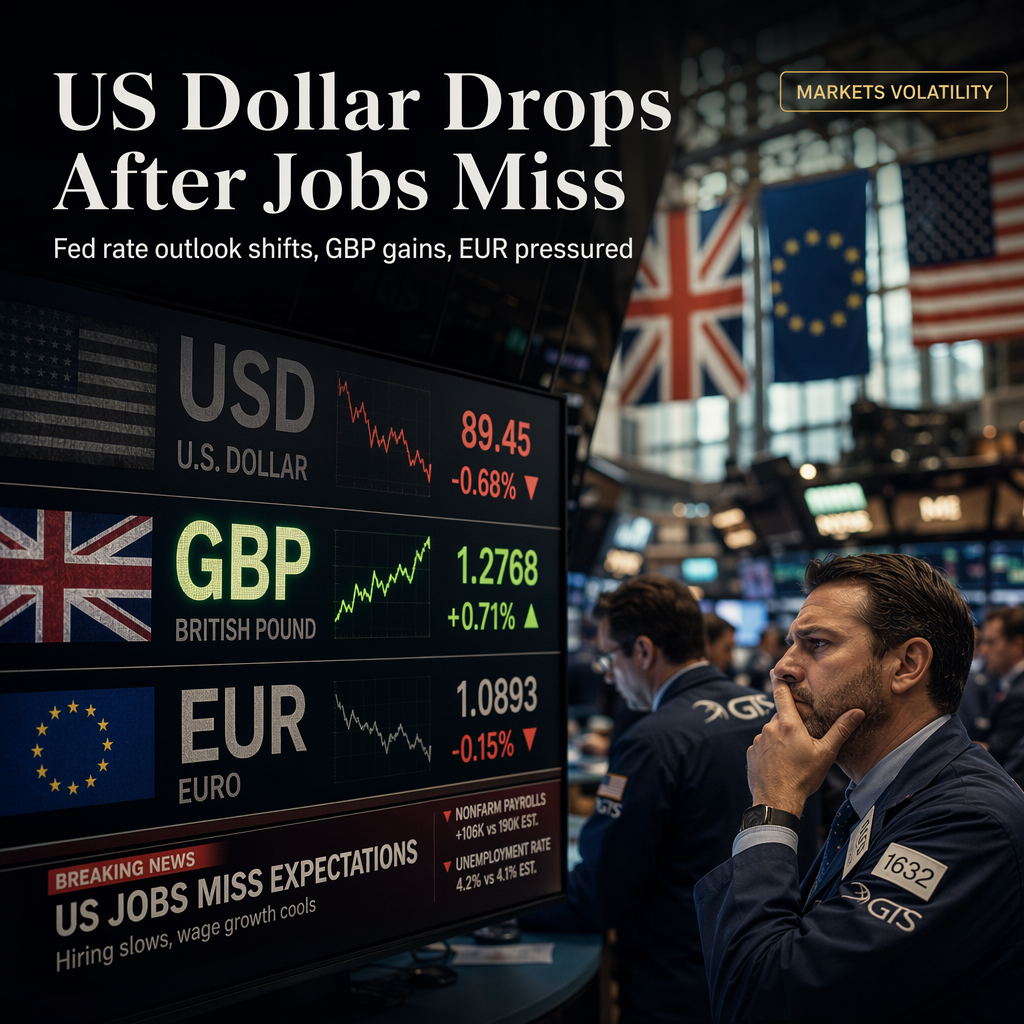
The US Dollar experienced notable movement against both the British Pound and the Euro following the release of weaker-than-expected US Nonfarm Payrolls (NFP) data for June. According to the US Bureau of Labor Statistics, the US economy added 57,000 jobs in June, significantly below the market consensus of 110,000 jobs [1][2]. The Unemployment Rate, however, fell to 4.2% from 4.3% in May [1][2]. This data, coupled with a prior report showing US private payrolls also increased less than expected, signaled a cooling US labor market [1][2].
In response, the GBP/USD pair traded with mild gains near 1.3350 during early Asian trading hours on Friday, as the weaker US jobs report weighed on the US Dollar [1]. Financial markets adjusted their expectations for US Federal Reserve policy, with the probability of a rate hike by September dropping to nearly 52%, down from 66% before the jobs data, according to the CME FedWatch tool [1].
Meanwhile, the EUR/USD pair declined to around 1.1420, pressured by a softer Eurozone inflation outlook and diminishing expectations for aggressive European Central Bank (ECB) rate hikes [2]. Eurozone headline CPI fell to 2.8% year-over-year in June from 3.2% in May, while core inflation dropped to 2.4% from 2.6% [2]. Financial markets now see only a one-in-three chance of a July ECB rate hike, though a move by October is fully priced in [2]. ECB policymakers, including Maltese central bank chief Alexander Demarco, cautioned against rushing further hikes due to the rapid retreat in oil prices [2]. ECB President Christine Lagarde stated that the ECB was correct to raise rates last month and is closely monitoring the risk of second-round effects, though none have materialized so far [2].
On the UK front, traders are also monitoring political developments following Keir Starmer's resignation, with analysts from Natixis noting that Burnham's commitment to fiscal discipline offers near-term support, but future budgets will be scrutinized for any relaxation of fiscal rules [1]. The Bank of England is set to meet later this month, with economists predicting no change in interest rates, though money markets show a 90% chance of a hike by year-end [1].
Overall, the combination of disappointing US labor data and shifting central bank expectations in both the Eurozone and UK has led to significant currency market volatility, with the US Dollar weakening against the Pound but strengthening against the Euro due to differing inflation and policy outlooks [1][2].
CONCLUSION
Weaker-than-expected US jobs data has prompted a reassessment of Federal Reserve rate hike expectations, resulting in a softer US Dollar against the British Pound but a firmer stance against the Euro amid softer Eurozone inflation. Central bank policy outlooks and upcoming political and economic developments in the UK and Eurozone remain key factors for currency markets in the near term.