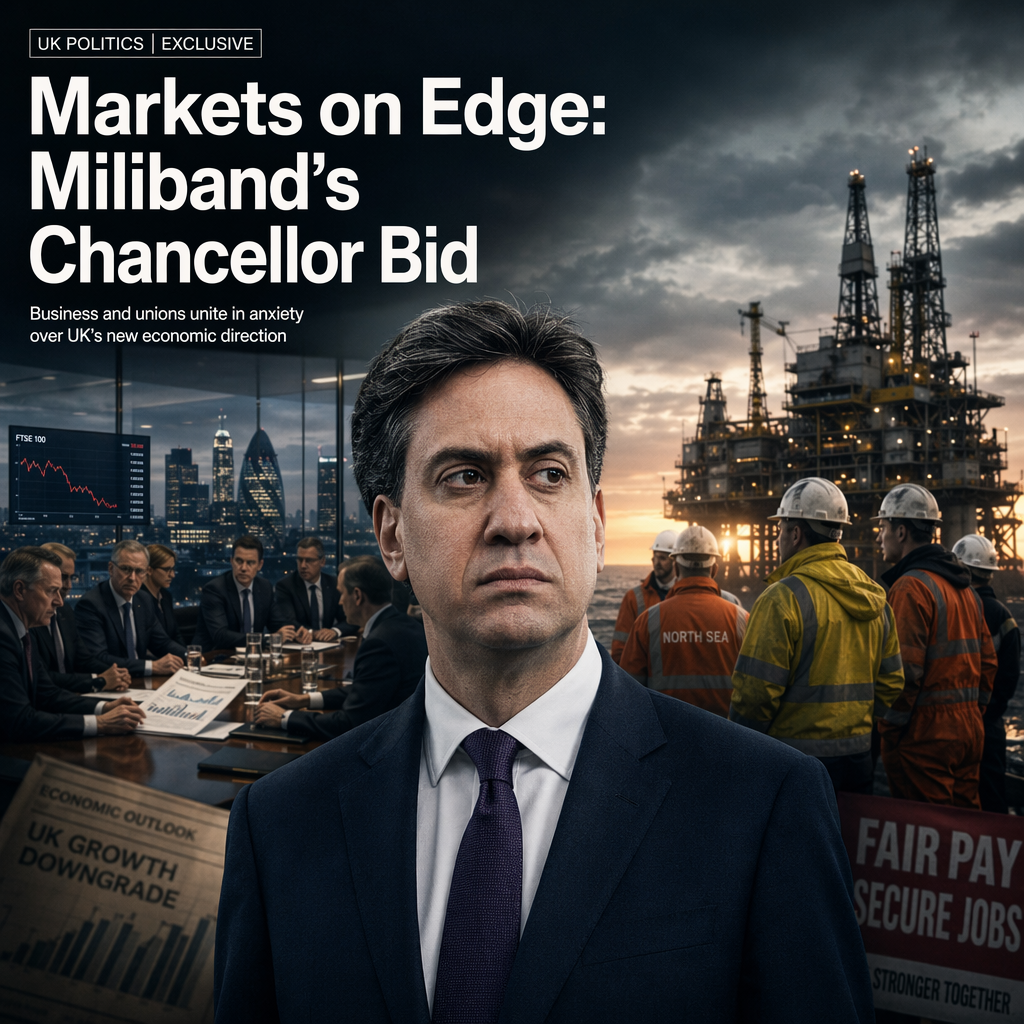
The appointment of the next chancellor of the Exchequer by incoming UK prime minister Andy Burnham is being closely watched by both the private sector and political observers, as it will signal Burnham's governing intentions and priorities [1]. Ed Miliband, currently serving as energy secretary and a key figure in the recent coup that led to Keir Starmer's resignation, is considered the overwhelming favorite in betting markets for the role [1]. However, his potential appointment is causing significant concern among FTSE-100 chairs and chief executives, who privately express horror at the prospect due to Miliband's reputation as deeply anti-business and less committed to fiscal discipline compared to the outgoing chancellor, Rachel Reeves [1].
Miliband's anti-business image stems from his career spent almost entirely in politics, as well as his refusal to issue new oil and gas exploration licenses—a Labour policy at the last election—and his reluctance to approve the Jackdaw and Rosebank oil fields in the British North Sea [1]. He argues that these projects would not improve Britain's energy self-sufficiency, but critics, including Scottish Labour MPs, contend that ruling out domestic production is illogical when the alternative is importing oil and gas, and it risks thousands of well-paid jobs [1]. This issue has political ramifications, as the Conservatives recently won a by-election in Aberdeen South by focusing on North Sea oil and gas policy [1].
Additionally, Miliband faces mistrust from trade unions, despite Labour's historical ties to organized labor. Sharon Graham, general secretary of Unite, Britain's second-largest union, warned that appointing Miliband as chancellor would put "a noose around" Labour's relationship with its biggest paymasters [1]. The incumbent chancellor, Rachel Reeves, is not expected to remain in the post, despite her desire to do so, as Burnham is likely to reward his supporters with key appointments [1].
Market participants are interpreting the potential appointment of Miliband as a signal of a shift away from fiscal discipline and business-friendly policies, raising concerns about the future direction of UK economic policy [1].
CONCLUSION
The possibility of Ed Miliband becoming the UK's next chancellor is generating significant anxiety among business leaders and trade unions, with concerns about his perceived anti-business stance and reluctance to support domestic oil and gas production. The market is closely watching Burnham's decision, as it will set the tone for the new government's economic policy and its relationship with both the private sector and organized labor.