
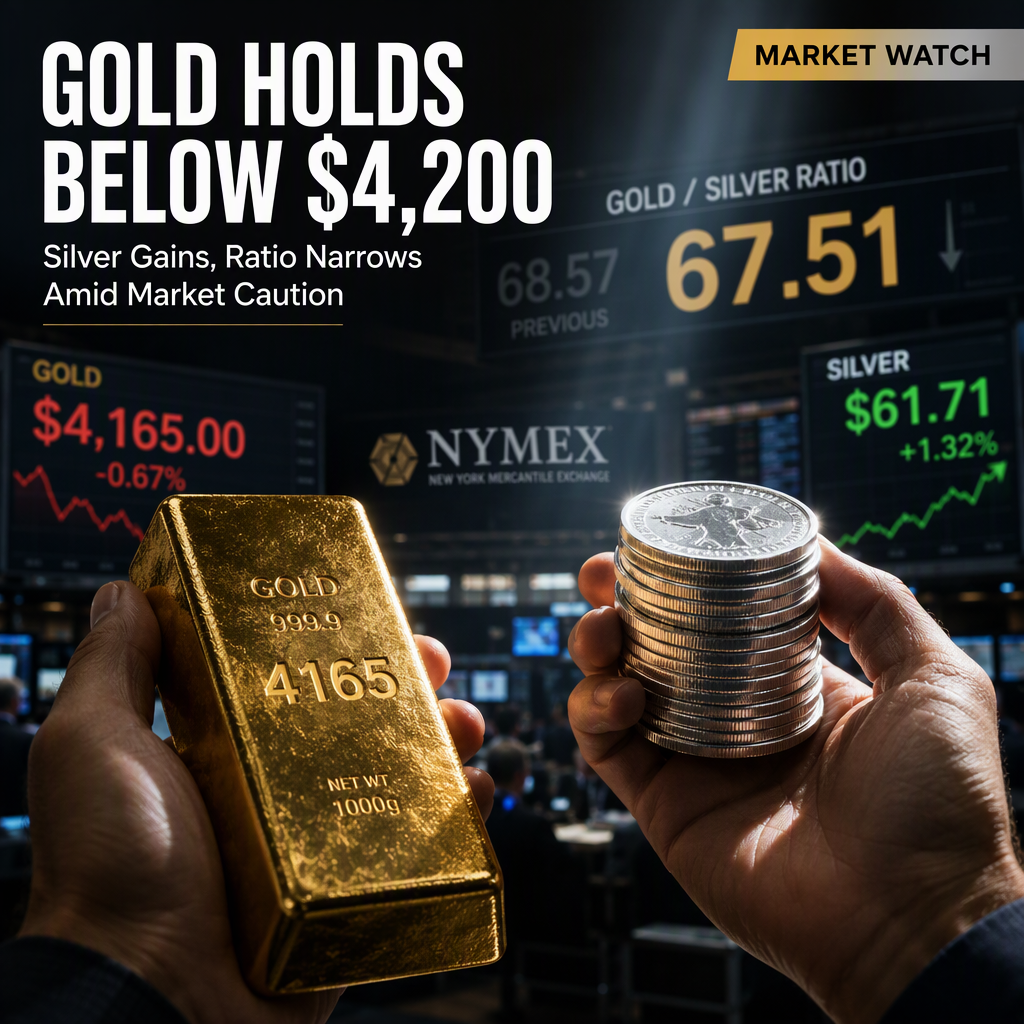
Gold (XAU/USD) trimmed some losses on Monday but remained confined below the $4,200 mark, with recent price action showing a near-term bearish trend and the metal trading at $4,165. The price is capped below a previous support level at $4,230, which also serves as the neckline of a bearish Head & Shoulders pattern. Gold recently touched two-month lows at $4,110, and technical indicators suggest only mild bullish momentum, with the Relative Strength Index (14) just below the midpoint and a moderately positive MACD. Immediate resistance is at $4,230, with further resistance at $4,315 and $4,500, while support lies at $4,110, $4,000, and $3,950 [1].
The gold market has been influenced by high US Treasury yields, which have limited upside attempts despite a recent pullback in the US Dollar Index (DXY). Disappointing US labor market data on Friday cooled expectations for Federal Reserve monetary tightening in October, with futures markets now pricing in an 80% chance that the Fed will keep rates unchanged, up from 30% a week ago. However, hopes for a December rate hike remain largely unchanged. The risk-averse market mood amid a global bond sell-off has offset the negative impact of a softer monetary tightening path. The US Dollar is also drawing support from Euro weakness as France’s borrowing costs escalate, though some analysts warn that a debt crisis could negatively impact the USD. According to DBS Group, 'Higher yields driven by Fed tightening can support the USD. Higher term premia driven by concerns over debt supply, fiscal sustainability, and Treasury-market credibility need not' [1].
In contrast, silver (XAG/USD) prices rose on Monday, trading at $61.71 per troy ounce, up 2.13% from $60.43 on Friday. Despite this daily gain, silver prices have decreased by 13.18% since the beginning of the year. The Gold/Silver ratio narrowed to 67.51 on Monday from 68.57 on Friday, indicating that silver outperformed gold on the day [2].
No forward-looking statements or analyst opinions specific to silver's future price direction were provided in the sources. However, the articles note that silver prices tend to follow gold's moves, and the Gold/Silver ratio is often used by investors to gauge the relative valuation between the two metals [2].
CONCLUSION
Gold remains under pressure below $4,200 amid high US yields and a risk-averse market, while silver saw a notable daily rebound, narrowing the Gold/Silver ratio. The market is closely watching US monetary policy expectations and global bond market developments for further direction. Overall, sentiment remains cautious for gold, with silver showing short-term relative strength.