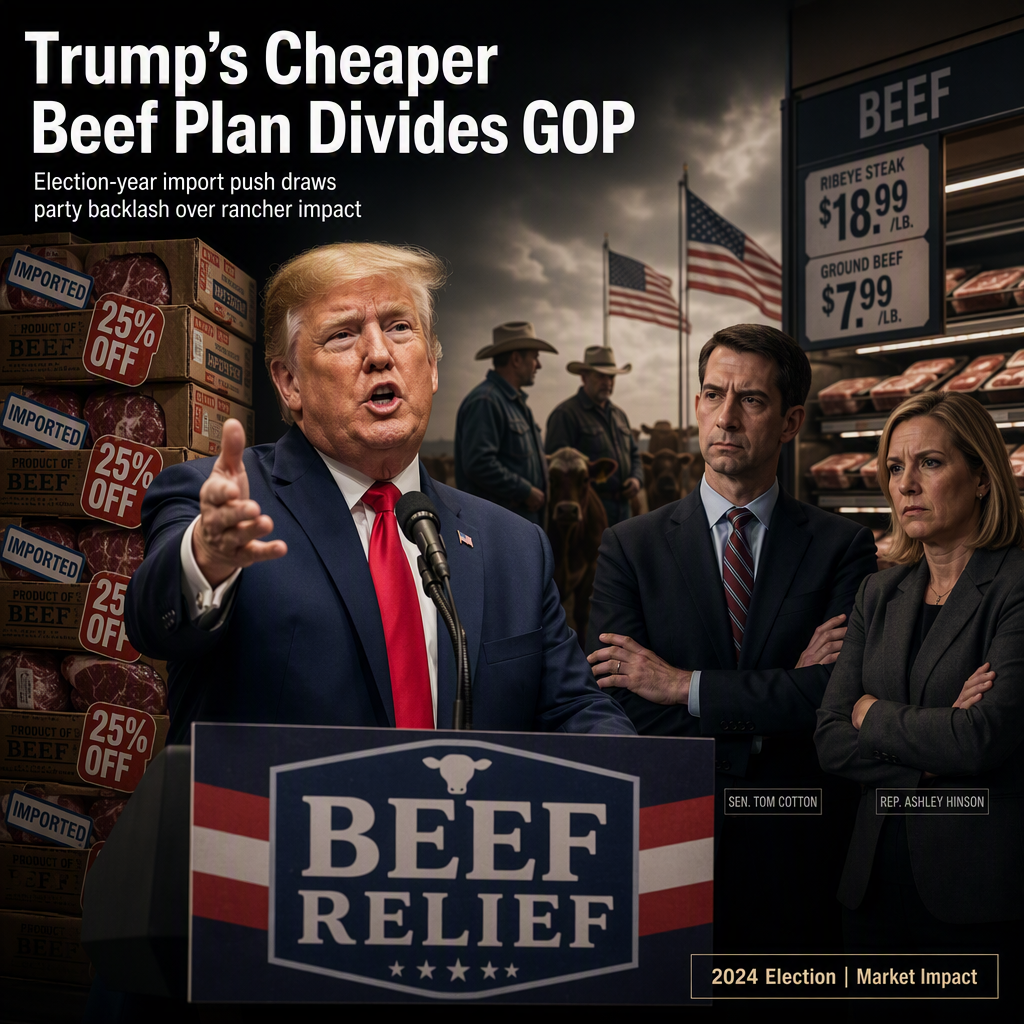
President Donald Trump has announced a plan to import 300,000 metric tons of ground beef into the United States, aiming to sell it at 25% below current market prices over a 90-day period in order to address soaring grocery bills for Americans [1]. This move comes as ground beef prices have reached approximately $7 per pound, with the U.S. cattle herd at historic lows not seen since the 1950s, according to the U.S. Department of Agriculture [1]. Trump defended his plan, stating, 'That’s what the voters want, and that’s what I want,' and emphasized the need to help ranchers bring prices down [1].
However, several Senate Republicans, particularly those facing tight re-election races, have voiced strong opposition to the plan. Sen. Tom Cotton, R-Ark., a close Trump ally, argued that importing beef below market prices would 'put more pressure on our cattlemen' and urged Trump to reconsider, advocating instead for growing the domestic herd and letting the market work [1]. Rep. Ashley Hinson, R-Iowa, who is running in a highly competitive race, also criticized the plan, calling it 'a bad idea' despite her desire to lower prices [1]. Other incumbents, such as Sen. Mike Rounds, R-S.D., and Sen. Pete Ricketts, R-Neb., expressed concerns that the policy would hurt local producers and warned that 'short-term policy shifts do not equal long-term solutions' [1].
The plan has not specified which countries the imported beef would come from, though earlier this year Trump signed an executive order allowing 80,000 metric tons of beef trimmings from Argentina to enter the U.S. market [1]. Previous similar directives have also sparked private discontent among Senate Republicans, including a closed-door meeting with Vice President JD Vance [1].
The political implications are significant, as affordability and grocery prices have become central issues for voters, and the Cook Political Report recently rated the Iowa Senate race as a toss-up [1]. The Republican backlash highlights a divide within the party, with some prioritizing support for domestic cattlemen and others focused on immediate consumer relief [1].
CONCLUSION
Trump's beef import plan has triggered strong opposition from key Republican figures, especially those in competitive races, who warn of negative impacts on domestic cattle producers. While the initiative aims to lower grocery prices for consumers, it has intensified intra-party tensions and raised questions about long-term solutions for the beef market. The controversy is likely to remain a focal point in upcoming elections, given its high market and political impact.