
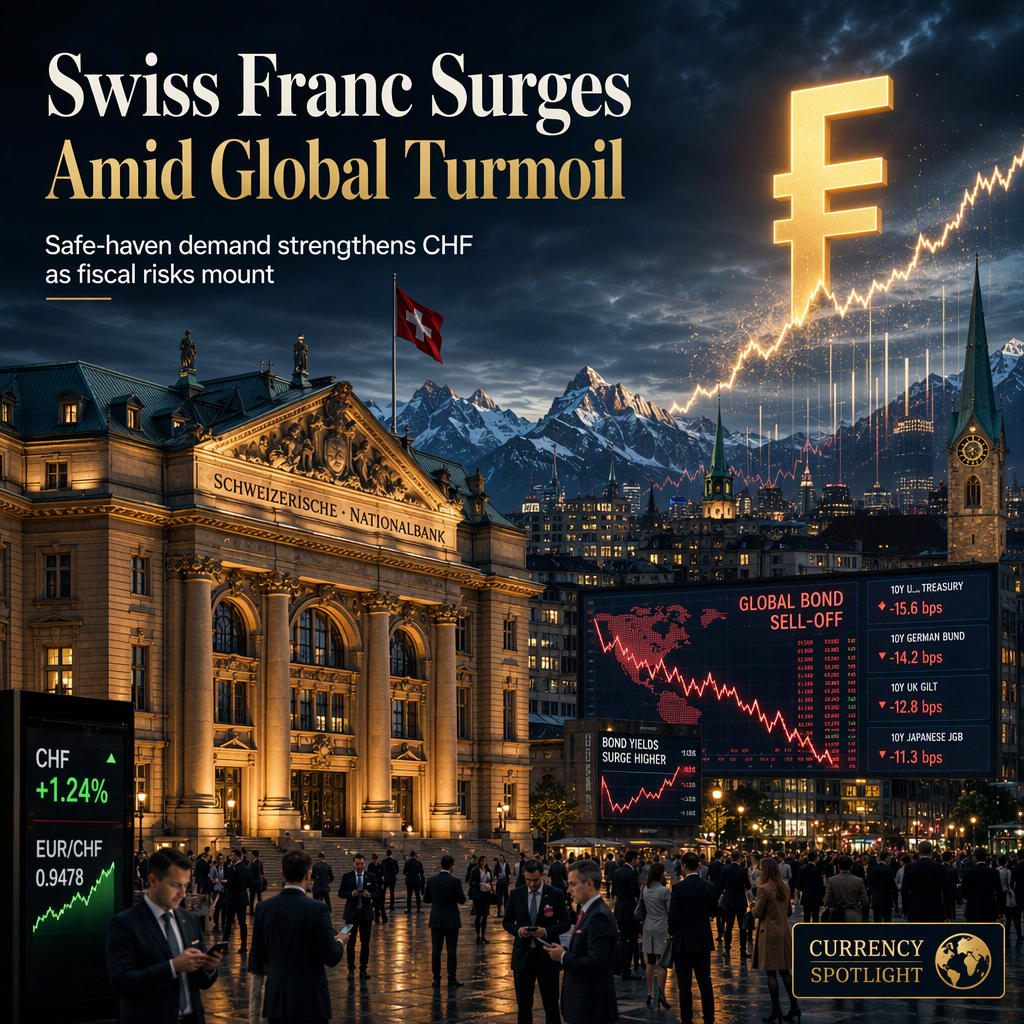
The Swiss Franc (CHF) has emerged as a safe-haven currency amid a global sell-off in government bonds, marking a notable recovery against the US Dollar (USD) this week. The USD/CHF pair dropped approximately 1.2% over the past two days, reaching daily lows at 0.8266 after previously hitting 16-month highs at 0.8382 earlier in the week [1]. This movement comes as risk aversion prevails, with global treasury yields rising and investors demanding higher returns due to escalating budget deficits and high energy prices, prompting most major central banks to tighten monetary policy [1].
Switzerland's fiscal position stands out in this environment, with a total net debt of CHF 149 billion, representing about 15% of the country's Gross Domestic Product (GDP). In comparison, France's debt has reached 119% of GDP, the US stands at 125%, and Japan's debt is well above 200% of GDP, raising concerns about potential credit crises in other economies [1]. The Swiss Franc's resilience is attributed to this low debt level, which has offset recent unfavorable monetary policy divergence that previously weakened the currency. The Swiss National Bank (SNB) has kept interest rates steady at 0% due to moderate inflation and an uncertain economic outlook, particularly amid trade tensions with the US. While global central banks are tightening, the SNB's low rates have attracted carry traders, posing risks to the CHF, but the currency has nonetheless rebounded [1].
Looking forward, analysts at Commerzbank suggest that fiscal concerns will increasingly influence FX dynamics into year-end, positioning the Swiss Franc to benefit from ongoing market uncertainty. They caution that periods of market stabilization may bring moments of CHF weakness, but assert that "the Franc has probably reached its low point in recent weeks and will not depreciate further in the near future" [1].
CONCLUSION
The Swiss Franc's recovery amid global bond market turmoil highlights its safe-haven status, supported by Switzerland's strong fiscal position. Analysts expect the CHF to remain resilient, with fiscal worries likely to drive further strength into year-end. Market participants should monitor global debt trends and central bank actions for future FX movements.