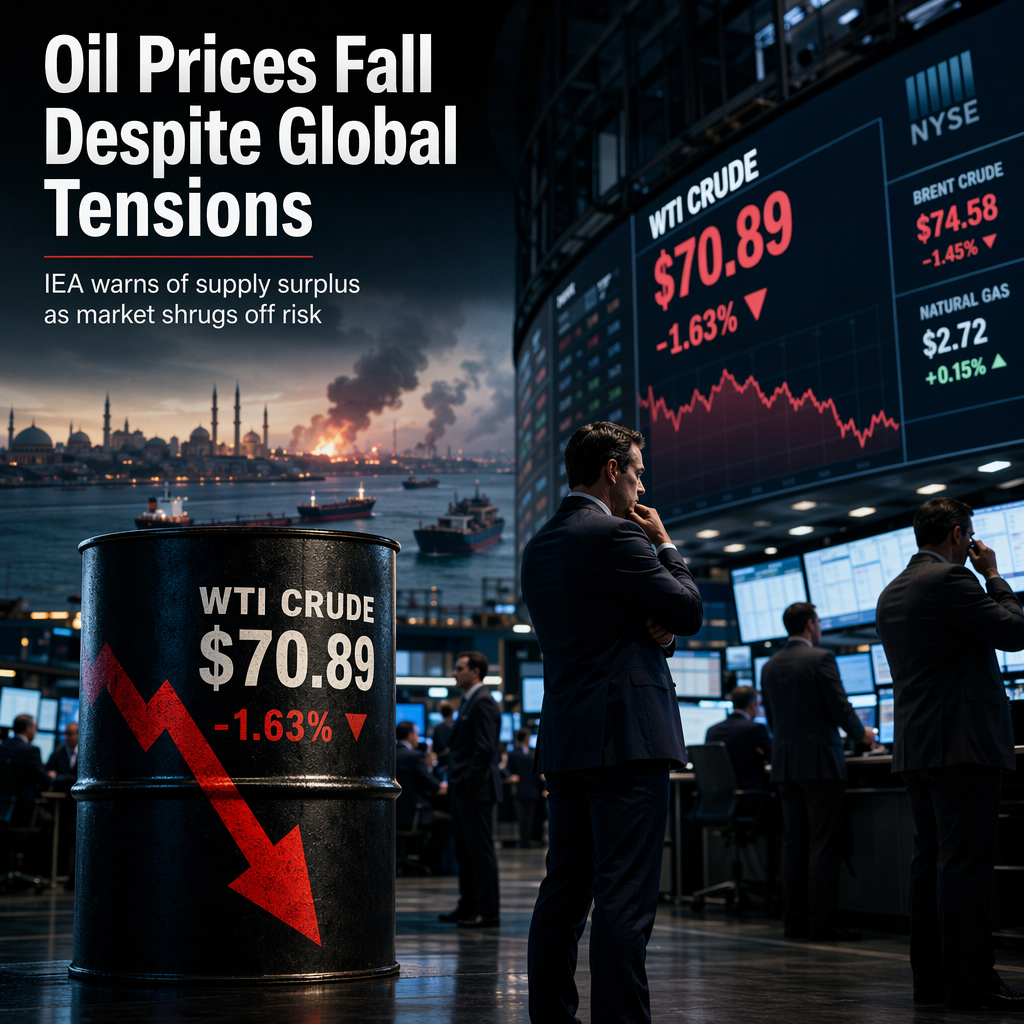
West Texas Intermediate (WTI) Crude Oil traded at $70.98 on Friday, marking a 1% decline after an earlier European-morning climb to $72.83 was quickly reversed by New York selling, driving prices to a session low of $70.70 within two hours [1]. Despite a backdrop of heightened geopolitical tensions—including over 170 US strikes on Iranian targets in two days, Iranian ballistic missile attacks on a base in Jordan, and disruptions to tanker traffic through the Strait of Hormuz—the market largely shrugged off these supply scare factors [1]. President Trump reiterated the end of the ceasefire on Friday, while Iranian sources denied rumors of new talks, even as diplomatic efforts by Qatar, Pakistan, Oman, and Turkey continued and Washington maintained that technical discussions were ongoing [1].
The market's reaction to these developments was muted, with each escalation generating diminishing price responses. Thursday's price action cooled on reports of potential negotiations, and Friday's brief push above $72.50 was short-lived, reflecting a market that had already erased its wartime premium in June and showed little interest in rebuilding it based on rhetoric alone [1].
The International Energy Agency (IEA) released its monthly report on Friday, projecting that global demand for crude oil and refined products will fall by 1 million barrels per day in 2026—the first annual decline since 2020—with the contraction most pronounced in the regions and products most affected by the Hormuz disruptions [1]. Supply has rebounded by 4.1 million barrels per day in June to reach 98.8 million, as flows through the Strait resumed, though output remains 9.4 million barrels per day below pre-war levels [1]. The IEA forecasts a return to surplus toward the end of the year and a significant overhang in 2027 if transit volumes continue to recover, though these projections depend on a lasting peace, which remains elusive [1].
Overall, the market appears to be discounting both geopolitical risks and bullish supply-demand narratives, with positioning and recent price action suggesting limited appetite for risk premiums absent concrete developments [1].
CONCLUSION
Crude oil prices declined despite escalating Middle East tensions and ongoing supply disruptions, as the market focused on bearish demand forecasts from the IEA and showed little interest in rebuilding risk premiums. The IEA's outlook points to a potential supply surplus by year-end and into 2027, contingent on peace in the region. Market sentiment remains cautious, with traders discounting both escalation and de-escalation headlines.