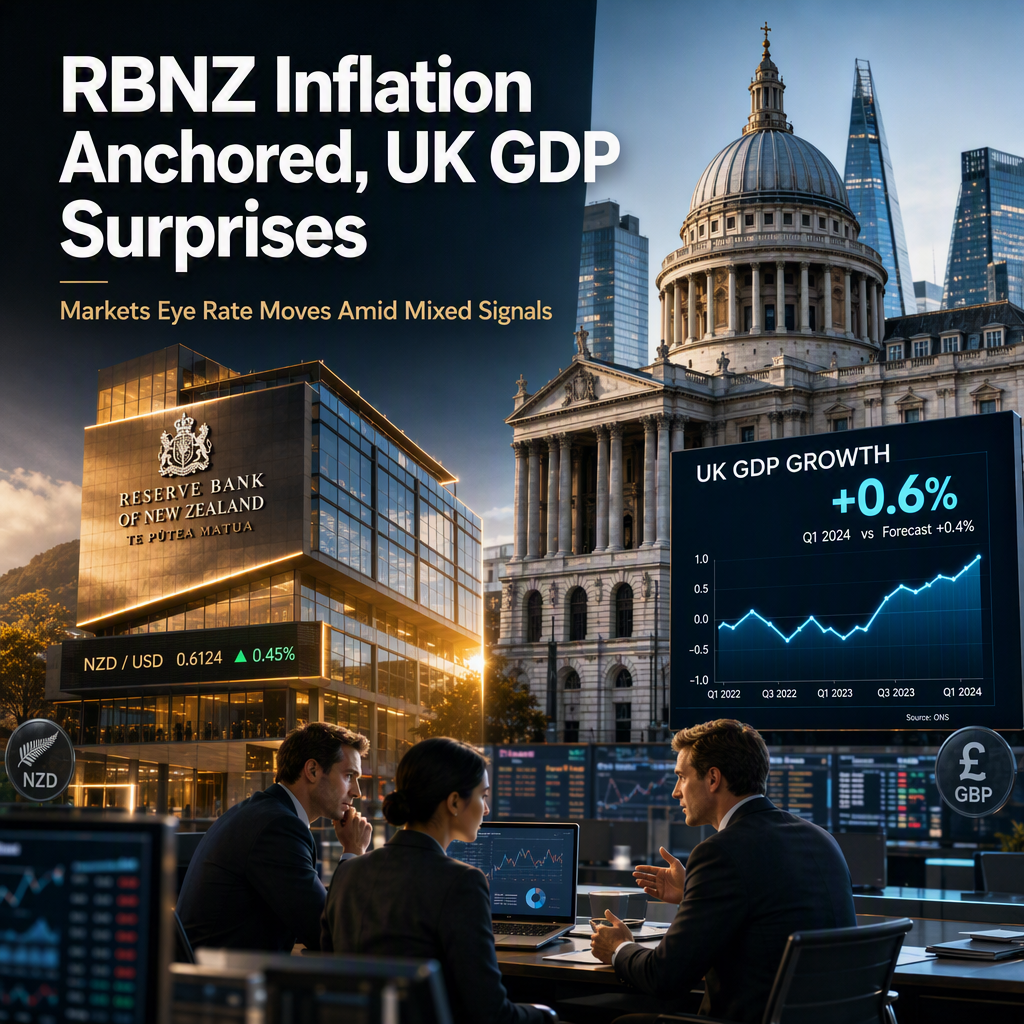
The Reserve Bank of New Zealand's (RBNZ) Q3 inflation expectations survey revealed that expectations remain well anchored near the central bank's 2% target midpoint, despite some mixed signals. Specifically, one-year-ahead annual CPI inflation expectations decreased by 81 basis points to 2.60%, two-year-ahead expectations fell by 19 basis points to 2.34%, while five-year and ten-year expectations edged up to 2.31% and 2.20%, respectively. These results underscore the RBNZ's credibility in managing inflation expectations, even as actual inflation remains above target levels. Brown Brothers Harriman’s (BBH) Elias Haddad notes that with stronger domestic growth and the policy rate near the lower end of the RBNZ’s neutral range (2.20%-4.10%), there is a case for additional rate hikes. The swaps market is fully pricing in 75 basis points of tightening over the next twelve months, which is seen as supportive for the New Zealand Dollar (NZD) [1].
In contrast, the United Kingdom's Q2 and June GDP data showed encouraging economic activity, with real GDP rising 0.4% quarter-on-quarter, in line with consensus and slightly above the Bank of England’s (BoE) 0.3% forecast. Growth was primarily driven by gross fixed capital formation (+0.24 percentage points) and household consumption (+0.16 percentage points), while government spending detracted from growth (-0.06 percentage points) due to declines in health and education. Notably, monthly real GDP in June beat expectations, increasing by 0.3% month-on-month (consensus: -0.1%), entirely due to a 0.4% rise in services output. Despite these positive data points, BBH’s Haddad believes that the GDP prints are unlikely to influence BoE rate expectations, with the upcoming July CPI report seen as more significant for policy direction [2].
Market reactions to these developments were muted. NZD/USD briefly dipped below its 200-day moving average (0.5832) following the RBNZ survey, while GBP/USD traded directionless near 1.3500 in response to the UK GDP data [1][2].
Analyst commentary from BBH highlights that while New Zealand's inflation expectations and domestic growth support the case for further RBNZ tightening, the UK’s solid GDP performance is not expected to alter the BoE’s policy outlook in the near term, with inflation data remaining the key focus [1][2].
CONCLUSION
The RBNZ's well-anchored inflation expectations and stronger domestic growth support the case for additional rate hikes, with markets fully pricing in further tightening. In the UK, despite better-than-expected GDP data, the BoE is unlikely to shift its policy stance until more inflation data is available. Overall, the market impact is moderate, with currency pairs showing limited directional movement in response to the data.