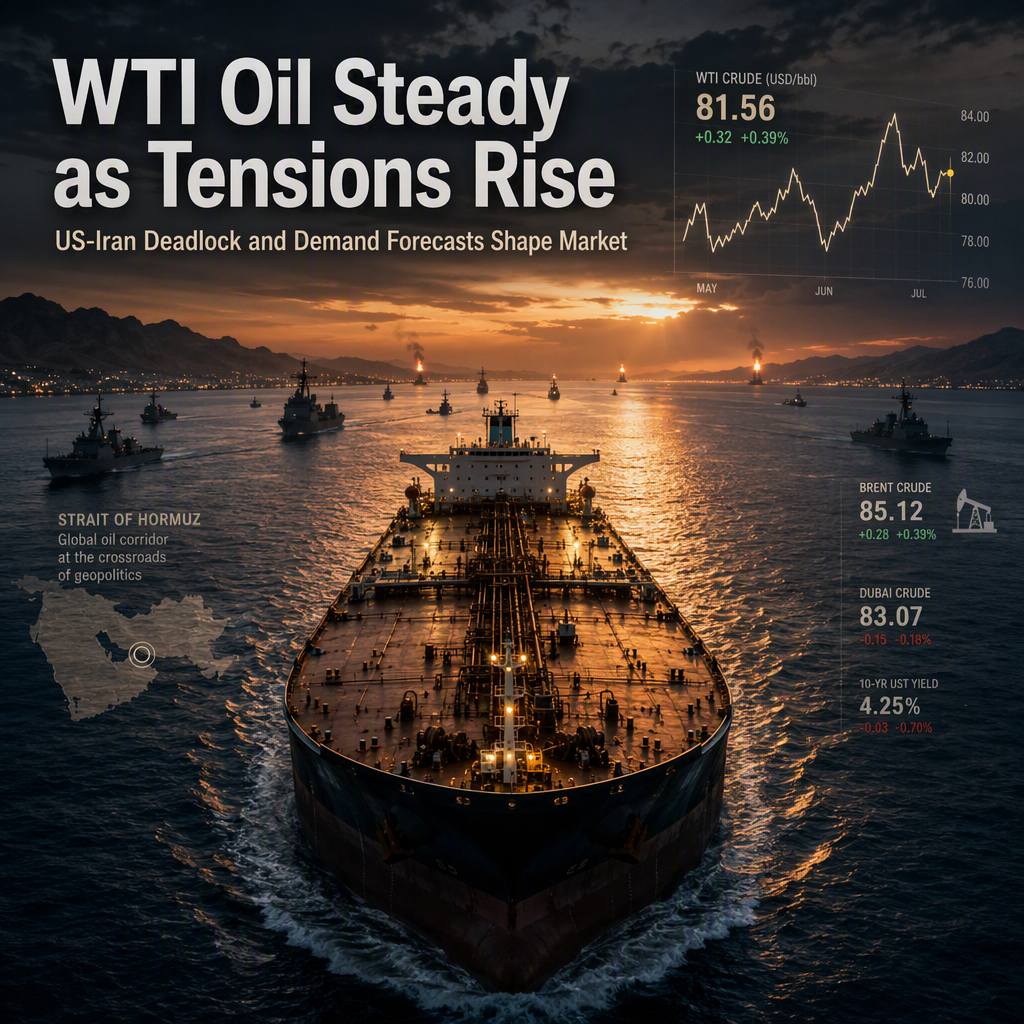
West Texas Intermediate (WTI), the US crude oil benchmark, traded around $81.60 during Asian hours on Monday, reflecting modest gains as traders assessed the ongoing deadlock in US-Iran negotiations regarding the reopening of the Strait of Hormuz [1]. Talks have stalled completely, with Iran’s Foreign Minister Abbas Araghchi confirming that 'no negotiations currently taking place between Tehran and Washington,' and emphasizing that the US must agree to Iran’s conditions for shipping to resume through the waterway [1]. Tensions escalated further after Iran’s Deputy Foreign Minister Kazem Gharibabadi responded to US President Donald Trump’s comments about the Strait of Hormuz, urging him to 'accept the reality of defeat and stop indulging in delusions' [1]. Regional instability was heightened as Israel struck Tehran-backed Hezbollah in Lebanon, marking the deadliest day of fighting in months [1]. Additionally, Russia is experiencing fuel shortages following Ukraine’s renewed near-daily attacks on oil refineries [1].
Market participants are awaiting the American Petroleum Institute (API) weekly crude oil report, due later on Tuesday. The report’s outcome could influence WTI prices: a larger-than-expected inventory draw would signal stronger demand and potentially lift prices, while a bigger build could indicate weaker demand or excess supply, undermining prices [1].
Commerzbank highlighted a softening oil demand outlook, noting that both the International Energy Agency (IEA) and OPEC have revised their forecasts for oil demand this year downward by 200,000 barrels per day [1]. The IEA now expects demand to fall by 1.6 million barrels per day, while OPEC still anticipates an increase of 580,000 barrels per day, underscoring a significant divergence in their consumption trend assessments [1]. On the supply side, the IEA projects oil supply from outside OPEC+ to rise by 690,000 barrels per day, potentially adding looseness to the market balance [1].
Technical analysis suggests WTI’s near-term tone is neutral to slightly constructive, with prices holding just above the Bollinger middle band but capped beneath the 100-day SMA at $86.38. The mid-range Relative Strength Index (RSI) reading around 53 indicates balanced momentum, pointing to a consolidative phase within a broader corrective structure. Initial resistance is at the 100-day SMA ($86.40), with the upper Bollinger band near $90.10 as a higher bullish trigger if buyers regain control. Immediate support is seen at the 20-day SMA/Bollinger mid [1].
CONCLUSION
WTI oil prices remain volatile but modestly positive amid geopolitical tensions and a deadlock in US-Iran talks. The market is awaiting key inventory data and is influenced by divergent demand forecasts from the IEA and OPEC. Near-term technicals suggest a neutral to slightly constructive outlook, with resistance and support levels closely watched by traders.