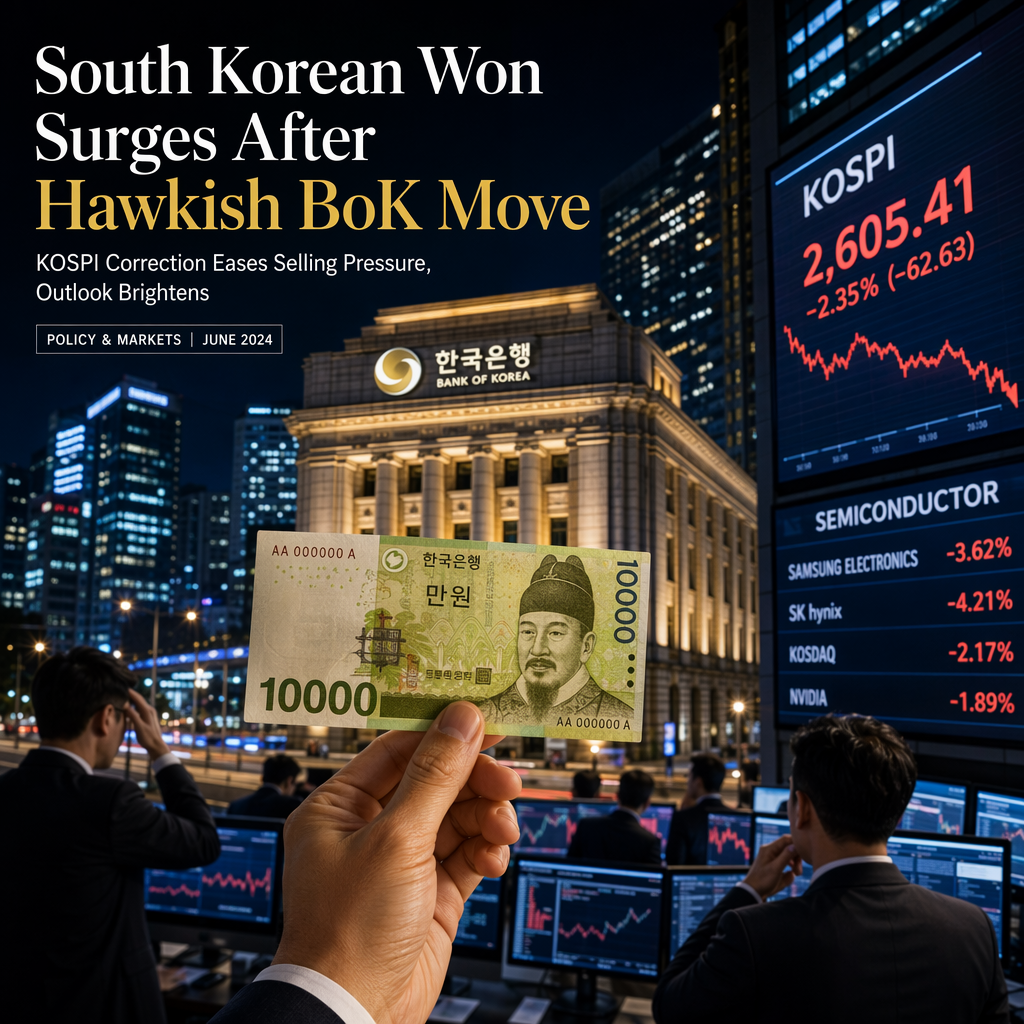
The South Korean Won (KRW) has shown notable outperformance, driven by a hawkish 25 basis point rate hike from the Bank of Korea (BoK), which raised its policy rate to 2.75% after maintaining a hold for the past year [1]. The BoK emphasized the necessity of maintaining a policy stance consistent with further rate hikes, citing expectations that real GDP growth (3.8% year-over-year in Q1) and core inflation (2.5% year-over-year in June) will surpass the BoK’s 2026 projections of 2.6% and 2.4%, respectively [1].
Simultaneously, the KOSPI index experienced a sharp correction, plunging as much as 7.6% in a single session, erasing previous gains and approaching its lowest level in over two months amid a selloff in AI-led semiconductor stocks [1]. This correction, following a period of outperformance, is seen as reducing the need for global investors to trim their Korean equity exposure to benchmark levels, thereby removing a significant source of KRW selling pressure [1].
Analysts at Brown Brothers Harriman (BBH) highlight that the KRW remains significantly undervalued—by approximately 11% based on its deviation from the real effective exchange rate trend—and that the South Korean government is actively pursuing measures to internationalize the currency [1]. The combination of policy tightening, attractive valuation, and supportive government actions contributes to an encouraging outlook for the KRW [1].
CONCLUSION
The Bank of Korea’s hawkish rate hike and the recent KOSPI correction have strengthened the South Korean Won’s position, reducing selling pressure and enhancing its outlook. With expectations for robust growth and inflation, and ongoing government efforts to internationalize the currency, the KRW is poised for further support in the near term.