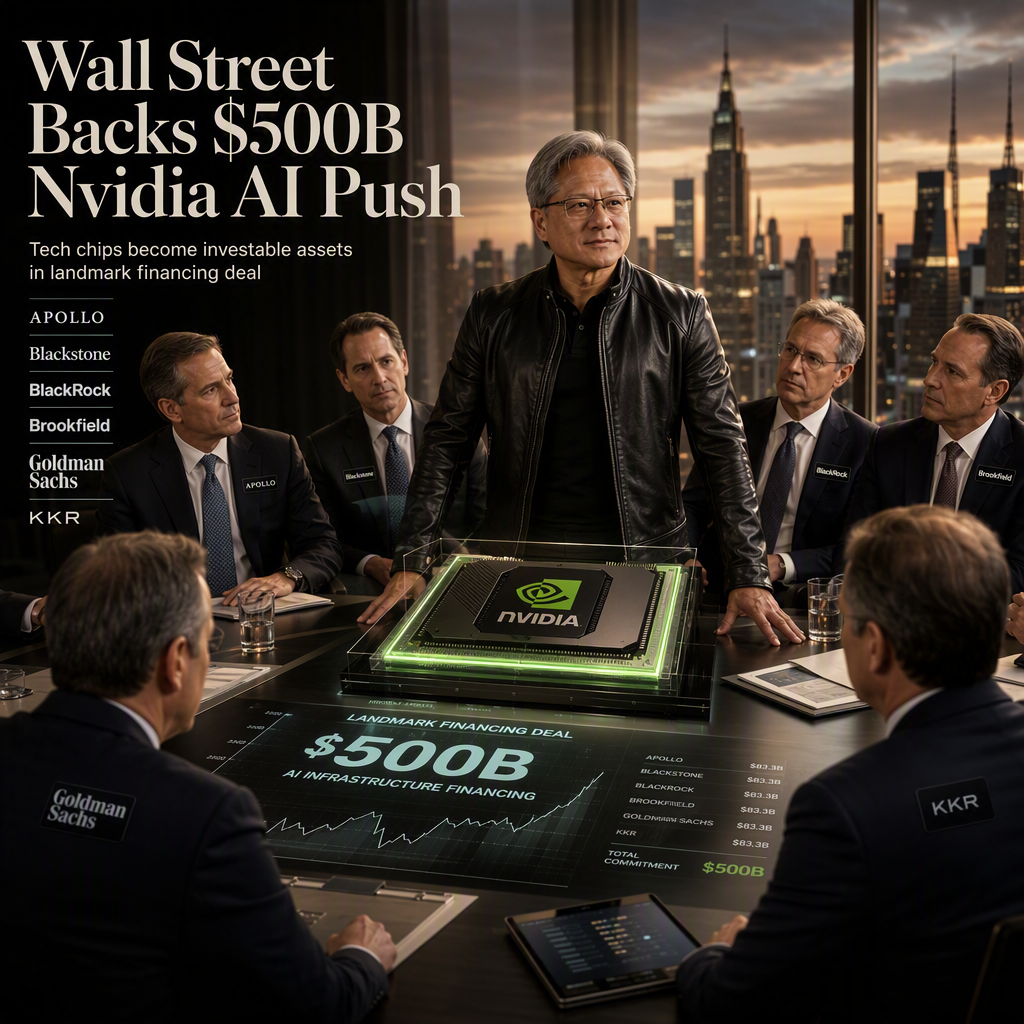
Nvidia has announced a major initiative to transform its artificial intelligence chips into a new asset class by partnering with six leading Wall Street asset managers—Apollo Global Management, Blackstone, BlackRock, Brookfield Asset Management, Goldman Sachs, and KKR—on a $500 billion financing push. The company signed memorandums of understanding with these firms to create financing platforms that will allow Nvidia's customers to fund data center buildouts and acquire Nvidia hardware using third-party capital, rather than relying on their own balance sheets [1].
Nvidia CEO Jensen Huang described this as a pivotal shift, stating, 'This is really the first time that technology chips have become an investable asset class. These are revenue-generating assets now. They're productive, they're long-lived, they're fungible, they're flexible.' Huang emphasized that Nvidia's hardware, due to its broad adoption and transferability, can be reliably underwritten as a revenue-generating asset with an extended life, challenging the traditional view of GPUs as rapidly depreciating hardware [1].
The financing effort is designed to mobilize more than $500 billion in third-party capital for hyperscalers, frontier AI labs, and enterprises, marking a significant change in how AI infrastructure is funded. By leveraging institutional credit, insurance funds, and private capital, Nvidia aims to help end users secure financing for compute infrastructure, similar to how commercial real estate or toll roads are financed [1].
This announcement comes in the wake of a July downturn in global markets, where investors questioned the payoff of Big Tech's AI investments. With hyperscalers expected to invest hundreds of billions into data centers and hardware, rating agencies like Moody's have warned that these unprecedented capital expenditures are putting pressure on free cash flow and increasing debt loads for tech giants [1].
CONCLUSION
Nvidia's $500 billion financing initiative with major Wall Street asset managers marks a transformative approach to funding AI infrastructure, positioning its chips as investable, revenue-generating assets. This move could reshape capital flows in the tech sector, though it comes amid market concerns about the sustainability of large-scale AI investments and rising debt levels for technology companies.