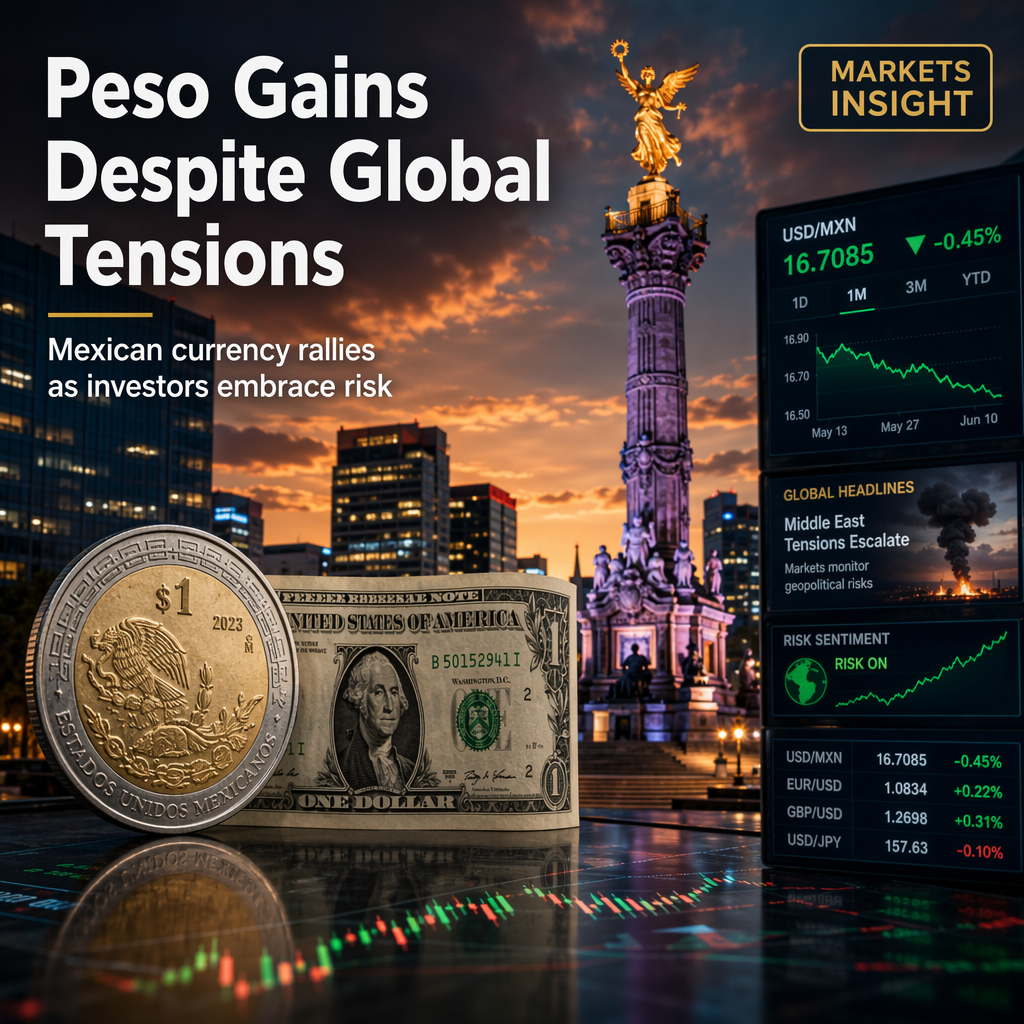
The Mexican Peso appreciated against the US Dollar on Monday, gaining 0.66% as risk appetite improved among investors despite escalating tensions in the Middle East [1]. At the time of reporting, the USD/MXN currency pair traded at 17.43, having reached a daily high of 17.55 earlier in the session [1]. This movement occurred even as the US Dollar Index (DXY) rose by 0.19% to 100.94, indicating overall strength in the US Dollar against a basket of major currencies [1].
Emerging-market currencies, including the Peso, posted solid gains, with demand for these assets offsetting concerns related to geopolitical risks. Over the weekend, tensions increased as the US and Iran exchanged strikes, and on Monday, Yemen's Iran-aligned Houthis announced a naval blockade on Saudi Arabia, potentially opening a new front in the ongoing conflict involving the US [1].
A Reuters poll cited in the article indicated that Mexico's economic growth is expected to slow, with GDP projected to expand by 1.1% in 2026 and 1.8% in 2027, according to a median of 32 economists surveyed [1]. Inflation is forecast to remain steady at 4% in 2026 and 3.8% in 2027 [1]. Additionally, uncertainty has increased regarding the USMCA trade agreement after Washington opposed a 16-year extension, instead favoring a 10-year term with annual reviews [1].
From a technical perspective, USD/MXN is trading just above a cluster of simple moving averages around 17.3906, which provides initial support and keeps the broader bias neutral for now. The pair remains capped beneath a descending resistance line near 17.5456, with the Relative Strength Index (RSI) at 48.9000, suggesting a lack of strong directional conviction. A break above 17.5456 could open the door to higher resistance near 18.1200, while a drop below 17.3900 could signal a deeper correction [1].
CONCLUSION
The Mexican Peso's gains reflect improved risk appetite among investors, even as geopolitical tensions in the Middle East persist. While technical indicators suggest a neutral outlook for USD/MXN, ongoing uncertainty around Mexico's economic growth and the USMCA trade agreement could influence future market movements.