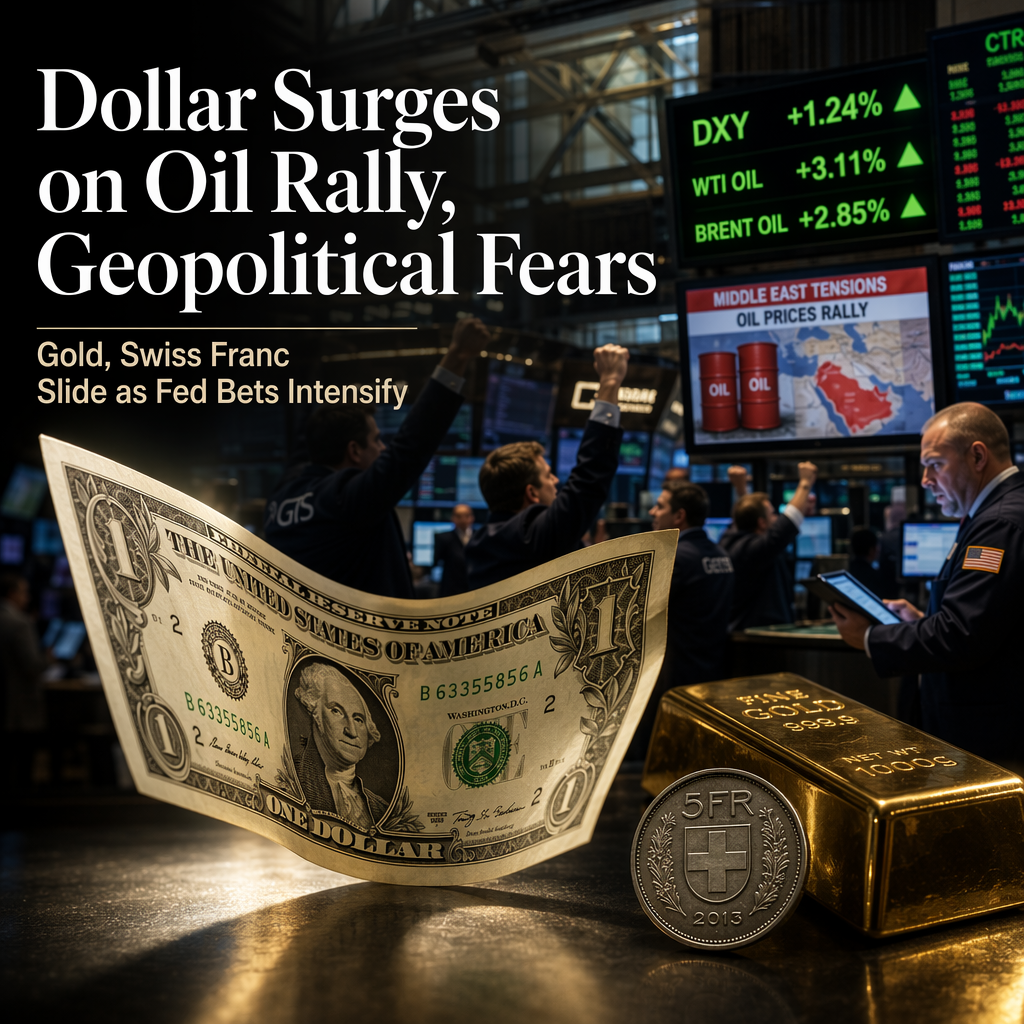
Escalating conflict in the Middle East, particularly renewed hostilities involving the US, Iran, and Yemen’s Ansar Allah group, has driven Oil prices sharply higher and intensified expectations for further Federal Reserve rate hikes. The US Dollar Index (DXY) climbed to 101.45, its highest level in three weeks, supported by these developments and robust US economic data, including Initial Jobless Claims falling to 187K, well below the forecast of 212K and the previous week’s revised 209K reading [1][2].
The Swiss Franc (CHF), typically seen as a safe haven during geopolitical turmoil, instead hit a 13-month low against the US Dollar, with USD/CHF trading around 0.8170 and extending gains for a fourth consecutive day. This unusual weakness is attributed to widening US-Swiss interest rate differentials and strong demand for the Greenback, which have outweighed the Franc’s traditional defensive appeal. The Swiss National Bank (SNB) has also signaled its readiness to intervene against excessive Franc strength, adding further pressure on the currency [1].
Gold (XAU/USD) tumbled nearly 2% on Thursday, falling below $4,050 after reaching a two-day high above $4,100. The metal’s decline is attributed to the US Dollar’s resurgence and rising Fed rate hike expectations, with swaps markets now pricing a 40% chance of a rate hike at the July 29 FOMC meeting, up from 33% a day earlier, and a 76% probability for a hike in September [2]. Technical analysis suggests gold’s path of least resistance remains to the downside, with key support levels at $4,000, $3,941 (YTD low), and $3,886 (October 28, 2025, low) [2].
Market participants are closely watching upcoming US economic releases, including the S&P Global Flash PMIs for July and New Home Sales data for June, as well as the Federal Open Market Committee (FOMC) meeting next week, for further direction [1][2].
CONCLUSION
Heightened geopolitical tensions and surging Oil prices have fueled a rally in the US Dollar, pressuring both the Swiss Franc and Gold. Strong US economic data and rising Fed rate hike expectations have intensified market volatility, with investors now focused on upcoming US economic releases and the FOMC meeting for further guidance.