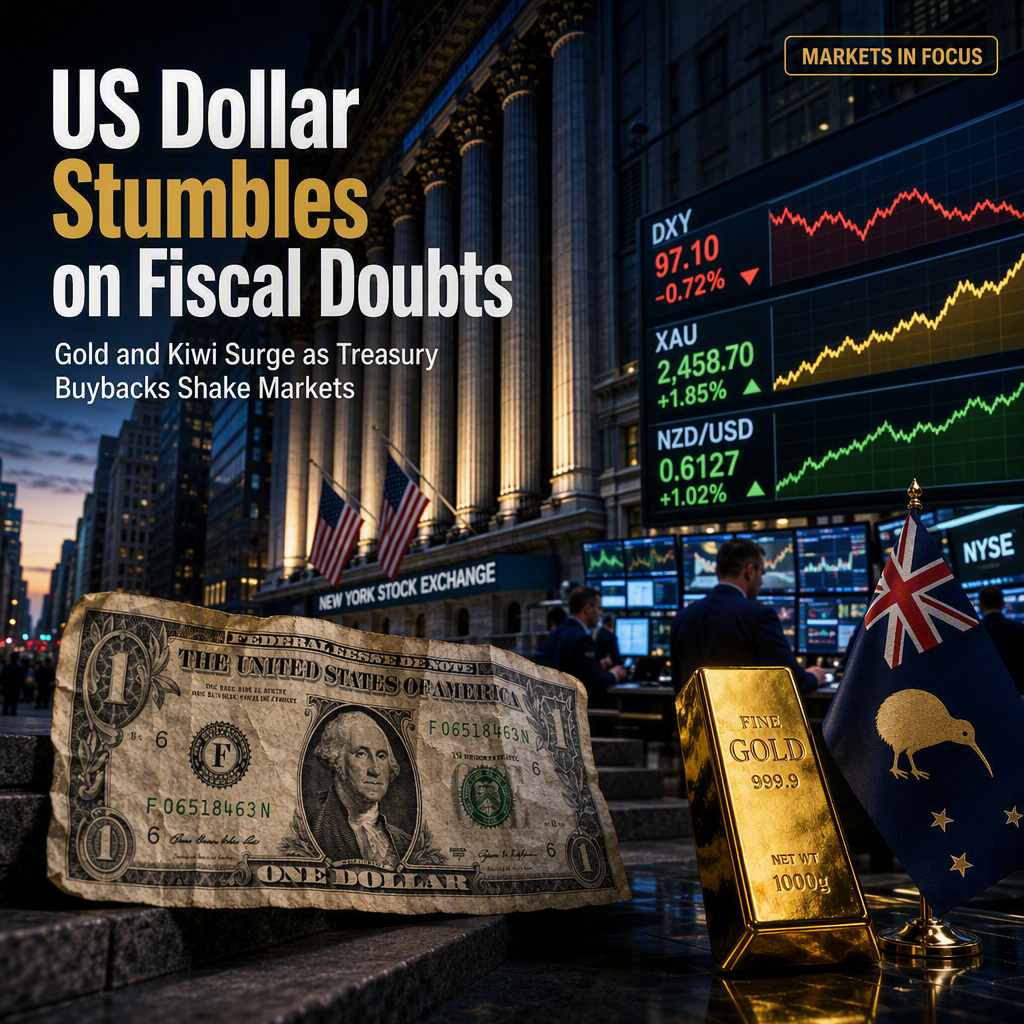
The US Dollar Index (DXY) has broadly weakened, consolidating near the 99.00 level and falling as low as 98.65 on Friday, as investors react to the US Treasury's announcement of expanded long-end bond buybacks aimed at boosting market liquidity and containing long-term yields [1][2][4]. While the buybacks initially helped cool borrowing costs, analysts remain divided on their long-term effectiveness. ING analysts view the Treasury's move as a proactive effort to protect the yield curve, suggesting it could foster a pro-risk environment and gradual US Dollar depreciation, benefiting high-beta commodity and emerging market currencies if broader market conditions remain stable [1]. Conversely, DBS Group Research and MUFG express skepticism, arguing that without meaningful fiscal reform—since the US Congress controls the budget—buybacks alone offer only a transient market impact and leave the Dollar vulnerable to inflation shocks, especially if geopolitical tensions or energy prices rise [1][4].
The weakening US Dollar has had notable market effects. The New Zealand Dollar (NZD/USD) climbed to its highest level since June, trading around 0.5980 and up 0.62% on the day, supported by the Greenback's decline and expectations of further monetary tightening by the Reserve Bank of New Zealand (RBNZ) [2]. Despite New Zealand posting a monthly trade deficit of NZ$1,949M in July, the focus remained on monetary policy divergence, with fading bets on immediate US Federal Reserve rate hikes and prospects of RBNZ action underpinning NZD strength [2].
Gold (XAU/USD) also surged, testing three-month highs near $4,600 as the US Dollar selloff intensified following the Treasury's buyback announcement [3]. Rabobank analysts noted that, unlike typical episodes where lower Treasury yields weaken the currency, this time both gold and cryptocurrencies rallied, reflecting market concerns about US fiscal credibility and borrowing cost management [3]. Technical indicators for gold remain bullish, with the price above the 200-day SMA and the next resistance levels at $4,590 and $4,700, though the rally appears stretched in the short term [3].
Market participants remain cautious about the sustainability of the US Dollar's decline. MUFG's Derek Halpenny highlights skepticism regarding the US's willingness or ability to deliver credible fiscal consolidation, suggesting limited further downside for the Dollar unless fiscal policy changes significantly [4]. Geopolitical risks, particularly US-Iran tensions and rising energy prices, could quickly revive demand for the safe-haven Dollar and reignite inflation fears, potentially reversing recent trends [1][2][4]. Upcoming US economic data, such as the S&P Global PMIs, could also influence the Dollar's direction, with weaker-than-expected figures likely to add pressure [2].
According to MUFG, while the appetite to sell the Dollar is present, it remains contained by ongoing Middle East risks and rising European natural gas prices, limiting the upside for EUR/USD in the near term [4].
CONCLUSION
The US Dollar's recent weakness is driven by Treasury buyback plans and doubts over US fiscal credibility, fueling gains in gold and the New Zealand Dollar. However, analysts caution that without structural fiscal reform, the Dollar remains vulnerable to inflation shocks and geopolitical risks. Market sentiment is negative for the Dollar in the short term, but uncertainty persists regarding the sustainability of these moves.